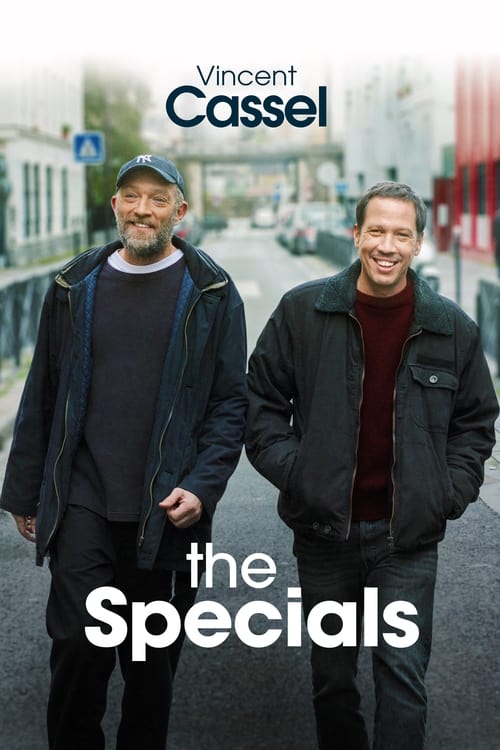
The Specials (2019)
Directed by Éric Toledano
Partly — The Specials is somewhat woke, scoring 56 out of 100 on our wokeness meter.
Éric Toledano and Olivier Nakache built a career on French comedies that arrive carrying a message, and The Specials (Hors normes) is their most earnest delivery yet.
Consciousness Markers
Autism and neurodivergence are the film's entire subject, portraying autistic individuals with dignity and complexity and advocating for their care outside institutional confinement.
The film casts autistic performers in autistic roles and centers North African and banlieue actors (Reda Kateb, Bryan Mialoundama) in prominent parts, giving the marginalized communities depicted a genuine on-screen presence.
The film is openly didactic, using its narrative to argue a case about the care system and the value of unconventional methods, though it embeds this in character drama rather than direct address.
The story foregrounds underprivileged youth from Paris's rough neighborhoods, largely of immigrant descent, and their path to certification, though race is treated through the lens of social class rather than explicit racial politics.
The film critiques bureaucratic institutions and licensing regimes that fail the vulnerable, but its target is the social welfare apparatus rather than capitalism or wealth itself.
Women appear as doctors, inspectors, and caregivers, but the film offers no feminist thesis or gendered critique of power.
No LGBTQ+ characters, relationships, or themes appear in the narrative.
No environmental or climate themes are present.
No body-positivity themes or body-diverse messaging appear.
The film is inspired by real caregivers but does not revise or reinterpret historical events.
Why it received this score
Éric Toledano and Olivier Nakache built a career on French comedies that arrive carrying a message, and The Specials (Hors normes) is their most earnest delivery yet. Vincent Cassel and Reda Kateb play Bruno and Malik, two men running shoestring nonprofits that place autistic children and teenagers into the world after the institutions have given up on them. The film is inspired by real caregivers, and it wears that inspiration like a coat it refuses to remove.
The casting is the picture's quiet accomplishment. Autistic performers occupy autistic roles, and the young caregivers pulled from the banlieues are played by actors who resemble the neighborhoods they come from. Reda Kateb and Bryan Mialoundama carry real weight, and the film grants its marginalized communities an on-screen presence that feels observed instead of assigned. Class does most of the talking; race lingers at the edges without hardening into an argument. Women appear as doctors, inspectors, and caregivers, competent and largely unexamined. There is no romantic subplot to distract anyone, and no other identity category is invited to the table.
Where the film strains is in its eagerness to convince. It pleads its case for unconventional care with a raised voice, stacking bureaucratic obstruction against small triumph until the shape becomes a position paper with a soundtrack. The inspectors exist to be wrong. The licensing regime exists to be indicted. Doubt is never permitted a hearing. The anger is aimed at the welfare apparatus, not at wealth, which keeps the politics narrower than the film seems to believe. What we get is a warm, well-acted sermon delivered by people who clearly mean it. The conviction is real. So is the fatigue of being lectured at for two hours by someone who happens to be right.
Analysis generated by our Consciousness Algorithm
Synopsis
For twenty years, Bruno and Malik have lived in a different world—the world of autistic children and teens. In charge of two separate nonprofit organizations (The Hatch & The Shelter), they train young people from underprivileged areas to be caregivers for extreme cases that have been refused by all other institutions. It’s an exceptional partnership, outside of traditional settings, for some quite extraordinary characters.
Questions about The Specials
Is The Specials woke?
Partly — The Specials is somewhat woke, scoring 56 out of 100 on our wokeness meter. That earns it a verdict of Woke-Adjacent.
What makes The Specials woke?
4 of the 10 markers register at 30 or above, led by Neurodivergence (90), Representation Casting (55) and Lecture Energy (45). On Neurodivergence: Autism and neurodivergence are the film's entire subject, portraying autistic individuals with dignity and complexity and advocating for their care outside institutional confinement.
How does The Specials compare to other 2019 movies?
It ranks #27 of the 284 films from 2019 we've scored; their average is 22. The wokest is Black Christmas (79).
How is the Woke Score calculated?
An AI-assisted process researches the film and its reception, scores it 0–100 on ten markers, then combines those into one 0–100 Woke Score. It measures a specific set of 2020s cultural themes, not film quality.