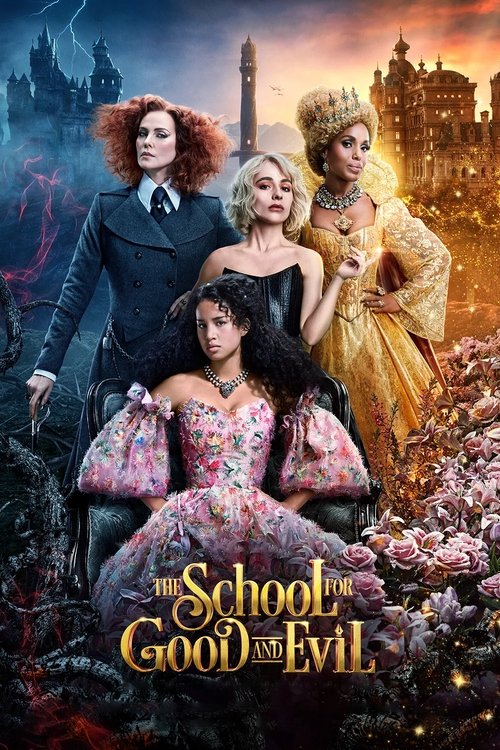
The School for Good and Evil (2022)
Directed by Paul Feig
Partly — The School for Good and Evil is somewhat woke, scoring 46 out of 100 on our wokeness meter.
Paul Feig's adaptation of Soman Chainani's young adult novel arrives with the full apparatus of a streaming fantasy: elaborate Art Nouveau sets, eight hundred costumes, and a running time that suggests nobody in the edit bay was willing to lose an argument.
Consciousness Markers
The climactic 'true love's kiss' that revives the dying Sophie is delivered by Agatha, a same-sex act of true love that explicitly resolves the plot, layered atop a central relationship built on two girls' devotion.
The ensemble is conspicuously diverse for a fairy-tale fantasy, with Sofia Wylie, Kerry Washington, Michelle Yeoh, and Laurence Fishburne in prominent roles, and the production openly discusses casting choices around representation.
Two female leads anchor the story, the female friendship is the emotional core, and the film deliberately subverts princess/fairy-tale tropes while female deans (Washington, Theron) wield the institutional power.
The film carries a mild moral about inner worth versus surface goodness and the value of friendship, but it delivers these through plot rather than overt preaching.
The film's Beauty/Uglification curriculum and Sophie's hag transformation gesture at beauty standards, and Wylie insisted on keeping her curly hair to broaden what a princess can look like, but the theme is underdeveloped.
The cast is diverse, but the narrative contains no engagement with race, racism, or racial themes; diversity is present without commentary.
No environmental or climate themes appear anywhere in the story.
There is no critique of wealth, class, or capitalism; the conflict is entirely magical and moral.
No neurodivergent characters or themes are present.
The film is pure fantasy with no historical subject matter to revise.
Why it received this score
Paul Feig's adaptation of Soman Chainani's young adult novel arrives with the full apparatus of a streaming fantasy: elaborate Art Nouveau sets, eight hundred costumes, and a running time that suggests nobody in the edit bay was willing to lose an argument. Two girls, Sophie and Agatha, are deposited at a school that trains heroes and villains, then sorted into the wrong houses. The film spends its energy on the friendship between them, which is the correct instinct, and on elaborate costume changes, which is the other instinct.
On the question of social consciousness, the production is unusually forthright. The ensemble is diverse in a way that fairy tale fantasy rarely bothers with, and the filmmakers have discussed casting decisions in those terms. More striking is the climax, in which the kiss that revives a dying Sophie comes from Agatha. The plot resolves on an act of love between two girls, and the film neither flinches from it nor makes a spectacle of it. Meanwhile, two female deans hold the institutional power, and the princess archetype takes a sustained beating. This is a film aware of its audience and its moment.
The softer registers are where it stumbles. A beauty and uglification curriculum gestures at appearance standards, and one lead's insistence on keeping her curls is a small, real intervention, but the theme never develops past a costume. The moral about inner worth arrives through plot mechanics, not sermonizing, which is to the film's credit and also to its detriment: it has little to say and says it at length. The result is a lavish, overlong, intermittently charming piece of streaming content that knows what it is for and executes it with competent enthusiasm. The critics were unkind. They were not wrong, exactly. They were simply tired.
Analysis generated by our Consciousness Algorithm


Synopsis
Best friends Sophie and Agatha navigate an enchanted school for young heroes and villains — and find themselves on opposing sides of the battle between good and evil.
Questions about The School for Good and Evil
Is The School for Good and Evil woke?
Partly — The School for Good and Evil is somewhat woke, scoring 46 out of 100 on our wokeness meter. That earns it a verdict of Woke-Adjacent.
What makes The School for Good and Evil woke?
4 of the 10 markers register at 30 or above, led by LGBTQ+ Themes (65), Representation Casting (60) and Feminist Agenda (50). On LGBTQ+ Themes: The climactic 'true love's kiss' that revives the dying Sophie is delivered by Agatha, a same-sex act of true love that explicitly resolves the plot, layered atop a central relationship built on two girls' devotion.
How does The School for Good and Evil compare to other 2022 movies?
It ranks #34 of the 223 films from 2022 we've scored; their average is 22. The wokest is Bros (92).
How is the Woke Score calculated?
An AI-assisted process researches the film and its reception, scores it 0–100 on ten markers, then combines those into one 0–100 Woke Score. It measures a specific set of 2020s cultural themes, not film quality.