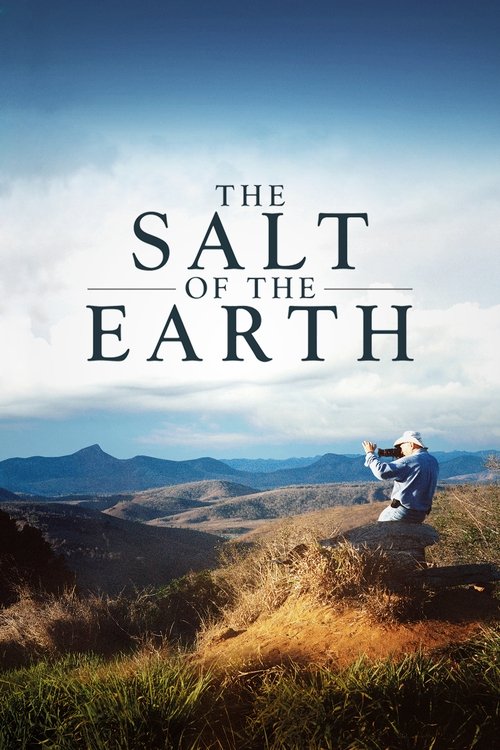
The Salt of the Earth (2014)
Directed by Juliano Ribeiro Salgado
No — The Salt of the Earth is not especially woke, scoring 39 out of 100 on our wokeness meter.
A documentary about a photographer who spent forty years pointing his lens at the world's suffering and then, in his later years, at its remaining beauty.
Consciousness Markers
Environmental themes are substantial: the Instituto Terra reforestation of the family ranch, a tribute to pristine landscapes and wildlife, and imagery of a planet in decline form a major throughline.
The film explicitly frames the environment and human labor as exploited to maximize profit for the global market, and characterizes the Ethiopian famine as a problem of distribution rather than mere natural disaster.
The film documents famine, exodus, and exploitation across the global South, implicitly highlighting racialized global inequality, though it observes rather than theorizes about race.
Salgado's commentary carries a humanist and environmental message, but the film is largely contemplative and observational rather than preachy.
The documentary centers non-Western subjects — Brazilian, African, and indigenous communities such as the Zo'é and Yali — but this reflects the photographer's actual subject matter rather than a deliberate diversity-casting agenda.
Lélia Salgado is credited with sparking her husband's photography career and conceiving the reforestation project, but the film remains a portrait of a male artist with no feminist framework.
No LGBTQ+ themes or characters appear anywhere in the film.
No body-positivity themes are present.
No neurodivergence themes are present.
The film documents historical events such as the Rwandan genocide and Yugoslav Wars as testimony, not as revisionist reinterpretation.
Why it received this score
A documentary about a photographer who spent forty years pointing his lens at the world's suffering and then, in his later years, at its remaining beauty. Wim Wenders and Juliano Ribeiro Salgado assemble the black and white work of Sebastião Salgado into a somber procession: the Sahel, the Ethiopian famine, the Rwandan genocide, the Yugoslav Wars, the workers of the world, the refugees. The film observes all of this with a heavy stillness. It does not lecture. It sits with the photographs and lets them do the talking, which is the correct choice and also the reason the viewing experience resembles being quietly crushed for two hours.
The environmental current runs strongest here. Lélia Wanick Salgado proposes reforesting the family ranch in Minas Gerais, and the Instituto Terra becomes the film's hopeful counterweight, a testament to what patience and dirt can accomplish. The final movement, with its pristine landscapes and the Zo'é and Yali communities living by ancestral custom, carries a reverence that borders on the devotional. Along the way, Salgado's commentary frames famine as a failure of distribution and the planet's resources as fodder for the global market. That is a critique of an economic order, delivered without a single slogan. Commendable restraint, honestly.
What we do not get is a reckoning with the ethics of the gaze itself, the thorny question of a Brazilian photographer rendering the global South's pain for Western galleries and magazines. The film notices exploitation abroad and never turns the lens around. Lélia's role as the instigator of both the career and the forest is acknowledged in a sentence or two before the portrait returns to its subject. A contemplative, humane, and occasionally sermonizing piece of work. It earns its melancholy. It does not interrogate it.
Analysis generated by our Consciousness Algorithm


Synopsis
During the last forty years, the photographer Sebastião Salgado has been travelling through the continents, in the footsteps of an ever-changing humanity. He has witnessed the major events of our recent history: international conflicts, starvations and exodus… He is now embarking on the discovery of pristine territories, of the wild fauna and flora, of grandiose landscapes: a huge photographic project which is a tribute to the planet's beauty. Salgado's life and work are revealed to us by his son, Juliano, who went with him during his last journeys, and by Wim Wenders, a photographer himself.
Questions about The Salt of the Earth
Is The Salt of the Earth woke?
No — The Salt of the Earth is not especially woke, scoring 39 out of 100 on our wokeness meter. That earns it a verdict of Based.
Does The Salt of the Earth have any woke elements?
4 of the 10 markers register at 30 or above, led by Climate Crusade (55), Eat the Rich (45) and Lecture Energy (30). On Climate Crusade: Environmental themes are substantial: the Instituto Terra reforestation of the family ranch, a tribute to pristine landscapes and wildlife, and imagery of a planet in decline form a major throughline.
How does The Salt of the Earth compare to other 2014 movies?
It ranks #17 of the 303 films from 2014 we've scored; their average is 13. The wokest is Selma (68).
How is the Woke Score calculated?
An AI-assisted process researches the film and its reception, scores it 0–100 on ten markers, then combines those into one 0–100 Woke Score. It measures a specific set of 2020s cultural themes, not film quality.