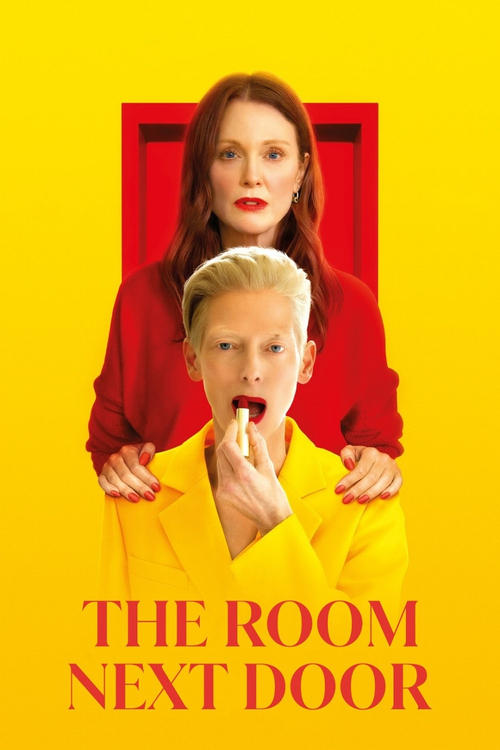
The Room Next Door (2024)
Directed by Pedro Almodóvar
No — The Room Next Door is not especially woke, scoring 20 out of 100 on our wokeness meter.
Pedro Almodóvar's The Room Next Door is a film about dying well, which is a subject that tends to arrive dressed in importance.
Consciousness Markers
The film centers a deep friendship between two women and one woman's bodily autonomy in choosing euthanasia, but frames it as humanist drama rather than explicit feminist polemic.
Two older women lead a predominantly white, European cast; some Spanish/Latino supporting players appear, but there is no strong diversity-casting agenda.
Dialogue engages mortality, euthanasia, and friendship with some philosophical weight, but it is not overtly preachy.
No LGBTQ+ themes or characters are present in the plot.
No racial themes or commentary are present.
No climate or environmental themes are present.
No critique of capitalism or wealth is present.
No body-positivity themes are present.
PTSD is mentioned in a backstory, but it is not explored as neurodivergence.
No revisionist historical narrative is present.
Why it received this score
Pedro Almodóvar's The Room Next Door is a film about dying well, which is a subject that tends to arrive dressed in importance. It follows Ingrid and Martha, old friends reunited by terminal cancer, and then by Martha's plan to take euthanasia pills in a rented Woodstock house. The performances are formidable. The colors are vivid. The mood is autumnal and expensive. This is a serious drama for adults, and it knows it.
On the social-consciousness ledger, the film is temperate. Its most notable gesture is placing two women of a certain age at the center and treating Martha's control over her own death as a matter of dignity. That is a humanist concern, not a polemic, and the screenplay never converts the friendship into a lecture on gender. The cast is largely white and European, with a few Spanish-speaking supporting players, which gives the proceedings a mild international texture but no diversity-casting mission. There is no racial argument here, no climate warning, no indictment of wealth, no body-positivity thread, no queer subtext, and no exploration of neurodivergence, though a backstory mentions PTSD in a way that remains strictly anecdotal. The film has other concerns.
Where the film does lean toward sermonizing, it does so softly. Conversations about mortality, euthanasia, and friendship carry philosophical weight, but they are delivered as intimate exchanges instead of platform speeches. The result is a work of restrained progressive sensibility, more interested in the ethics of care than in cultural combat. It is beautifully acted, handsomely mounted, and occasionally so pleased with its own gravity that it forgets to breathe. A sommelier might call it a well-balanced vintage with low alcohol. A critic might call it a very respectable film about death that never quite risks becoming dangerous.
Analysis generated by our Consciousness Algorithm


Synopsis
Ingrid and Martha were close friends in their youth, when they worked together at the same magazine. Ingrid went on to become an autofiction novelist while Martha became a war reporter, and they were separated by the circumstances of life. After years of being out of touch, they meet again in an extreme but strangely sweet situation.
Questions about The Room Next Door
Is The Room Next Door woke?
No — The Room Next Door is not especially woke, scoring 20 out of 100 on our wokeness meter. That earns it a verdict of Based.
Does The Room Next Door have any woke elements?
1 of the 10 markers register at 30 or above, led by Feminist Agenda (30). On Feminist Agenda: The film centers a deep friendship between two women and one woman's bodily autonomy in choosing euthanasia, but frames it as humanist drama rather than explicit feminist polemic.
How does The Room Next Door compare to other 2024 movies?
It ranks #78 of the 189 films from 2024 we've scored; their average is 22. The wokest is The Six Triple Eight (92).
How is the Woke Score calculated?
An AI-assisted process researches the film and its reception, scores it 0–100 on ten markers, then combines those into one 0–100 Woke Score. It measures a specific set of 2020s cultural themes, not film quality.