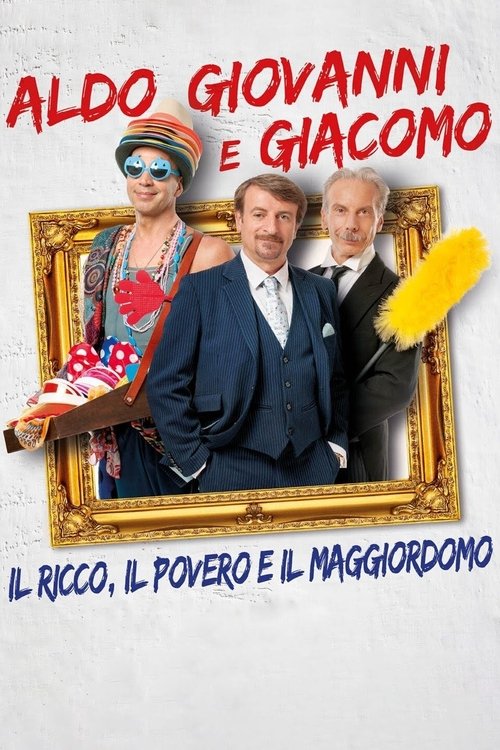
The Rich, the Pauper and the Butler (2014)
Directed by Aldo Baglio
No — The Rich, the Pauper and the Butler is not woke, scoring 5 out of 100 on our wokeness meter.
The Aldo, Giovanni and Giacomo trio return with a comedy of reversed fortunes, in which a wealthy broker, his dutiful butler, and a street vendor find their stations shuffled by accident.
Consciousness Markers
The premise of a wealthy broker trading places with a pauper gestures at class inequality, but it is played for farce rather than as an indictment of capitalism.
The cast is overwhelmingly white Italian, with one Spanish actress in a minor role; no deliberate diversity casting is evident.
Female characters exist in supporting roles but the film advances no feminist argument or critique of patriarchy.
This is a light slapstick comedy of manners with no preachy or didactic messaging.
No LGBTQ+ characters or themes appear in the film.
Race and racial identity play no role in this Italian class-swap comedy.
No environmental or climate themes are present.
No body-positivity themes or messaging are present.
No neurodivergent characters or themes are depicted.
The film is a contemporary fictional comedy with no historical revisionism.
Why it received this score
The Aldo, Giovanni and Giacomo trio return with a comedy of reversed fortunes, in which a wealthy broker, his dutiful butler, and a street vendor find their stations shuffled by accident. The machinery is familiar: mistaken identity, financial ruin, the indignity of a man accustomed to linen now selling trinkets from a cart. The film is brisk, professional, and content to be a farce. Nobody involved appears to have ambitions beyond the next gag, and the gags arrive on schedule.
On the matter of social consciousness, the cupboard is bare. The premise brushes against class resentment, letting a rich man taste poverty for ninety minutes, but the film treats inequality as a costume to be worn and discarded, never as a system to be indicted. The cast is Italian and white, with a Spanish actress in a small role and no evident appetite for anything else. Women appear as wives, servants, and objects of confusion; the film has no argument to make about them. Race, sexuality, climate, body image, and neurodivergence are simply absent, which in a 2014 Italian slapstick comedy is not a failing so much as a description. There is no sermon here. The film wants only to make you laugh at a man falling into a fountain.
The result is a modest, harmless entertainment, the kind that plays well on a Sunday evening and vanishes by Monday. It gestures at the gap between rich and poor the way a waiter gestures at a menu: aware of the item, unwilling to order it. For the purposes of classification, this is a film with almost nothing to say and no apparent regret about that. We file it accordingly, with a small nod to the butler, who at least knows his place, and the film, which knows its own limits even better. A quiet entry in an unquiet canon. Nothing more is asked of it, and nothing more is given.
{"thematic_tags": []}
Analysis generated by our Consciousness Algorithm
Synopsis
A wealthy broker, his loyal butler, and a poor street seller all see their social positions change in a twist of fate.
Questions about The Rich, the Pauper and the Butler
Is The Rich, the Pauper and the Butler woke?
No — The Rich, the Pauper and the Butler is not woke, scoring 5 out of 100 on our wokeness meter. That earns it a verdict of Ultra Based.
Does The Rich, the Pauper and the Butler have any woke elements?
Very few. None of the 10 markers reaches 30, the level where a marker counts as present; the highest is Eat the Rich at 15.
How does The Rich, the Pauper and the Butler compare to other 2014 movies?
It ranks #212 of the 303 films from 2014 we've scored; their average is 13. The wokest is Selma (68).
How is the Woke Score calculated?
An AI-assisted process researches the film and its reception, scores it 0–100 on ten markers, then combines those into one 0–100 Woke Score. It measures a specific set of 2020s cultural themes, not film quality.