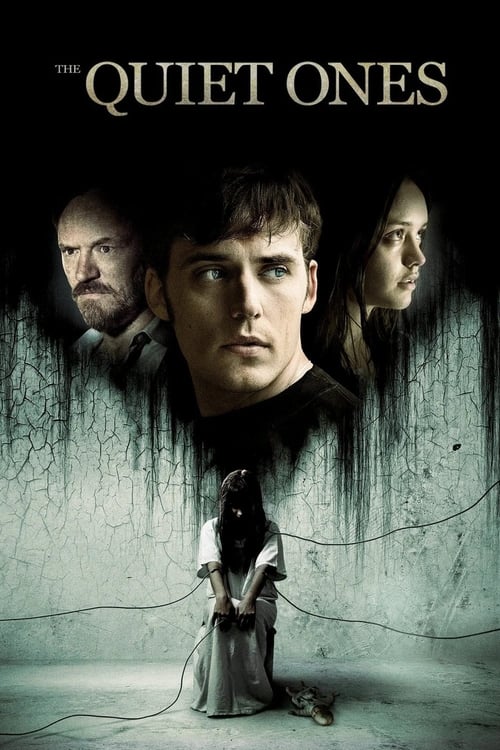
The Quiet Ones (2014)
Directed by John Pogue
No — The Quiet Ones is not woke, scoring 0 out of 100 on our wokeness meter.
The Quiet Ones, a 2014 British supernatural horror directed by John Pogue, concerns a 1974 Oxford professor who believes poltergeists are psychological phenomena.
Consciousness Markers
The cast is a uniformly white British ensemble with no deliberate diverse or inclusive casting choices.
No LGBTQ+ characters, relationships, or themes appear anywhere in the film.
Jane is a victim-subject and Krissi a supporting assistant; the film offers no feminist critique or gender-power commentary.
Race is entirely absent as a subject; the film is a period supernatural horror with an all-white cast.
No environmental or climate themes are present.
The College Board cutting funding is a plot device for isolation, not an anti-capitalist or eat-the-rich statement.
No body-positivity themes; the film treats Jane's body as a site of horror and self-harm.
Mental disturbance is framed as demonic possession and trauma, not as neurodivergence to be affirmed or destigmatized.
The film is loosely inspired by the 1972 Philip experiment but makes no revisionist historical argument or reframing.
The professor's lectures are in-world exposition about parapsychology, not moralizing social messaging aimed at the audience.
Why it received this score
The Quiet Ones, a 2014 British supernatural horror directed by John Pogue, concerns a 1974 Oxford professor who believes poltergeists are psychological phenomena. He enlists two assistants and a student filmmaker to study Jane Harper, a young woman whose presence generates strange occurrences. The film is loosely based on the Philip experiment, a real 1972 parapsychology study. It is a Hammer production, and it carries the studio's signature blend of gothic atmosphere and grim consequence. The cast is uniformly white and British. The setting is a damp, isolated house. The agenda, such as it is, is to frighten.
In terms of social consciousness, the film is a vacuum. It offers no commentary on gender, race, sexuality, or class. The female characters exist to be victimized or to assist. Mental illness is treated as a supernatural affliction, not a neurodivergent identity. The body is a site of self-harm and demonic invasion, not a vessel for positivity. The only economic critique is a funding cut that serves to isolate the characters. The only lectures are about parapsychology, delivered by a professor whose hubris drives the plot. There is no climate anxiety, no anti-capitalist rage, no revisionist history. The film is a period piece that refuses to impose modern values on its characters or its audience.
What remains is a modestly effective horror film that trusts its premise. It does not pause to educate. It does not wink at the audience. It simply proceeds from one unsettling image to the next. The performances are committed, the atmosphere is thick, and the ending is suitably bleak. For those who track such things, this is a zero-vintage. It is a film that will never be cited in a discourse. It is a film that simply wants to scare you. And in that narrow, unprogressive ambition, it occasionally succeeds.
Analysis generated by our Consciousness Algorithm


Synopsis
A professor and his students perform a dangerous experiment that causes a young woman to lose her sanity.
Questions about The Quiet Ones
Is The Quiet Ones woke?
No — The Quiet Ones is not woke, scoring 0 out of 100 on our wokeness meter. That earns it a verdict of Ultra Based.
Does The Quiet Ones have any woke elements?
No. All 10 markers score zero.
How does The Quiet Ones compare to other 2014 movies?
It ranks #271 of the 303 films from 2014 we've scored; their average is 13. The wokest is Selma (68).
How is the Woke Score calculated?
An AI-assisted process researches the film and its reception, scores it 0–100 on ten markers, then combines those into one 0–100 Woke Score. It measures a specific set of 2020s cultural themes, not film quality.