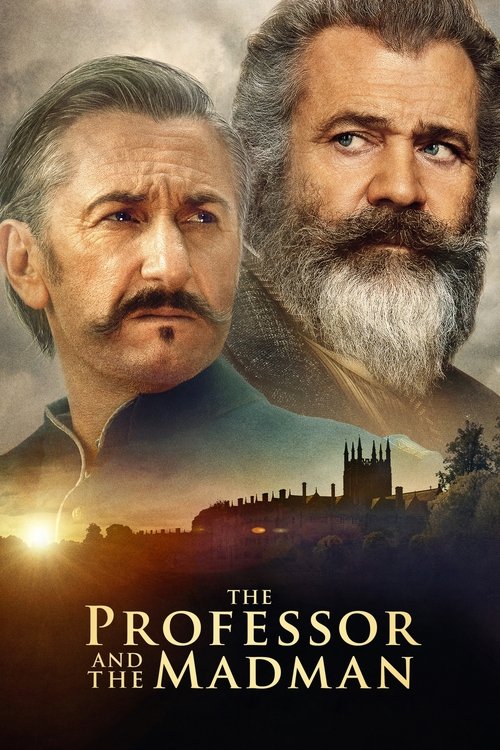
The Professor and the Madman (2019)
Directed by Farhad Safinia
No — The Professor and the Madman is not woke, scoring 6 out of 100 on our wokeness meter.
The Professor and the Madman arrives with the weary dignity of a film that has survived its own production.
Consciousness Markers
William Minor's mental illness and asylum confinement are central and treated with some sympathy, but the film frames him through 19th-century 'madness' rather than modern neurodivergence advocacy.
The cast is almost entirely white and drawn from conventional British/Irish period-drama ranks; no deliberate diverse or color-conscious casting is evident.
No LGBTQ+ characters, relationships, or themes appear in the story.
Female characters such as Eliza and Ada have narrative agency, but the film does not advance a modern feminist thesis or critique patriarchy.
The film is set in 19th-century Oxford and Broadmoor and does not engage with race, racism, or racial justice.
No environmental or climate-related themes are present.
The conflicts are institutional and personal—academic rivalry, asylum treatment, legal battles—not a critique of capitalism or wealth.
No body-positivity themes or body-diverse representation are present.
It is a dramatized true story with compressed events, but it does not revise history to serve a modern ideological narrative.
The film has a mild moral streak about compassion and forgiveness, but it is not structured as a modern social-issue sermon.
Why it received this score
The Professor and the Madman arrives with the weary dignity of a film that has survived its own production. Shot in Dublin in 2016, delayed by litigation, and ultimately disowned by both its director and its star, it tells the story of James Murray, the Oxford lexicographer, and William Chester Minor, the American surgeon confined at Broadmoor who mailed him ten thousand dictionary entries from a cell. It is a period piece about two Victorian men and a very long book. Mel Gibson and Sean Penn bring a certain stuffy intensity to proceedings that critics received with the enthusiasm of a man handed a lukewarm cup of tea.
Measured against the contemporary cultural ledger, the film is a near-total abstention. Its cast is drawn from the standard British and Irish period-drama register. There is no color-conscious casting, no LGBTQ thread, no engagement with race, no climate anxiety, no critique of wealth, no body-diverse representation. The conflicts are academic and institutional: a rival named Bradley scheming for Murray's position, a commission fretting over citations, an asylum director experimenting with humane treatment. Eliza, the widow of the man Minor killed, is given genuine agency and a small arc toward forgiveness, but the film mounts no argument about patriarchy. It simply lets her grieve.
The single point of contact with modern sensibilities is Minor's mental illness. The film treats his hallucinations and his confinement with a sympathy that borders on tenderness, and his friendship with Murray becomes a quiet case for compassion over punishment. Yet the vocabulary is Victorian throughout: madness, lunacy, moral treatment, a jury that cannot withdraw the insanity diagnosis. This is a portrait of suffering, not an advocacy document, and it never reaches for the language of contemporary neurodiversity. What remains is a handsomely photographed drama about etymology and forgiveness, with a mild moral streak and no ambitions beyond it. It wants us to feel for a man who maimed himself in a fit of guilt. That is a great deal to ask. It asks politely, and without a single bullet point.
Analysis generated by our Consciousness Algorithm


Synopsis
Professor James Murray begins work compiling words for the first edition of the Oxford English Dictionary in the mid 19th century, and receives over 10,000 entries from a patient at Broadmoor Criminal Lunatic Asylum, Dr. William Minor.
Questions about The Professor and the Madman
Is The Professor and the Madman woke?
No — The Professor and the Madman is not woke, scoring 6 out of 100 on our wokeness meter. That earns it a verdict of Ultra Based.
Does The Professor and the Madman have any woke elements?
Very few. None of the 10 markers reaches 30, the level where a marker counts as present; the highest is Neurodivergence at 10.
How does The Professor and the Madman compare to other 2019 movies?
It ranks #222 of the 284 films from 2019 we've scored; their average is 22. The wokest is Black Christmas (79).
How is the Woke Score calculated?
An AI-assisted process researches the film and its reception, scores it 0–100 on ten markers, then combines those into one 0–100 Woke Score. It measures a specific set of 2020s cultural themes, not film quality.