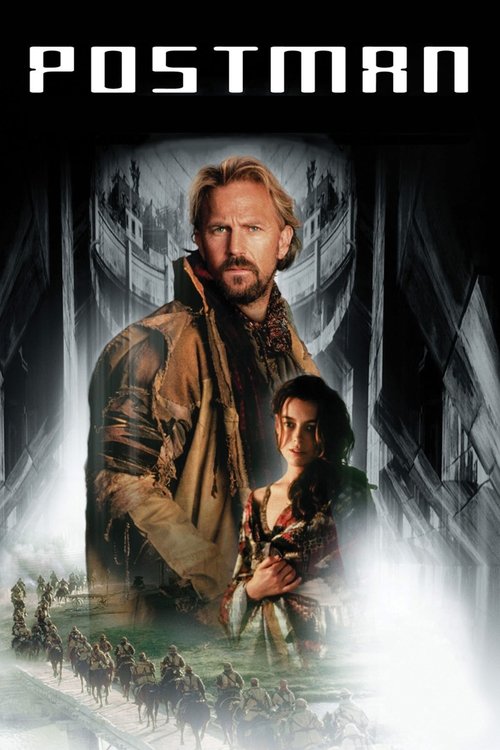
The Postman (1997)
Directed by Kevin Costner
No — The Postman is not woke, scoring 12 out of 100 on our wokeness meter.
Kevin Costner's 1997 adaptation of David Brin's novel arrives with the gravity of a man who has decided that the mail is a sacrament.
Consciousness Markers
The film is earnestly preachy about hope, community, and the postal service as a symbol of civilization, though its sermon is civic rather than modern progressive.
The cast includes Larenz Tate as a prominent Black postal carrier and depicts a multiracial restored society, but diversity is presented naturally rather than as a modern representation agenda.
No LGBTQ+ characters, themes, or subtext are present.
Abby is a significant female character, but her arc is defined by motherhood, abduction, and romance rather than any feminist agenda.
The film includes a Black supporting character but makes no explicit commentary on race, racism, or racial justice.
The apocalypse is unexplained and not framed as a climate crisis or environmental parable.
The antagonist is a neo-feudal militia, not a capitalist class; the film's civic message is not anti-capitalist.
No body-positivity themes or messaging are present.
No neurodivergence themes or representation are present.
The story is a fictional post-apocalyptic future, not a revisionist retelling of real history.
Why it received this score
Kevin Costner's 1997 adaptation of David Brin's novel arrives with the gravity of a man who has decided that the mail is a sacrament. A drifter trades Shakespeare for food, stumbles into a postal uniform, and inadvertently invents the United States government by lying about it. The film runs three hours because Costner refused to cut it, and it won five Golden Raspberry Awards because audiences refused to sit through it. Both parties were being honest about what they had made.
The film's social conscience is civic, not progressive. It believes in institutions, in the restorative power of a delivered letter, in the idea that a country is a thing people agree to rebuild. A Black postal carrier, Ford Lincoln Mercury, is sworn in early and rises to keep the service alive, and the restored society at the end is plainly multiracial. The film never remarks on any of this. Nobody delivers a speech about race, gender, or identity. Abby, the female lead, exists to be abducted, impregnated, and widowed, a trajectory that predates any modern framework for discussing such things. The apocalypse itself is never explained, which spares us an environmental parable. The villain is a neo-feudal warlord armed with a misread self-help book, not a board of directors, so the anger here has no economic target.
Where the film does preach, it preaches about hope. Costner's nomad confesses his fraud in writing, the carriers keep riding anyway, and the whole thing ends with a bronze statue and a speech by a daughter named Hope. The sincerity is total and slightly exhausting. This is a movie that genuinely believes the postal service is the load-bearing wall of civilization, and it will tell you so at length, twice, with a mule. It is not a film with a modern ideological program. It is a film with a pamphlet about stamp distribution. The distinction matters, and it is the only thing about the picture that has aged gracefully.
Analysis generated by our Consciousness Algorithm
Part of


Synopsis
In 2013, there are no highways, no I-ways, no dreams of a better tomorrow, only scattered survivors across what was once the United States. Into this apocalyptic wasteland comes an enigmatic drifter with a mule, a knack for Shakespeare, and something yet undiscovered: the power to inspire hope.
Questions about The Postman
Is The Postman woke?
No — The Postman is not woke, scoring 12 out of 100 on our wokeness meter. That earns it a verdict of Ultra Based.
Does The Postman have any woke elements?
1 of the 10 markers register at 30 or above, led by Lecture Energy (30). On Lecture Energy: The film is earnestly preachy about hope, community, and the postal service as a symbol of civilization, though its sermon is civic rather than modern progressive.
How does The Postman compare to other 1997 movies?
It ranks #34 of the 109 films from 1997 we've scored; their average is 12. The wokest is Happy Together (65).
How is the Woke Score calculated?
An AI-assisted process researches the film and its reception, scores it 0–100 on ten markers, then combines those into one 0–100 Woke Score. It measures a specific set of 2020s cultural themes, not film quality.