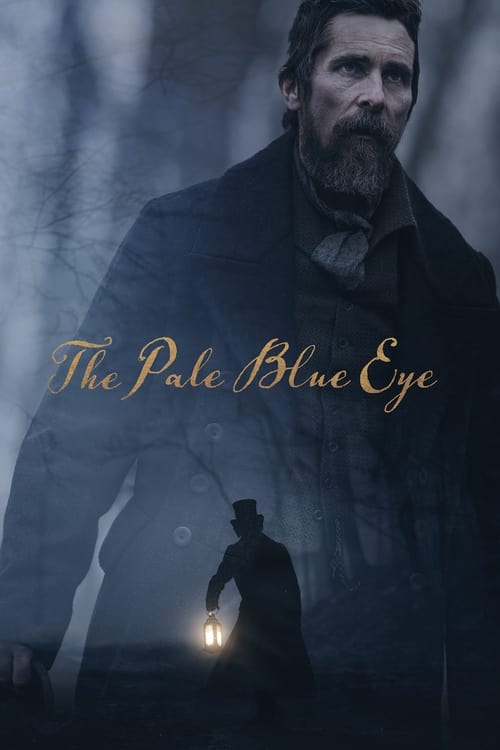
The Pale Blue Eye (2022)
Directed by Scott Cooper
No — The Pale Blue Eye is not woke, scoring 5 out of 100 on our wokeness meter.
The Pale Blue Eye arrives as a period gothic mystery, adapted from Louis Bayard's 2006 novel, with Scott Cooper directing and Christian Bale brooding through the 1830 snows of West Point.
Consciousness Markers
An almost entirely white Anglo-American ensemble; female players (Anderson, Boynton, Gainsbourg) are confined to suspect or victim roles with no diversity-conscious casting on display.
Poe is drawn as an eccentric, socially awkward, brilliant outsider, a modest but real signal of the odd-genius archetype rather than an explicit neurodivergence thesis.
Women exist largely as objects of occult menace or as the murdered daughter whose death motivates the avenger; no feminist thesis is advanced.
A slow-burn gothic mystery that ends in moral ambiguity, with the detective revealed as the killer and unpunished; it never turns to preach at the audience.
No queer characters, subtext, or romance of any kind appears in the 1830 West Point setting.
The academy, the cast, and the story are uniformly white with no engagement with race as a subject.
Winter weather is atmosphere, not argument; there is no environmental messaging.
No class critique or economic messaging; the military hierarchy is simply the setting.
No body-image or self-acceptance themes; bodies here are corpses to be autopsied.
The film is historical fiction that inserts a young Poe into a wholly invented murder plot; it is not a revisionist rewriting of history for modern ideological purposes.
Why it received this score
The Pale Blue Eye arrives as a period gothic mystery, adapted from Louis Bayard's 2006 novel, with Scott Cooper directing and Christian Bale brooding through the 1830 snows of West Point. A cadet is found hanged, his heart removed. Bale's retired constable investigates, aided by a young Edgar Allan Poe, played by Harry Melling as a pale, prattling oddity. The film's interests are antiquarian: candlelight, cadavers, Latin, the occasional dab of black magic. It wants to be a mood, and for a while it is one.
On the ledger of contemporary social consciousness, the film is a near-total blank. The ensemble is uniformly white and Anglo, and the women drift through as suspects, corpses, or hysterics. Gillian Anderson gets a scene or two of occult menace. Lucy Boynton gets a seizure disorder and a knife. Charlotte Gainsbourg gets to be a doctor's wife. No romance, no queerness, no racial reckoning, no economic grievance, no environmental sermon. The winter is weather, not warning. Bodies are autopsied here, not affirmed. Even the murder of the heroine is handled as a plot mechanism, a dead girl whose violation exists to explain a man's grief, which is the oldest narrative debt in the ledger and one this film pays without interest.
What remains is Poe himself, the eccentric, socially hopeless, brilliant outsider, a mild instance of the odd-genius archetype that has been with us since long before anyone thought to name it. The film closes in ambiguity: the detective is the killer, he goes unpunished, and Poe burns the evidence out of friendship. No lecture follows. It is a grim, slow, faintly preposterous entertainment that commits the cardinal sin of the current cultural moment, which is to have nothing to teach us. The snow falls. The ribbon floats away. The audience is left to its own devices, an outcome the industry increasingly regards as negligence. Mixed reviews were inevitable. So was the silence on every question of the day, which here is not evasion but simply the weather of 1830, and the film never bothers to apologize for it.
The film was adapted from a published novel, and that is the only classification worth entering into the record.
{"thematic_tags": ["book_adaptation"]}
Analysis generated by our Consciousness Algorithm


Synopsis
West Point, New York, 1830. When a cadet at the burgeoning military academy is found hanged with his heart cut out, the top brass summons former New York City constable Augustus Landor to investigate. While attempting to solve this grisly mystery, the reluctant detective engages the help of one of the cadets: a strange but brilliant young fellow by the name of Edgar Allan Poe.
Questions about The Pale Blue Eye
Is The Pale Blue Eye woke?
No — The Pale Blue Eye is not woke, scoring 5 out of 100 on our wokeness meter. That earns it a verdict of Ultra Based.
Does The Pale Blue Eye have any woke elements?
Very few. None of the 10 markers reaches 30, the level where a marker counts as present; the highest is Representation Casting at 12.
How does The Pale Blue Eye compare to other 2022 movies?
It ranks #193 of the 223 films from 2022 we've scored; their average is 22. The wokest is Bros (92).
How is the Woke Score calculated?
An AI-assisted process researches the film and its reception, scores it 0–100 on ten markers, then combines those into one 0–100 Woke Score. It measures a specific set of 2020s cultural themes, not film quality.