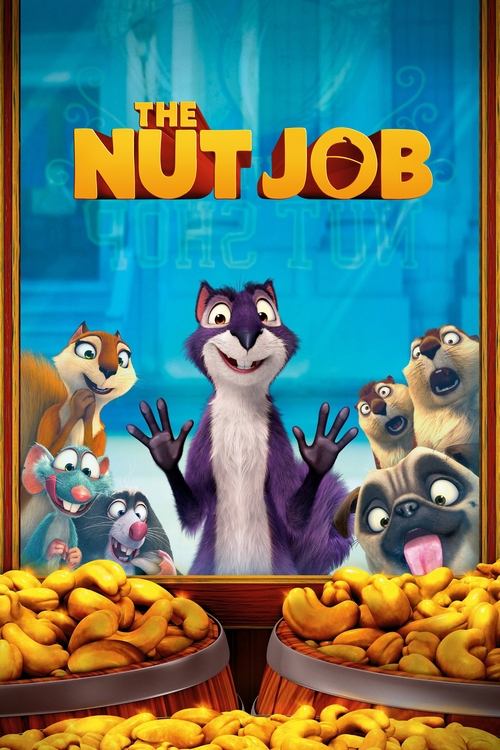
The Nut Job (2014)
Directed by Peter Lepeniotis
No — The Nut Job is not woke, scoring 0 out of 100 on our wokeness meter.
The Nut Job arrives from 2014 bearing a 1959 setting, a nut heist, and a purple squirrel named Surly who begins as an unrepentant thief and ends as a marginally less unrepentant thief.
Consciousness Markers
The voice cast is not assembled around modern representation goals, and no deliberate diversity casting is evident in the film's characters or marketing.
There are no LGBTQ+ characters, themes, or subtext in the film.
Andie is a female squirrel and love interest, but the film does not advance a feminist agenda or critique patriarchal structures.
The film contains no racial themes, commentary, or consciousness.
The plot concerns storing nuts for winter, not climate change or environmental activism.
The heist and mob elements are genre mechanics, not a modern eat-the-rich or anti-capitalist message.
There is no body positivity theme or messaging in the film.
No characters are framed through a neurodivergence lens or as representation for neurodivergent experiences.
The 1959 setting is aesthetic backdrop for a fictional animal caper, not a revisionist historical narrative.
The film is a broad animated comedy and does not lecture the audience on social or political issues.
Why it received this score
The Nut Job arrives from 2014 bearing a 1959 setting, a nut heist, and a purple squirrel named Surly who begins as an unrepentant thief and ends as a marginally less unrepentant thief. That is the arc. The film, loosely expanded from a 2005 short called Surly Squirrel, concerns a park community hoarding food for winter under a raccoon who turns out to be a tyrant, a nut shop that fronts for a bank robbery, and a pug named Precious who is menaced with a dog whistle. It is a caper picture with fur, and the machinery of the genre grinds along to predictable effect.
What it does not do is instruct. There is no lesson about the climate, no critique of the wealthy, no meditation on identity, no character built as a vessel for a cause. Raccoon is a villain because he is greedy, not because he stands for structural inequality. Andie is a red squirrel who becomes a love interest, and the film makes no argument about her place in any patriarchy. A mute rat named Buddy exists, and his silence is a running gag, not representation. The 1959 period dressing is nostalgia and homage to mid-century animation, not a historical thesis. Nobody here is trying to teach us anything, which is either a relief or a vacuum, depending on the viewer.
Critics at the time were unkind and the box office was not, which tells us what it always tells us. A sequel followed. The film sits in the record as a minor animated heist comedy with a sour protagonist and a fondness for flatulence. There is no social program, no sermon, no moment where the audience is asked to examine its conscience. On the scale of contemporary cultural consciousness, this is a clean zero, and there is something restful about that. The squirrel simply wants the nuts.
Analysis generated by our Consciousness Algorithm


Synopsis
Surly, a curmudgeon, independent squirrel is banished from his park and forced to survive in the city. Lucky for him, he stumbles on the one thing that may be able to save his life, and the rest of park community, as they gear up for winter - Maury's Nut Store.
Questions about The Nut Job
Is The Nut Job woke?
No — The Nut Job is not woke, scoring 0 out of 100 on our wokeness meter. That earns it a verdict of Ultra Based.
Does The Nut Job have any woke elements?
No. All 10 markers score zero.
How does The Nut Job compare to other 2014 movies?
It ranks #271 of the 303 films from 2014 we've scored; their average is 13. The wokest is Selma (68).
How is the Woke Score calculated?
An AI-assisted process researches the film and its reception, scores it 0–100 on ten markers, then combines those into one 0–100 Woke Score. It measures a specific set of 2020s cultural themes, not film quality.