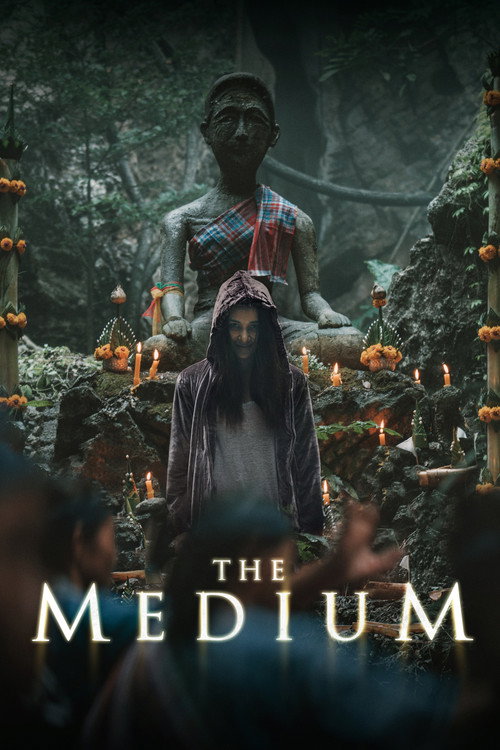
The Medium (2021)
Directed by Banjong Pisanthanakun
No — The Medium is not woke, scoring 5 out of 100 on our wokeness meter.
The Medium arrives from the Isan region of Thailand bearing a documentary crew, a shaman named Nim, and a curse that has been quietly thinning the men of one family for generations.
Consciousness Markers
The cursed family's patriarch was a factory owner who killed himself after insurance fraud, faintly linking ancestral sin to greed, but this is incidental backstory rather than an eat-the-rich message.
The cast is entirely Thai/Isan performers, but this reflects the film's native production context rather than any deliberate diversity-casting agenda.
The narrative centers on three generations of women (Nim, Noi, Mink) and their fraught bonds, but it offers no feminist thesis or critique of patriarchy.
This is a visceral found-footage horror film that aims to disturb rather than preach; any thematic content about faith and ancestral sin is delivered through dread, not sermon.
No LGBTQ+ characters, themes, or subtext appear anywhere in the film.
The film explores Isan folk belief and ancestral curses, not racial identity or racial justice.
No environmental or climate themes are present.
The film features body horror and possession, the opposite of any body-positive messaging.
Mink's shifting personalities are framed as spirit possession, not neurodivergence, and no such themes are explored.
The film is a fictional folk-horror narrative with no historical revisionism.
Why it received this score
The Medium arrives from the Isan region of Thailand bearing a documentary crew, a shaman named Nim, and a curse that has been quietly thinning the men of one family for generations. It is a found-footage possession picture, co-written by Na Hong-jin and directed by Banjong Pisanthanakun, and it conducts itself with the grim patience of a funeral rite. The camera shakes. The goddess, we are told, has chosen a new host. The goddess, it turns out, has nothing to do with any of it.
The film's social conscience, such as it is, amounts to very little in the contemporary sense. Three generations of women orbit one another with suspicion and grief, and the arrangement is dramatic without ever becoming a thesis. The cast is uniformly Thai and Isan, which is simply what the story requires and not a statement of any kind. A dead factory owner, guilty of insurance fraud, lingers in the backstory, and a viewer determined to find a parable about greed could construct one, though the film itself seems more interested in the smell of a boiled dog and the sound of a daughter calling for her mother.
There is no environmental sermon, no meditation on identity, no affirmation of any body. Mink's many voices are spirits, not a diagnosis. What remains is dread, administered generously and without a lecture. The picture runs long, and the mockumentary framing occasionally strains, but it knows exactly what it is: a horror film that earns its horror the old way, through the slow accumulation of ancestral sin. It offers no lessons. It offers a family, a shrine, and a very bad night. In an era of cinema that cannot resist explaining itself, this one simply opens its mouth and screams, which is, in its own limited fashion, a kind of integrity.
Analysis generated by our Consciousness Algorithm


Synopsis
A shaman's family learn that their goddess is supposedly controlling one of them. However, their lives take a frightening turn when they realise the goddess has nothing to do with the possession.
Questions about The Medium
Is The Medium woke?
No — The Medium is not woke, scoring 5 out of 100 on our wokeness meter. That earns it a verdict of Ultra Based.
Does The Medium have any woke elements?
Very few. None of the 10 markers reaches 30, the level where a marker counts as present; the highest is Eat the Rich at 12.
How does The Medium compare to other 2021 movies?
It ranks #214 of the 242 films from 2021 we've scored; their average is 23. The wokest is The Forever Purge (83).
How is the Woke Score calculated?
An AI-assisted process researches the film and its reception, scores it 0–100 on ten markers, then combines those into one 0–100 Woke Score. It measures a specific set of 2020s cultural themes, not film quality.