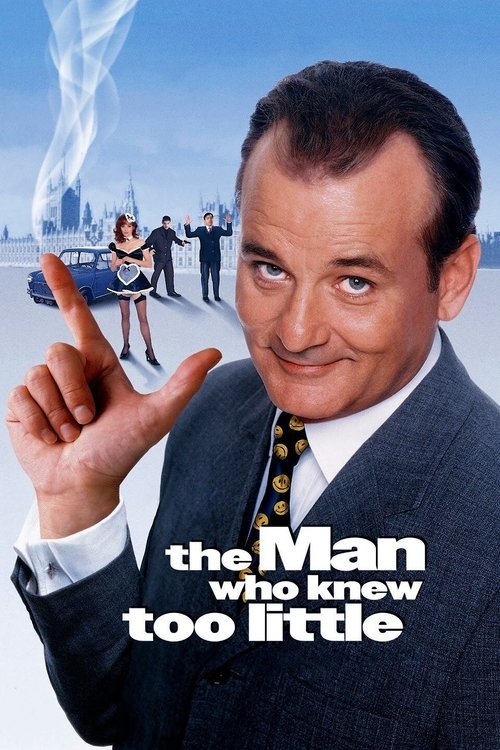
The Man Who Knew Too Little (1997)
Directed by Jon Amiel
No — The Man Who Knew Too Little is not woke, scoring 0 out of 100 on our wokeness meter.
The Man Who Knew Too Little arrives from 1997, a year in which a spy comedy could still be built entirely on the premise that a man from Des Moines misunderstands everything and everyone around him mistakes the misunderstanding for genius.
Consciousness Markers
The cast is overwhelmingly white and the film makes no effort at diverse or representative casting.
There are no LGBTQ+ characters, themes, or subtext.
Female characters exist mainly as a call girl/love interest and a torturer; no feminist agenda is present.
The film does not engage with race, racism, or racial identity.
No environmental or climate-related themes appear.
The plot involves blackmail, espionage, and money, but offers no anti-capitalist critique.
There is no body-positive messaging or body-diversity theme.
Wallace is a bumbling everyman mistaken for a spy, not a neurodivergent character or theme.
The Cold War-era conspiracy is fictional farce, not historical revisionism.
The film is a light mistaken-identity comedy and contains no preachy or lecture-like messaging.
Why it received this score
The Man Who Knew Too Little arrives from 1997, a year in which a spy comedy could still be built entirely on the premise that a man from Des Moines misunderstands everything and everyone around him mistakes the misunderstanding for genius. Bill Murray plays Wallace Ritchie, who wanders into a live improv crime theatre and out the other side into an actual assassination plot involving Russian nesting dolls and a bomb. Jon Amiel directs with the flat competence of a man completing a contract. The film grossed $13.7 million against a $20 million budget, a fact the film itself would find funnier than anything in its runtime.
The cultural inventory is remarkably bare. The cast is white, the women are a call girl and a torturer named Ludmilla, and the villains are Cold War holdovers attempting to restart a conflict for reasons of obsolete technology. Money changes hands, three million pounds of it, without a single word about the systems that produce such sums. There is no identity politics, no environmental anxiety, no body-diversity theme, no neurodivergent reading available, no revisionist account of history. The film's politics extend to the observation that blackmail is bad and that British people are eccentric. This is not restraint. It is simply a different era's default.
We are left with a comedy of misheard words: ambassador for cigar, port for wine, gone for departed. Reviewers at the time found this thin, and time has not thickened it. The film lectures no one. It has no thesis about how we ought to live. It simply wants us to watch Bill Murray dance with Russian folk performers and smile. In an age of cinema as moral instruction, this registers as almost quaint. Our classification yields a flat zero across every marker we track, which is less an insult than an archaeological note. The specimen is preserved. The specimen says nothing.
Analysis generated by our Consciousness Algorithm


Synopsis
An American gets a ticket for an audience participation game in London, then gets involved in a case of mistaken identity. As an international plot unravels around him, he thinks it's all part of the act.
Questions about The Man Who Knew Too Little
Is The Man Who Knew Too Little woke?
No — The Man Who Knew Too Little is not woke, scoring 0 out of 100 on our wokeness meter. That earns it a verdict of Ultra Based.
Does The Man Who Knew Too Little have any woke elements?
No. All 10 markers score zero.
How does The Man Who Knew Too Little compare to other 1997 movies?
It ranks #95 of the 109 films from 1997 we've scored; their average is 12. The wokest is Happy Together (65).
How is the Woke Score calculated?
An AI-assisted process researches the film and its reception, scores it 0–100 on ten markers, then combines those into one 0–100 Woke Score. It measures a specific set of 2020s cultural themes, not film quality.