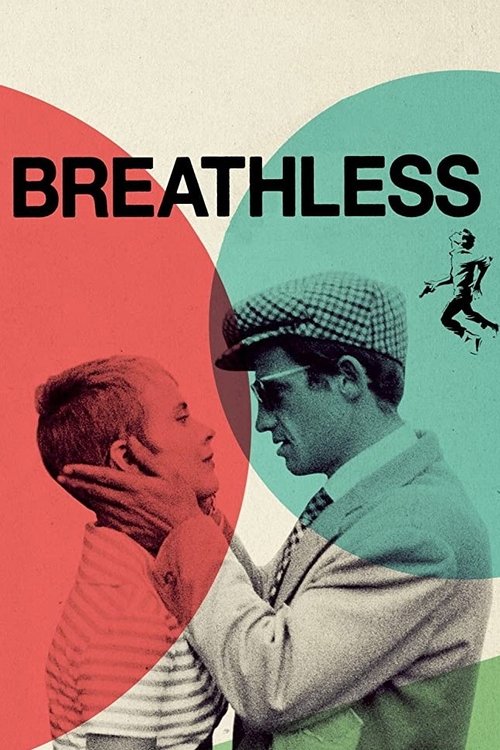
Breathless (1960)
Directed by Jean-Luc Godard
No · Ultra Based
How we score movies →Consciousness Markers
While not explicitly preachy, the film's formal innovations and self-conscious artistic experimentation carry an intellectual, almost pedagogical quality about cinema itself.
Features a female lead in Jean Seberg's Patricia, though she functions primarily as a romantic interest and plot device rather than an autonomous character with agency.
Michel's petty theft and rejection of bourgeois society suggest a vague anti-establishment posture, though this is more aesthetic rebellion than political critique.
Patricia is manipulated, deceived, and ultimately betrayed by Michel. She exists to service the male protagonist's narrative arc rather than as an equal agent.
No LGBTQ+ themes, representation, or subtext present in the film.
The film contains no engagement with racial themes or consciousness of any kind.
Climate concerns are entirely absent from this existential crime drama.
No body positivity messaging or representation of diverse body types appears in the film.
The film contains no representation of neurodivergence or engagement with neurodivergent themes.
This is not a historical film and contains no revisionist historical engagement.


Synopsis
A small-time thief steals a car and impulsively murders a motorcycle policeman. Wanted by the authorities, he attempts to persuade a girl to run away to Italy with him.
Why it received this score
Jean-Luc Godard's debut is a work of staggering formal innovation, a film that rewrote the rules of cinematic syntax through jump cuts, breaking the fourth wall, and a casual disregard for narrative convention. The famous scene in which Michel addresses the camera while driving Patricia through Paris remains a masterclass in how to shatter the boundary between film and viewer. Yet beneath this aesthetic revolution lies a curiously traditional gender dynamic. Patricia exists almost entirely in service to Michel's story, manipulated, deceived, and ultimately abandoned by a protagonist who is, let us be clear, a murderer. She is the film's ultimate casualty, not its moral conscience.
The film's cultural positioning as a work of youthful rebellion and existential freedom has been well-established for six decades now. What we might call its progressive sensibilities are limited to a general aesthetic and philosophical rejection of bourgeois convention, a posture that was intellectually fashionable in 1960s Paris but which bears little resemblance to the social consciousness frameworks of the contemporary moment. Michel's criminality is presented as romantic rather than criminal, a function of his refusal to participate in society rather than a genuine political statement. The film asks us to sympathize with his condition but offers no structural critique, no engagement with power systems, no suggestion that anything about society requires changing beyond the personal liberation of its protagonist.
Godard's later work would develop into increasingly explicit political engagement, particularly his Maoist period in the late 1960s. But Breathless itself remains fundamentally a work of aesthetic modernism masquerading as rebellion. It is a brilliant film, certainly. It is also almost entirely indifferent to the social consciousness that would define progressive politics decades later. The film's score reflects this historical distance: it is what it was, a work of its time, revolutionary in form but conservative in its actual engagement with questions of representation, power, and social justice.
Analysis generated by our Consciousness Algorithm
Critic Reviews
“But the slickness grows mesmeric and the performance unexpectedly wrenching as each trip Gere takes in a succession of classic cars brings him ever closer to his fate, a fate sealed the moment he drops a gun on top of a Silver Surfer comic while speeding through the desert to the accompaniment of Jerry Lee Lewis in the same type of Porsche that James Dean rode to his death. ”
“A wanton, playful film, belying the stated despair by its boiling energy.”
“A very stylish and sexy film noir, a tale of obsessive love neatly balanced between exploitation movie and art film. [23 May 1983, p.54]”
“It's foul, with so little left to the imagination that we get a look between his toes. [13 May 1983, p.19]”