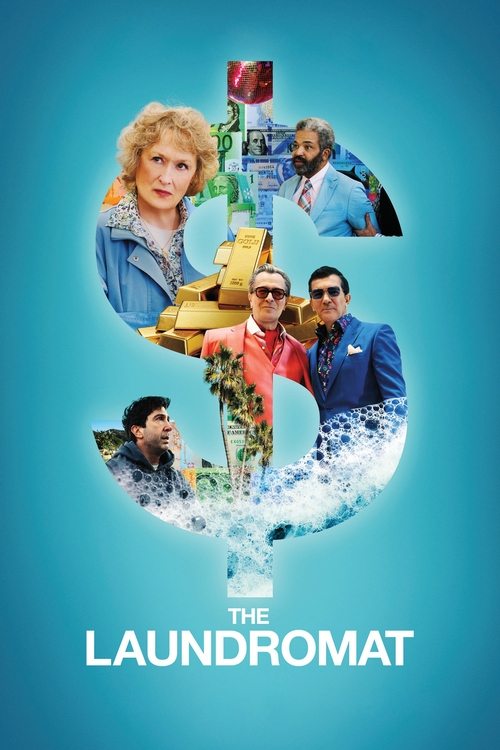
The Laundromat (2019)
Directed by Steven Soderbergh
Partly — The Laundromat is somewhat woke, scoring 43 out of 100 on our wokeness meter.
The Laundromat arrives with the smug confidence of a film that has done its homework and intends to make sure we know it.
Consciousness Markers
The entire film is a broadside against the superrich, tax havens, shell companies, and money laundering, ending with Meryl Streep directly calling for US campaign finance reform—an unmistakable eat-the-rich indictment of global capital.
The narrators explicitly explain money and credit, the fourth wall is broken repeatedly, and Streep closes the film with a direct address demanding campaign finance reform—textbook didacticism.
Meryl Streep anchors the film as a wronged widow seeking justice, and Gu Kailai is depicted as a ruthless power player, but the film frames these as character traits within a corruption narrative rather than advancing any feminist thesis.
The ensemble includes Jeffrey Wright and Cristela Alonzo in supporting roles, but the film's most notable casting decision was widely condemned as brownface, with Meryl Streep playing a Panamanian woman, making this a net liability rather than a woke credential.
An African billionaire and his daughter appear as figures in the money-laundering web, and the cast is internationally varied, but the film interrogates class and corruption, not racial structures or consciousness.
The film dramatizes the real Panama Papers and Wang Lijun incidents with acknowledged fictionalization and renamed characters, but it presents recent events rather than reinterpreting history through an ideological lens.
No LGBTQ+ characters, themes, or subtext appear anywhere in the film's three interlocking stories of financial fraud.
There is no climate or environmental content whatsoever in this film about offshore finance and shell companies.
No body-positivity themes or messaging are present in the film.
No neurodivergent characters, themes, or framing appear in the film.
Why it received this score
The Laundromat arrives with the smug confidence of a film that has done its homework and intends to make sure we know it. Steven Soderbergh assembles a glittering ensemble to explain offshore finance through three interlocking tales of fraud. Meryl Streep anchors the proceedings as Ellen Martin, a widow swindled out of insurance money. Jeffrey Wright and Cristela Alonzo appear in support. The most discussed casting decision remains Streep as a Panamanian woman named Elena, a brownface choice that plays as a liability instead of a credential. There is no LGBTQ content, no climate concern, no body positivity, and no neurodivergent framing. These absences are not sins of omission. They are simply outside the film's narrow ledger.
The film's true passion is economic. Mossack and Fonseca serve as narrators, guiding us through shell companies, tax havens, and the machinery that hides cash for the superrich. The finale has Streep as herself demanding US campaign finance reform before striking the Statue of Liberty pose. That is an eat-the-rich sermon with footnotes. Feminist gestures remain modest: a wronged widow seeks justice, and Gu Kailai is depicted as a ruthless power player, but the story treats these as character traits inside a corruption narrative. Racial consciousness is similarly thin. An African billionaire and his daughter figure in the money-laundering web, and the cast is internationally varied, yet the target is class and corruption, not racial structures. Historical revisionism is mild. The Panama Papers and the Wang Lijun incident are dramatized with acknowledged fictionalization and renamed characters, but this is recent history, not ideological reinterpretation.
The lecture energy is the film's dominant mode. Narrators explain money and credit. The fourth wall breaks repeatedly. Streep closes with a direct address on campaign finance reform. Soderbergh wants to inoculate viewers against obliviousness, and the effort is unmistakable. It is also heavy-handed. The mixed critical reception makes sense. A film can be furious about injustice and still mistake a subpoena for a screenplay. The brownface controversy and the defamation suit from Mossack and Fonseca add extra noise. The Laundromat is based on true events and adapted from a book, which gives its anger a factual spine. It remains a blunt instrument, useful for instruction, less so for drama.
{"thematic_tags":["true_story","book_adaptation"]}
Analysis generated by our Consciousness Algorithm


Synopsis
When a widow gets swindled out of insurance money, her search for answers leads to two cunning lawyers in Panama who hide cash for the superrich.
Questions about The Laundromat
Is The Laundromat woke?
Partly — The Laundromat is somewhat woke, scoring 43 out of 100 on our wokeness meter. That earns it a verdict of Woke-Adjacent.
What makes The Laundromat woke?
2 of the 10 markers register at 30 or above, led by Eat the Rich (82) and Lecture Energy (75). On Eat the Rich: The entire film is a broadside against the superrich, tax havens, shell companies, and money laundering, ending with Meryl Streep directly calling for US campaign finance reform—an unmistakable eat-the-rich indictment of global capital.
How does The Laundromat compare to other 2019 movies?
It ranks #42 of the 284 films from 2019 we've scored; their average is 22. The wokest is Black Christmas (79).
How is the Woke Score calculated?
An AI-assisted process researches the film and its reception, scores it 0–100 on ten markers, then combines those into one 0–100 Woke Score. It measures a specific set of 2020s cultural themes, not film quality.