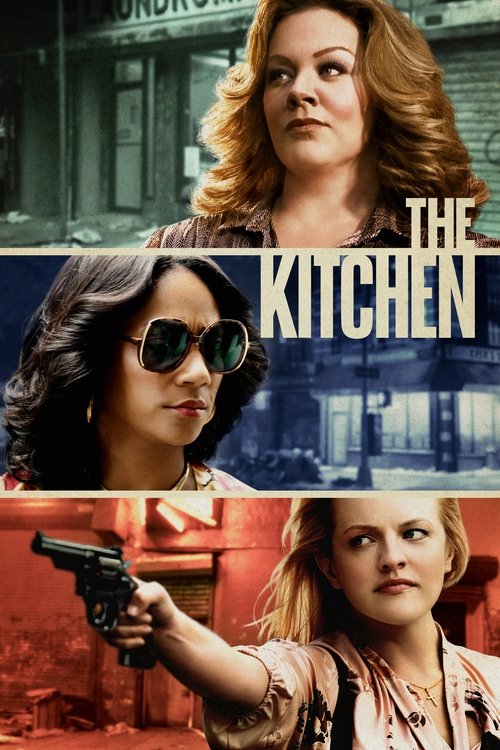
The Kitchen (2019)
Directed by Andrea Berloff
No — The Kitchen is not especially woke, scoring 32 out of 100 on our wokeness meter.
The Kitchen arrives as a 2019 crime picture in which three Hell's Kitchen housewives, circa 1978, inherit the Irish mob after the FBI carts their husbands away.
Consciousness Markers
The entire premise is housewives seizing the mob rackets from their imprisoned husbands, and Kathy explicitly declares she entered crime 'to attain autonomy,' not for her children. Female empowerment is the film's organizing engine.
A woman-directed film led by three female stars, with Tiffany Haddish and Common cast in a 1970s Irish-American mob milieu where such faces were historically rare. The casting is notable but presented as straightforward ensemble work rather than a statement.
Ethnic turf conflict (Irish unions, Italian Mafia, the Jewish community's hiring deals) is central to the plot, and Haddish leads as a Black woman inside an Irish crime family, but race itself is largely unexamined.
A few speeches land the autonomy theme (Kathy's funeral-side declaration, Jimmy's wounded ego monologue), but the film plays as genre entertainment rather than sermon.
Protection rackets and territorial economics are the subject, but the film treats criminal enterprise as a vehicle for personal power rather than a critique of capitalism.
No LGBTQ+ characters, themes, or subtext appear in the film.
No environmental themes whatsoever.
Melissa McCarthy leads without any narrative commentary on body image or size.
No neurodivergent characters or themes are present.
A fictional period crime story adapted from a comic; it does not reframe or reinterpret historical events.
Why it received this score
The Kitchen arrives as a 2019 crime picture in which three Hell's Kitchen housewives, circa 1978, inherit the Irish mob after the FBI carts their husbands away. Andrea Berloff directs her own screenplay, adapted from a DC Vertigo comic, and the enterprise carries the quiet confidence of a first-time filmmaker who has studied the genre's furniture closely. Melissa McCarthy, Tiffany Haddish and Elisabeth Moss take the leads. The premise is empowerment by way of extortion, and the film knows it. Kathy eventually announces at a graveside that she entered the rackets to attain autonomy, not to feed her children. That line is the thesis statement, delivered with the subtlety of a cinder block through a window.
The casting draws a certain attention. Haddish and Common occupy an Irish-American underworld where such faces were historically scarce, and the film treats this as ordinary ensemble business, which is either admirable restraint or an oversight. Ethnic friction supplies most of the plot's engine: Irish unions, Italian territory, Jewish hiring arrangements, all negotiated like zoning disputes. Race itself goes largely unexamined, which keeps that register muted. Elsewhere the ledger is thin. No LGBTQ threads. No climate anxiety. No commentary on body image despite McCarthy's presence. No neurodivergent characters. Criminal enterprise functions as a ladder for personal ambition, never as an indictment of capital. The point is power, and the film is honest about wanting it.
It plays as genre entertainment, sermonizing only in short bursts. A monologue about wounded male ego here, a funeral declaration there. Most of the runtime goes to territory maps and betrayals. Critics were unkind, audiences indifferent, and the box office was a bruise. Still, the organizing obsession, women seizing what their husbands left behind, is unmistakable and sustained. A somber vintage, well structured, faintly hollow on the finish.
Analysis generated by our Consciousness Algorithm
Part of


Synopsis
The mobster husbands of three 1978 Hell's Kitchen housewives are sent to prison by the FBI. Left with little but a sharp ax to grind, the ladies take the Irish mafia's matters into their own hands — proving unexpectedly adept at everything from running the rackets to taking out the competition… literally.
Questions about The Kitchen
Is The Kitchen woke?
No — The Kitchen is not especially woke, scoring 32 out of 100 on our wokeness meter. That earns it a verdict of Based.
Does The Kitchen have any woke elements?
2 of the 10 markers register at 30 or above, led by Feminist Agenda (62) and Representation Casting (45). On Feminist Agenda: The entire premise is housewives seizing the mob rackets from their imprisoned husbands, and Kathy explicitly declares she entered crime 'to attain autonomy,' not for her children.
How does The Kitchen compare to other 2019 movies?
It ranks #71 of the 284 films from 2019 we've scored; their average is 22. The wokest is Black Christmas (79).
How is the Woke Score calculated?
An AI-assisted process researches the film and its reception, scores it 0–100 on ten markers, then combines those into one 0–100 Woke Score. It measures a specific set of 2020s cultural themes, not film quality.