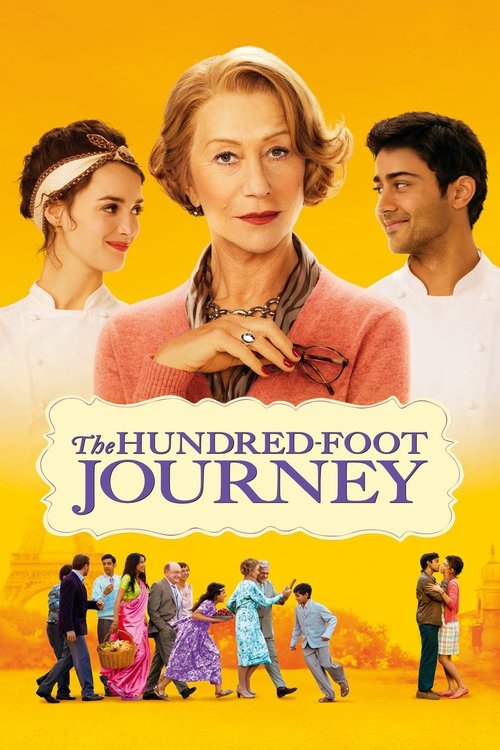
The Hundred-Foot Journey (2014)
Directed by Lasse Hallström
No — The Hundred-Foot Journey is not especially woke, scoring 24 out of 100 on our wokeness meter.
Lasse Hallström's The Hundred-Foot Journey arrives with the softest possible landing.
Consciousness Markers
The film centers an Indian immigrant family with a predominantly South Asian cast (Om Puri, Manish Dayal, Juhi Chawla), giving substantial screen presence to non-white leads in a major studio release, though the casting is organic to the story rather than a modern diversity mandate.
The plot directly engages xenophobia and anti-immigrant hostility, including the 'La France aux Français' graffiti and the firebombing of the Indian restaurant, framing cultural tolerance as a central theme.
Helen Mirren's Madame Mallory is a formidable, self-made female restaurateur commanding a Michelin-starred kitchen, but the film treats this as character rather than a feminist thesis.
The film is a gentle feel-good dramedy that conveys its themes of cultural harmony through story and character rather than explicit sermonizing.
No LGBTQ+ characters or themes appear anywhere in the narrative.
No environmental or climate themes are present.
The film is about culinary craft, family, and prestige rather than class warfare or economic critique; Michelin stars are aspirational, not condemned.
No body positivity themes or messaging appear.
No neurodivergent characters or themes are depicted.
The film is a fictional adaptation of a novel with no historical revisionism.
Why it received this score
Lasse Hallström's The Hundred-Foot Journey arrives with the softest possible landing. An Indian family, displaced by violence in Mumbai, opens Maison Mumbai directly across the road from a Michelin-starred French establishment, and the culture clash resolves itself, over two hours, into a warm bath of cardamom and beurre blanc. The casting is notably South Asian at its center, with Om Puri, Manish Dayal and Juhi Chawla carrying the emotional weight of a major studio release. The arrangement feels organic to the source novel, not engineered by committee. The screenplay does engage genuine hostility toward outsiders: vandals spray "La France aux Français" on the wall, then firebomb the family's terrace, and the film treats this ugliness as something to be scrubbed away by hand.
At its center stands Helen Mirren's Madame Mallory, a self-made proprietress who commands her kitchen with a martinet's precision. That the film grants a woman such authority without a single speech about glass ceilings is, in the present climate, close to subversive. The progressive content arrives through omelettes, sabotage and slow courtship, not sermons. A viewer braced for a lecture will find only a gently simmering stew. Even the firebombing, the film's ugliest moment, is resolved by an apology and a shared breakfast.
The film's absences are equally instructive. There is no queer subplot, no climate anxiety, no reckoning with body image, no neurodivergent character, and no indictment of wealth. Michelin stars are the object of desire here, not a symptom of decay. History goes untouched. The remainder is cinematic comfort food of the most accommodating sort, a film that asks nothing of its audience but appetite. Hallström's touch is so gentle that the occasional gestures toward tolerance register as good manners. It is a pleasant meal, competently plated, and it leaves no aftertaste whatsoever.
Analysis generated by our Consciousness Algorithm


Synopsis
A story centered around an Indian family who moves to France and opens a restaurant across the street from a Michelin-starred French restaurant.
Questions about The Hundred-Foot Journey
Is The Hundred-Foot Journey woke?
No — The Hundred-Foot Journey is not especially woke, scoring 24 out of 100 on our wokeness meter. That earns it a verdict of Based.
Does The Hundred-Foot Journey have any woke elements?
2 of the 10 markers register at 30 or above, led by Representation Casting (50) and Racial Consciousness (45). On Representation Casting: The film centers an Indian immigrant family with a predominantly South Asian cast (Om Puri, Manish Dayal, Juhi Chawla), giving substantial screen presence to non-white leads in a major studio release, though the casting is organic to the story rather than a modern diversity mandate.
How does The Hundred-Foot Journey compare to other 2014 movies?
It ranks #38 of the 303 films from 2014 we've scored; their average is 13. The wokest is Selma (68).
How is the Woke Score calculated?
An AI-assisted process researches the film and its reception, scores it 0–100 on ten markers, then combines those into one 0–100 Woke Score. It measures a specific set of 2020s cultural themes, not film quality.