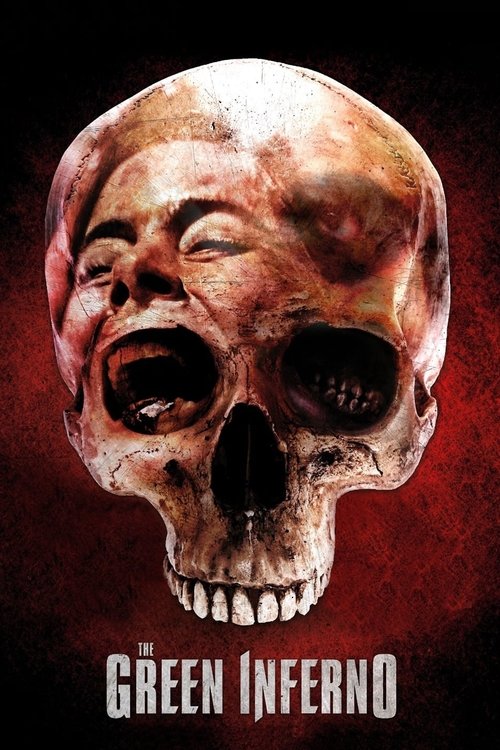
The Green Inferno (2014)
Directed by Eli Roth
No — The Green Inferno is not woke, scoring 17 out of 100 on our wokeness meter.
Eli Roth's The Green Inferno arrives as a loving reproduction of the Italian cannibal cycle of the late 1970s, which is a curious thing to love.
Consciousness Markers
A petrochemical company and its private militia are villains, and corporate greed is a plot mechanism, but the film offers no systemic anti-capitalist critique.
Rainforest deforestation and environmental activism drive the setup, but the film treats the cause as a naive pretext for horror rather than a climate crusade.
Features a largely Latin American cast, including Chilean and Argentine actors in lead roles, though the indigenous tribe is portrayed through stereotypical, non-progressive lens.
Contains an unsubtle message about uninformed activism doing more harm than good, but it is not a progressive social justice lecture.
The plot involves indigenous displacement by a petrochemical company, but the film has been widely criticized for racist stereotypes of Amazonian tribes as savage cannibals.
A female protagonist survives, but the film's treatment of women, including graphic FGM, is exploitative rather than feminist.
No LGBTQ+ characters or themes are present.
No body positivity themes.
No neurodivergence themes.
Not a historical revision; fictional cannibal tribe tale.
Why it received this score
Eli Roth's The Green Inferno arrives as a loving reproduction of the Italian cannibal cycle of the late 1970s, which is a curious thing to love. A group of New York student activists flies to the Amazon to chain themselves to bulldozers and stream the results, and the film treats this as an act of vanity long before it treats it as anything else. The plane goes down. The tribe appears. What follows is a patient, extended exercise in gristle.
The production cast heavily from Chile and Argentina, and Lorenza Izzo carries the film with a survivor's blankness. That is where the cultural credit ends. The indigenous villagers exist to shriek, to fondle blonde hair, and to perform a genital mutilation ceremony with no basis in Amazonian practice, a detail somebody might have checked. Environmental concern serves as the ignition switch and nothing more. A petrochemical company and its private militia supply the villains, and corporate greed moves the plot, but the film holds no interest in the system that manufactures such companies. It holds an interest in the meat.
The message, delivered with the subtlety of a dropped anvil, is that uninformed activism harms the people it claims to defend. That is a real observation, made badly, mostly by having the protagonists die for it. Survival International and Amazon Watch objected to the portrayal of uncontacted peoples as savages, and Roth replied that gas companies do not need a movie's permission to destroy a village. He is correct about the gas companies. The film stays a curiosity: a throwback that borrowed the aesthetics of exploitation and inherited the politics along with them. It opened ninth. It earned its gross. The sequel never arrived.
Analysis generated by our Consciousness Algorithm


Synopsis
A group of student activists travel from New York City to the Amazon to save the rainforest. However, once they arrive in this vast green landscape, they soon discover that they are not alone… and that no good deed goes unpunished.
Questions about The Green Inferno
Is The Green Inferno woke?
No — The Green Inferno is not woke, scoring 17 out of 100 on our wokeness meter. That earns it a verdict of Ultra Based.
Does The Green Inferno have any woke elements?
1 of the 10 markers register at 30 or above, led by Eat the Rich (30). On Eat the Rich: A petrochemical company and its private militia are villains, and corporate greed is a plot mechanism, but the film offers no systemic anti-capitalist critique.
How does The Green Inferno compare to other 2014 movies?
It ranks #73 of the 303 films from 2014 we've scored; their average is 13. The wokest is Selma (68).
How is the Woke Score calculated?
An AI-assisted process researches the film and its reception, scores it 0–100 on ten markers, then combines those into one 0–100 Woke Score. It measures a specific set of 2020s cultural themes, not film quality.