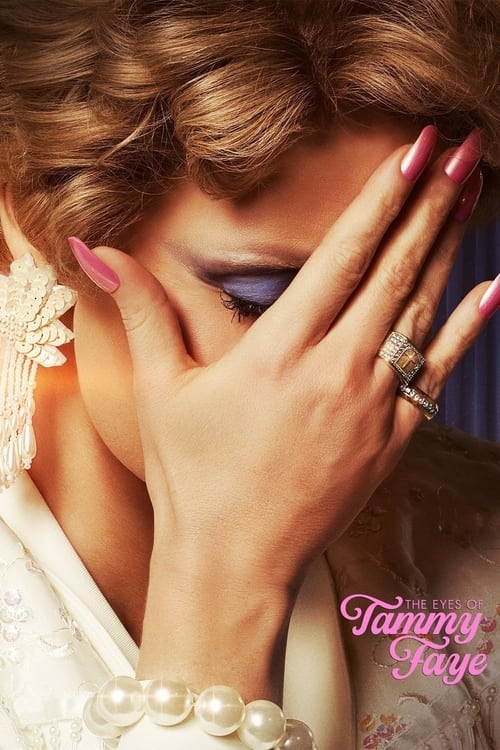
The Eyes of Tammy Faye (2021)
Directed by Michael Showalter
Partly — The Eyes of Tammy Faye is somewhat woke, scoring 43 out of 100 on our wokeness meter.
This biographical chronicle of the Bakker empire functions primarily as a meticulous dissection of institutional hypocrisy.
Consciousness Markers
Tammy Faye's deliberate interview with an AIDS patient and her later support for LGBTQ+ communities are significant, sympathetic subplots. The film contrasts her empathy with Falwell's homophobic rhetoric.
The film centers an ambitious woman navigating male-dominated evangelical institutions and critiques the men who control her. However, it frames this primarily as biography rather than explicit feminist argument.
The film critiques the monetization of faith, tax-exempt religious empires, and financial fraud within televangelism. Its target is prosperity-gospel greed rather than capitalism as a system.
The film offers a sympathetic reclamation of Tammy Faye Bakker, emphasizing her LGBTQ+ support and conflict with the religious right. It reframes a controversial figure through a more progressive lens while remaining based on real events.
The film has moments of moral contrast, especially around empathy, hypocrisy, and the politicization of faith. It generally delivers these through drama rather than direct preaching.
The cast is overwhelmingly white, with limited meaningful representation beyond a supporting gay AIDS patient. The film does not foreground diverse casting as a marker.
There is no meaningful engagement with race or racial justice in the film. The story remains focused on white evangelical culture and its internal conflicts.
The film contains no climate or environmental themes.
Tammy Faye's makeup and appearance are central to her identity, but the film does not engage with body-positivity themes or body acceptance as a social marker.
There is no depiction or discussion of neurodivergence in the film.
Why it received this score
This biographical chronicle of the Bakker empire functions primarily as a meticulous dissection of institutional hypocrisy. We are presented with the ascent of a woman who weaponizes aesthetics and empathy within the rigid structure of the evangelical church. Her journey provides a surprisingly nuanced look at the monetization of faith, successfully critiquing the inherent greed of a prosperity gospel empire without descending into a direct anti-capitalist manifesto. The film frames this financial excess as a cultural rot, a theme that lingers long after the screen goes dark.
The most progressive energy resides in Tammy Faye’s specific moral inclinations. Her sympathetic engagement with marginalized groups, such as the LGBTQ+ community and those afflicted by the AIDS crisis, serves as a deliberate counterpoint to the entrenched bigotry of her contemporaries. It is a reclamation of a complex figure, offering a revisionist lens that prioritizes her personal conscience over the rigid doctrine of the religious right. However, the narrative remains confined to a predominantly white cultural landscape, offering little exploration of race or broader systemic inequities. The social commentary functions as a dramatic subplot rather than a sustained sociological treatise.
While the film avoids the pitfalls of overt moralizing, its progressive sensibilities are rarely purely didactic. The focus remains on the personal tragedy of ambition colliding with religious dogma. The cultural awareness is present, though it is confined to the sphere of televangelism. The sheer spectacle of the melodrama provides a necessary backdrop to these internal conflicts, allowing the audience to observe the clash between burgeoning modern progressive ideals and entrenched fundamentalist tradition.
Analysis generated by our Consciousness Algorithm
Part of


Synopsis
From the 1960s to the 1980s, evangelist Jim Baker and his ambitious wife, Tammy Faye, rose from humble beginnings to build an empire based on big-time evangelical Christianity--only for the couple to fall from grace because of some all-too-human sins.
Questions about The Eyes of Tammy Faye
Is The Eyes of Tammy Faye woke?
Partly — The Eyes of Tammy Faye is somewhat woke, scoring 43 out of 100 on our wokeness meter. That earns it a verdict of Woke-Adjacent.
What makes The Eyes of Tammy Faye woke?
5 of the 10 markers register at 30 or above, led by LGBTQ+ Themes (65), Eat the Rich (40) and Feminist Agenda (40). On LGBTQ+ Themes: Tammy Faye's deliberate interview with an AIDS patient and her later support for LGBTQ+ communities are significant, sympathetic subplots.
How does The Eyes of Tammy Faye compare to other 2021 movies?
It ranks #40 of the 242 films from 2021 we've scored; their average is 23. The wokest is The Forever Purge (83).
How is the Woke Score calculated?
An AI-assisted process researches the film and its reception, scores it 0–100 on ten markers, then combines those into one 0–100 Woke Score. It measures a specific set of 2020s cultural themes, not film quality.