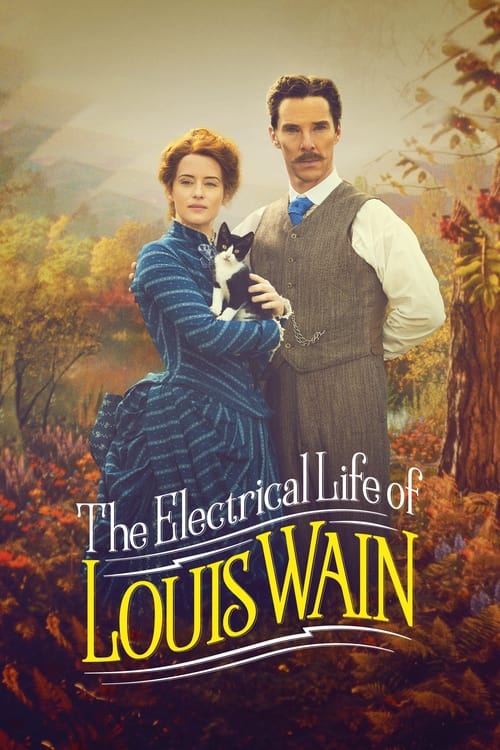
The Electrical Life of Louis Wain (2021)
Directed by Will Sharpe
No — The Electrical Life of Louis Wain is not especially woke, scoring 26 out of 100 on our wokeness meter.
The Electrical Life of Louis Wain arrives dressed in the familiar costume of the British period biopic, all lamplight and wool coats, and yet its true subject is not cats.
Consciousness Markers
The film is centrally concerned with Louis Wain's eccentric, 'electrical' mind, his obsessive creative patterns, sensory visions, and eventual mental breakdowns and institutionalization. Neurodivergence and mental illness are the emotional core of the story, treated with sympathy and framed as a difference to be accommodated rather than cured.
A recurring thread concerns Louis being exploited by publishers and postcard manufacturers who profit from his cat illustrations while he remains in debt, and Hearst's sponsorship is transactional. This is a mild critique of commercial exploitation of artists rather than a systemic anti-capitalist argument.
The film carries a gentle didactic message about the humane treatment of the mentally ill, contrasting the grim Springfield institution with the cat-friendly Napsbury, but it delivers this through whimsy and narration rather than overt sermonizing.
Emily Richardson is portrayed as a quietly independent woman who defies class and age conventions, and the Wain sisters' constrained Victorian options are noted. However, this is period-appropriate drama rather than a feminist thesis.
A predominantly white British period cast, with Adeel Akhtar and Asim Chaudhry providing minor South Asian presence in a Victorian London setting. No commentary is made on this casting; it is incidental rather than a statement.
No LGBTQ+ characters, relationships, or themes appear anywhere in the narrative.
The film engages no racial themes or commentary whatsoever; it is a white Victorian family drama.
No environmental or climate content is present.
No body-positivity themes or content are present.
The film is a fairly faithful, affectionate biopic of the real Louis Wain and does not substantially rewrite or reinterpret historical events for ideological purposes.
Why it received this score
The Electrical Life of Louis Wain arrives dressed in the familiar costume of the British period biopic, all lamplight and wool coats, and yet its true subject is not cats. It is the interior weather of a man whose mind will not settle. Benedict Cumberbatch plays Wain as a creature of runaway associations, sketching at odd hours, narrating the cosmos to anyone nearby, overwhelmed by sound and color. The film treats this as a difference to be sheltered, not a defect to be scrubbed away, and its closing passages in the institutions of Springfield and Napsbury carry a quiet argument about what a decent society owes its unwell. That argument lands softly. Whimsy does the work that sermonizing usually does.
Where the film glances at commerce, it does so with a raised eyebrow. Louis invents a feline civilization, the postcard trade grows fat on it, and he neglects to copyright a single image, dying in debt while manufacturers count his money. Hearst's patronage is transactional, the family is evicted twice, and the arrangement between artist and industry is shown as a slow extraction. This is a grumble about exploitation, not a manifesto. The romance with Emily Richardson offers a similar restraint. She is ten years his senior, lower born, and unbothered by either fact, and the Wain sisters' cramped Victorian options are acknowledged in passing. The film notices these things without assembling them into a thesis.
Elsewhere the ledger is largely blank. This is a white Victorian family drama and it makes no racial observation of any kind. There is no queer thread, no environmental anxiety, no body-positivity subplot, no reordering of the historical record for ideological convenience. The casting of Adeel Akhtar and Asim Chaudhry registers as incidental texture in a London street scene, nothing more. The result is a tender, occasionally indulgent portrait of an artist whom history remembered chiefly for drawing cats and forgot to pay. The film is kind to him. Kindness, in this instance, is not a political program.
Thematic tags: true_story. The film is based on the real life of Louis Wain, but it is not an Oscar winner, not a sequel or remake, not adapted from a book, not a superhero property, and did not reach number one at the domestic box office given its limited theatrical release and streaming debut.
{"review": "The Electrical Life of Louis Wain arrives dressed in the familiar costume of the British period biopic, all lamplight and wool coats, and yet its true subject is not cats. It is the interior weather of a man whose mind will not settle. Benedict Cumberbatch plays Wain as a creature of runaway associations, sketching at odd hours, narrating the cosmos to anyone nearby, overwhelmed by sound and color. The film treats this as a difference to be sheltered, not a defect to be scrubbed away, and its closing passages in the institutions of Springfield and Napsbury carry a quiet argument about what a decent society owes its unwell. That argument lands softly. Whimsy does the work that sermonizing usually does.\n\nWhere the film glances at commerce, it does so with a raised eyebrow. Louis invents a feline civilization, the postcard trade grows fat on it, and he neglects to copyright a single image, dying in debt while manufacturers count his money. Hearst's patronage is transactional, the family is evicted twice, and the arrangement between artist and industry is shown as a slow extraction. This is a grumble about exploitation, not a manifesto. The romance with Emily Richardson offers a similar restraint. She is ten years his senior, lower born, and unbothered by either fact, and the Wain sisters' cramped Victorian options are acknowledged in passing. The film notices these things without assembling them into a thesis.\n\nElsewhere the ledger is largely blank. This is a white Victorian family drama and it makes no racial observation of any kind. There is no queer thread, no environmental anxiety, no body-positivity subplot, no reordering of the historical record for ideological convenience. The casting of Adeel Akhtar and Asim Chaudhry registers as incidental texture in a London street scene, nothing more. The result is a tender, occasionally indulgent portrait of an artist whom history remembered chiefly for drawing cats and forgot to pay. The film is kind to him. Kindness, in this instance, is not a political program.", "thematic_tags": ["true_story"]}
Analysis generated by our Consciousness Algorithm

Synopsis
The extraordinary true story of eccentric British artist Louis Wain, whose playful, sometimes even psychedelic pictures helped to transform the public's perception of cats forever.
Questions about The Electrical Life of Louis Wain
Is The Electrical Life of Louis Wain woke?
No — The Electrical Life of Louis Wain is not especially woke, scoring 26 out of 100 on our wokeness meter. That earns it a verdict of Based.
Does The Electrical Life of Louis Wain have any woke elements?
1 of the 10 markers register at 30 or above, led by Neurodivergence (65). On Neurodivergence: The film is centrally concerned with Louis Wain's eccentric, 'electrical' mind, his obsessive creative patterns, sensory visions, and eventual mental breakdowns and institutionalization.
How does The Electrical Life of Louis Wain compare to other 2021 movies?
It ranks #75 of the 242 films from 2021 we've scored; their average is 23. The wokest is The Forever Purge (83).
How is the Woke Score calculated?
An AI-assisted process researches the film and its reception, scores it 0–100 on ten markers, then combines those into one 0–100 Woke Score. It measures a specific set of 2020s cultural themes, not film quality.