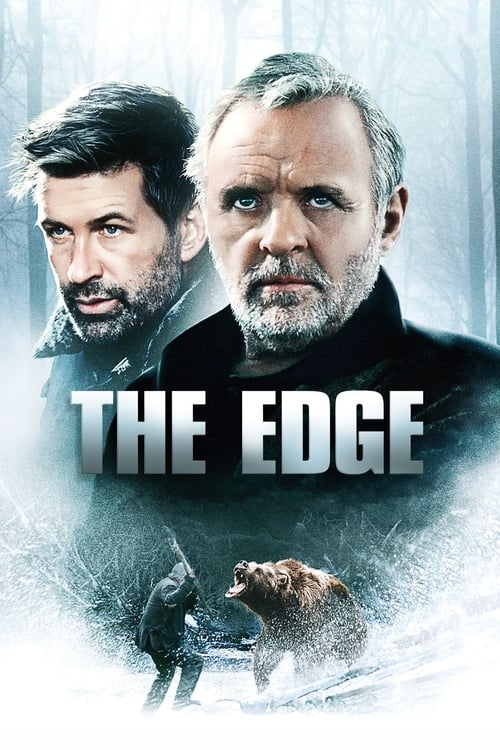
The Edge (1997)
Directed by Lee Tamahori
No — The Edge is not woke, scoring 9 out of 100 on our wokeness meter.
The Edge arrives from 1997, a year when a survival thriller could still be assembled from a Mamet script, a trained Kodiak bear, and two movie stars arguing about a watch.
Consciousness Markers
Harold Perrineau appears as Stephen, a Black supporting character, and Elle Macpherson as a model, but the film makes no comment on their presence; casting is diverse by accident of the era rather than by design.
Bob voices disgust at Charles's wealth and there is a faint rich-man-versus-working-man tension, but the film ultimately celebrates the billionaire's resourcefulness rather than indicting capital.
Mamet's dialogue is brainy and sharp but never preachy; the film has no lecture energy to speak of.
Mickey exists as the unfaithful model wife and a plot device for the men's conflict; there is no feminist framing or commentary whatsoever.
No LGBTQ+ characters, themes, or subtext of any kind appear in this survival thriller.
Stephen is a Black character who exists naturally in the story with no racial commentary, which by definition does not register as racial consciousness.
The Alaskan wilderness is a survival antagonist, not a climate-crisis statement; no environmental messaging is present.
No body-positivity themes or messaging appear.
No neurodivergent characters or themes are present.
The film is a straightforward original survival narrative with no historical revisionism.
Why it received this score
The Edge arrives from 1997, a year when a survival thriller could still be assembled from a Mamet script, a trained Kodiak bear, and two movie stars arguing about a watch. Anthony Hopkins plays Charles Morse, a billionaire who crashes into the Alaskan bush with a photographer (Alec Baldwin) and an assistant (Harold Perrineau), then spends the remaining runtime negotiating with weather, wildlife, and marital suspicion. The cultural inventory here is thin. The film wants to be about men and meat and the thin membrane between civilization and appetite, and mostly it is.
Two modest flickers register. Harold Perrineau appears as Stephen, a Black member of the expedition, and the screenplay never remarks on it, which is either admirable restraint or simple disinterest. Elle Macpherson plays Mickey, the unfaithful model wife, a plot device in heels. There is a faint class friction when Bob sneers at Charles's money, but the third act resolves it by admiring the rich man's competence with a spear. Capital survives the crash. It always does.
The remaining markers are a null set. No queer subtext, no climate sermon, no body politics, no neurodivergent arc, no revisionist history. The bear is not a metaphor for anything except a bear. Mamet's dialogue crackles with intelligence and never stoops to preach, which earns a small nod and nothing more. The result is a lean, well-made genre picture from an era that did not yet feel obliged to explain itself. A dry, austere vintage: low in ideological sugar, faintly tannic, best paired with a helicopter and a wristwatch.
Analysis generated by our Consciousness Algorithm


Synopsis
The plane carrying wealthy Charles Morse crashes down in the Alaskan wilderness. Together with the two other passengers, photographer Robert and assistant Stephen, Charles devises a plan to help them reach civilization. However, his biggest obstacle might not be the elements, or even the Kodiak bear stalking them -- it could be Robert, whom Charles suspects is having an affair with his wife and would not mind seeing him dead.
Questions about The Edge
Is The Edge woke?
No — The Edge is not woke, scoring 9 out of 100 on our wokeness meter. That earns it a verdict of Ultra Based.
Does The Edge have any woke elements?
Very few. None of the 10 markers reaches 30, the level where a marker counts as present; the highest is Representation Casting at 18.
How does The Edge compare to other 1997 movies?
It ranks #46 of the 109 films from 1997 we've scored; their average is 12. The wokest is Happy Together (65).
How is the Woke Score calculated?
An AI-assisted process researches the film and its reception, scores it 0–100 on ten markers, then combines those into one 0–100 Woke Score. It measures a specific set of 2020s cultural themes, not film quality.