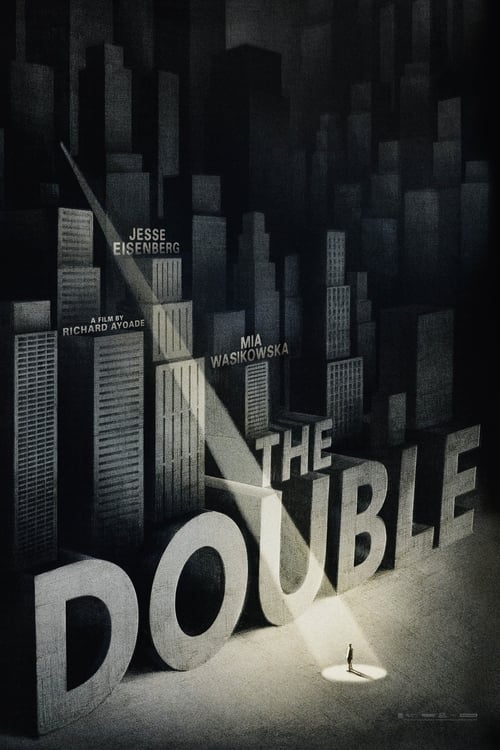
The Double (2014)
Directed by Richard Ayoade
No — The Double is not woke, scoring 6 out of 100 on our wokeness meter.
Richard Ayoade's The Double takes Dostoevsky's 1846 novella and drops it into a grey, analogue office purgatory.
Consciousness Markers
The Kafkaesque office setting gestures at corporate dehumanization and bureaucratic anonymity, but it is existential alienation rather than an 'eat the rich' class polemic.
The cast is overwhelmingly white (Eisenberg, Wasikowska, Shawn, Fox, Moriarty), with no diverse casting choices made or commented upon.
No LGBTQ+ characters, themes, or subtext appear anywhere in this Dostoevsky adaptation.
Hannah and Melanie exist largely as objects of male desire and rivalry; the film offers no feminist critique or agency-driven female narrative.
Race is entirely absent as a theme; the dystopian office is uniformly white and the film engages no racial commentary.
No environmental or climate themes whatsoever in this surrealist doppelgänger tale.
No body-positivity themes; the film does not engage with body image or size acceptance.
Simon's awkwardness and social invisibility read as existential alienation, not an explicit or coded neurodivergence narrative.
The film is a modernized adaptation of an 1846 novella, not a revisionist retelling of historical events.
Ayoade's film is a bleak, deadpan surrealist comedy that observes rather than preaches; it delivers no moralizing lecture.
Why it received this score
Richard Ayoade's The Double takes Dostoevsky's 1846 novella and drops it into a grey, analogue office purgatory. Jesse Eisenberg plays Simon James, a man so invisible that his own mother's death barely registers, and James Simon, the confident doppelgänger who steals his work, his romantic hopes, and his name. The film is a black comedy thriller, and it is very good at being one. It is also, by the standards of contemporary social consciousness, a barren landscape. The cast is white, the office is white, and the film never pauses to acknowledge this. Women exist as objects of desire and rivalry. Hannah is an artist Simon watches from his window; Melanie is a rebellious daughter used as a pawn. Neither gets an inner life that would satisfy a modern audience survey.
Race, sexuality, climate, body image, and neurodivergence are absent as themes. Simon's awkwardness reads as existential invisibility, not a coded diagnosis. The film's one faint political pulse is the Kafkaesque office, where The Colonel presides over meaningless tasks and interchangeable workers. That is corporate dehumanization, but it is not an eat-the-rich polemic. It has no interest in class revolution. The target is the soul, not the tax code. Ayoade's direction is deadpan and surreal. He observes, he does not lecture. There is no closing speech about the importance of kindness, no montage of diverse faces learning to love themselves.
The Double is a cold, precise machine. Its social agenda is essentially a shrug. It offers alienation without advocacy, absurdity without instruction. We are left with Eisenberg's two faces and a bleak joke about uniqueness. The film does not ask us to check our privilege. It asks us to watch a man step off a ledge and land badly. For that restraint, it deserves a kind of respect. It is not preachy. It is not representative. It is not trying to be. It simply is.
Analysis generated by our Consciousness Algorithm


Synopsis
An awkward office drone becomes increasingly unhinged after a charismatic and confident look-alike takes a job at his workplace and seduces the woman he desires.
Questions about The Double
Is The Double woke?
No — The Double is not woke, scoring 6 out of 100 on our wokeness meter. That earns it a verdict of Ultra Based.
Does The Double have any woke elements?
Very few. None of the 10 markers reaches 30, the level where a marker counts as present; the highest is Eat the Rich at 10.
How does The Double compare to other 2014 movies?
It ranks #185 of the 303 films from 2014 we've scored; their average is 13. The wokest is Selma (68).
How is the Woke Score calculated?
An AI-assisted process researches the film and its reception, scores it 0–100 on ten markers, then combines those into one 0–100 Woke Score. It measures a specific set of 2020s cultural themes, not film quality.