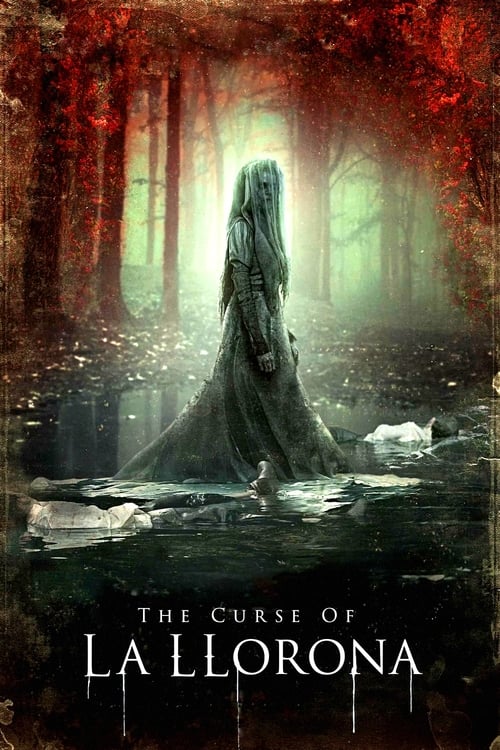
The Curse of La Llorona (2019)
Directed by Michael Chaves
No — The Curse of La Llorona is not woke, scoring 13 out of 100 on our wokeness meter.
The Curse of La Llorona carries the weight of a three-hundred-year-old folk legend and a Conjuring-adjacent pedigree, and it sets both down in 1973 Los Angeles.
Consciousness Markers
The cast is heavily Hispanic/Latino, with Patricia Velásquez, Raymond Cruz, and Marisol Ramirez in prominent roles, and the story is rooted in Mexican folklore — casting that is culturally appropriate rather than self-congratulatory, but it does put a non-white ensemble front and center.
The film engages Mexican folklore and a Hispanic community in 1970s Los Angeles, but it never interrogates race, immigration, or social inequality — the culture is texture, not argument.
A recently widowed single mother drives the narrative and the antagonist is a mother driven by grief, but the film treats these as horror mechanics rather than a feminist thesis.
The film is a jump-scare horror with no didactic messaging; any moralizing is limited to a brief 'a mother's love' beat.
No LGBTQ+ characters, themes, or subtext appear anywhere in the film.
No environmental or climate themes are present.
No economic critique or class commentary exists in the film.
No body-positivity themes or messaging appear.
No neurodivergent characters or themes are present.
The film is a supernatural folklore tale, not a historical narrative subject to revision.
Why it received this score
The Curse of La Llorona carries the weight of a three-hundred-year-old folk legend and a Conjuring-adjacent pedigree, and it sets both down in 1973 Los Angeles. The cast is overwhelmingly Latino, the myth is Mexican, and the film treats the supernatural as inherited business, the sort of thing a community knows about and a caseworker does not. Nobody stops to explain the culture to the viewer. Linda Cardellini's Anna is the outsider here, a widowed social worker who ignores a warning and pays for it. That inversion of the usual arrangement is quiet and effective, and it never announces itself as a virtue.
The film's emotional engine is maternal grief. Anna is a single mother holding a household together. Her antagonist is a mother who drowned her children and now wants replacements. Patricia, the client who unleashes the spirit, is another mother undone by loss. Three women, three versions of the same wound. The screenplay uses this as horror machinery, not as an argument, and the closest it comes to a thesis is a line about a mother's love near the end. The sermonizing is minimal, which suits a film built on jump scares and a curandero with a cross made from a tree.
The film does not interrogate anything. Race, immigration, and class in 1970s Los Angeles exist as backdrop, not as subject. There is no economic critique, no environmental concern, no advocacy of any kind, and the only lecture is delivered by a shaman instructing a family to keep their eyes on the water. It is a modest, efficient, critically dismissed chiller that opened at number one and made a great deal of money. The culture here is texture. Texture, it turns out, sells tickets.
Analysis generated by our Consciousness Algorithm


Synopsis
In 1970s Los Angeles, the legendary ghost La Llorona is stalking the night -- and the children. Ignoring the eerie warning of a troubled mother, a social worker and her own kids are drawn into a frightening supernatural realm. Their only hope of surviving La Llorona's deadly wrath is a disillusioned priest who practices mysticism to keep evil at bay.
Questions about The Curse of La Llorona
Is The Curse of La Llorona woke?
No — The Curse of La Llorona is not woke, scoring 13 out of 100 on our wokeness meter. That earns it a verdict of Ultra Based.
Does The Curse of La Llorona have any woke elements?
1 of the 10 markers register at 30 or above, led by Representation Casting (45). On Representation Casting: The cast is heavily Hispanic/Latino, with Patricia Velásquez, Raymond Cruz, and Marisol Ramirez in prominent roles, and the story is rooted in Mexican folklore — casting that is culturally appropriate rather than self-congratulatory, but it does put a non-white ensemble front and center.
How does The Curse of La Llorona compare to other 2019 movies?
It ranks #158 of the 284 films from 2019 we've scored; their average is 22. The wokest is Black Christmas (79).
How is the Woke Score calculated?
An AI-assisted process researches the film and its reception, scores it 0–100 on ten markers, then combines those into one 0–100 Woke Score. It measures a specific set of 2020s cultural themes, not film quality.