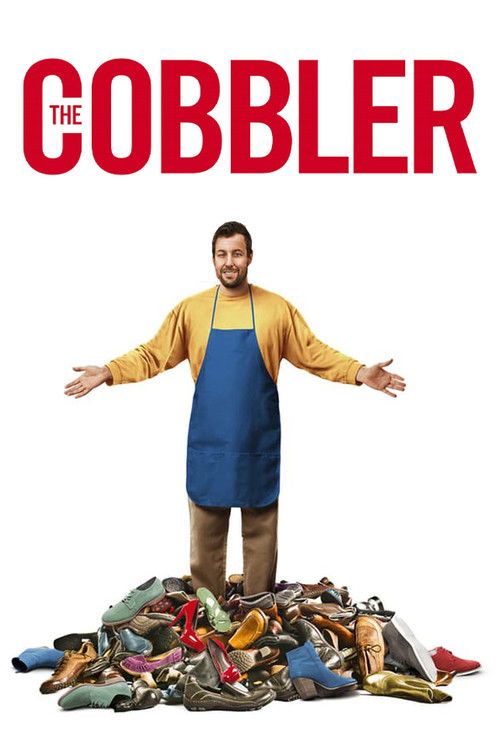
The Cobbler (2014)
Directed by Tom McCarthy
No — The Cobbler is not woke, scoring 15 out of 100 on our wokeness meter.
Tom McCarthy's The Cobbler arrives with an appealing premise: a sad shoemaker on the Lower East Side inherits a family stitching machine that lets him inhabit other people's bodies, provided he first inhabits their shoes.
Consciousness Markers
The gentrification subplot, the slumlord Elaine Greenawalt whose corruption is exposed, and the extortion of local businesses give the film a mild anti-greed, pro-neighborhood streak, though it is not framed as systemic class warfare.
The cast is moderately diverse (Method Man, Melonie Diaz, Dascha Polanco, Sondra James) and reflects a real Lower East Side milieu, but diversity is incidental set-dressing rather than a foregrounded representation statement.
The film gestures at a moral ('walking in another man's shoes') but delivers it softly through sentiment rather than explicit preaching.
Gentrification and a black gangster antagonist are present, but race is never examined as a subject; the Chinese-man impersonation gag is played purely for comedy, not consciousness.
Carmen is an activist fighting gentrification, but the film offers no gendered critique or feminist thesis; she serves mostly as a romantic interest and plot engine.
No LGBTQ+ characters, relationships, or themes appear anywhere in the film.
Climate change is entirely absent from the film.
No body-positivity themes or narratives are present.
No neurodivergence is depicted or discussed.
No historical revisionism; the early-1900s framing is period flavor for a family curse, not a re-reading of history.
Why it received this score
Tom McCarthy's The Cobbler arrives with an appealing premise: a sad shoemaker on the Lower East Side inherits a family stitching machine that lets him inhabit other people's bodies, provided he first inhabits their shoes. Adam Sandler plays Max Simkin with a hangdog weariness that suits the material, and the film keeps one foot in the Jewish immigrant history of its neighborhood. The supporting cast includes Method Man, Melonie Diaz, Dascha Polanco, and Sondra James, so the faces on screen reflect a genuine New York mix. That diversity functions as texture. It is not a statement, and nobody in the film treats it as one.
Politics enter through the side door. Carmen, played by Diaz, campaigns against developers tearing up the block, and a slumlord named Elaine Greenawalt eventually gets exposed and arrested for her treatment of tenants. The film carries a mild pro-neighborhood, anti-greed streak: local businesses are shaken down by a thug, the wealthy landlord is a villain, the little guy prevails. It never builds this into a systemic argument, and Carmen's activism serves mostly to give Max something to admire between scenes. A running gag in which Max impersonates a Chinese man in Chinatown is played entirely for laughs, with no awareness of itself as anything else.
Where the film might have lectured, it mostly sighs. The moral, about understanding others by occupying their lives, arrives through sentiment and a dying mother's happiness instead of a sermon. There are no queer characters, no meditation on the body, no neurodivergent perspective, no climate anxiety, and no attempt to rewrite the past. What we get is a gentle fantasy about empathy that critics rejected and audiences ignored. It was, by most accounts, the largest financial failure of Sandler's career. That is its own kind of cultural statement, though not the one anyone intended.
Analysis generated by our Consciousness Algorithm


Synopsis
Max Simkin repairs shoes in the same New York shop that has been in his family for generations. Disenchanted with the grind of daily life, Max stumbles upon a magical heirloom that allows him to step into the lives of his customers and see the world in a new way. Sometimes walking in another man's shoes is the only way one can discover who they really are.
Questions about The Cobbler
Is The Cobbler woke?
No — The Cobbler is not woke, scoring 15 out of 100 on our wokeness meter. That earns it a verdict of Ultra Based.
Does The Cobbler have any woke elements?
1 of the 10 markers register at 30 or above, led by Eat the Rich (35). On Eat the Rich: The gentrification subplot, the slumlord Elaine Greenawalt whose corruption is exposed, and the extortion of local businesses give the film a mild anti-greed, pro-neighborhood streak, though it is not framed as systemic class warfare.
How does The Cobbler compare to other 2014 movies?
It ranks #88 of the 303 films from 2014 we've scored; their average is 13. The wokest is Selma (68).
How is the Woke Score calculated?
An AI-assisted process researches the film and its reception, scores it 0–100 on ten markers, then combines those into one 0–100 Woke Score. It measures a specific set of 2020s cultural themes, not film quality.