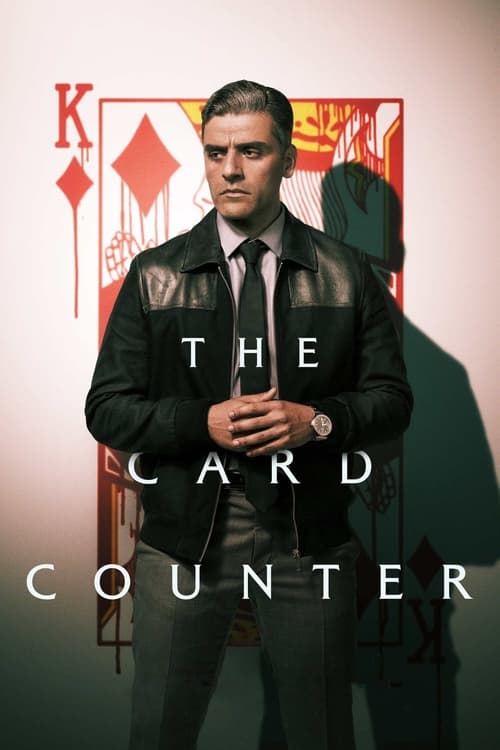
The Card Counter (2021)
Directed by Paul Schrader
No — The Card Counter is not woke, scoring 14 out of 100 on our wokeness meter.
Paul Schrader has spent a career arranging men in small rooms with their guilt, and The Card Counter continues the project with Oscar Isaac's William Tell, a former interrogator who plays modest poker hands and wraps motel furniture in bedsheets.
Consciousness Markers
The film dramatizes America's torture scandal and holds a decorated officer culpable for the rot he trained and escaped, which is a pointed revision of the tidy official narrative, though it works through fiction rather than historical reclamation.
Schrader is a sermonizer, and the film delivers mournful pronouncements about American guilt, complicity, and institutional evil, but the register is Calvinist confession rather than contemporary social instruction.
Tiffany Haddish, a Black woman, occupies the second lead as La Linda, and the cast is reasonably multiethnic, but none of this is framed, commented upon, or curated as representation. It's just casting.
The casino-and-WSOP world is portrayed as dreary, transactional, and soul-eroding, and the investors who stake gamblers are parasites by implication, but this is atmosphere and theme rather than an economic argument.
La Linda is a self-possessed professional who runs a gambling stable and negotiates on her own terms, but the film has no interest in gender politics and never argues a feminist thesis.
Abu Ghraib and its aftermath are central, but the lens is moral and psychological rather than racial; Mr. USA's jingoistic Ukrainian-bro persona is satirized as obnoxious nationalism, not as a racial critique.
No queer characters, relationships, subtext, or thematic engagement of any kind.
No environmental content whatsoever.
No engagement with body image, size, or physical self-acceptance.
Tell's asceticism, affect flattening, and buried trauma are read as guilt and dissociation, never as neurodivergence.
Why it received this score
Paul Schrader has spent a career arranging men in small rooms with their guilt, and The Card Counter continues the project with Oscar Isaac's William Tell, a former interrogator who plays modest poker hands and wraps motel furniture in bedsheets. The film's social consciousness registers as a low hum. Tiffany Haddish occupies the second lead as La Linda, a Black woman running a gambling stable, and the cast is agreeably multiethnic. None of it is curated. The film casts people and moves on, which in the current climate reads as almost negligent.
La Linda negotiates on her own terms and answers to no man in the room, though the screenplay never advances a thesis about gender and shows no interest in doing so. There is no queer presence of any kind. Abu Ghraib sits at the center of the story, but the lens is moral and psychological, a study of complicity and shame, not a racial critique. Mr. USA, the Ukrainian player in a jingoistic American costume, is mocked as obnoxious nationalism and nothing more. The casino circuit is rendered as dreary and transactional, its investors implied parasites, but this is atmosphere. Nobody hands out a pamphlet.
The film does revise the tidy official account of America's torture scandal, holding a decorated officer culpable for the rot he trained and escaped. Schrader remains a preacher, delivering mournful pronouncements about guilt and institutional evil in a register closer to Calvinist confession than to contemporary social instruction. Climate, body image, and neurodivergence go untouched. Tell's flat affect reads as buried trauma, not diagnosis. The result is a grim, well-made film that keeps its politics in the confessional booth, where they belong.
Analysis generated by our Consciousness Algorithm


Synopsis
William Tell just wants to play cards. His spartan existence on the casino trail is shattered when he is approached by Cirk, a vulnerable and angry young man seeking help to execute his plan for revenge on a military colonel. Tell sees a chance at redemption through his relationship with Cirk.
Questions about The Card Counter
Is The Card Counter woke?
No — The Card Counter is not woke, scoring 14 out of 100 on our wokeness meter. That earns it a verdict of Ultra Based.
Does The Card Counter have any woke elements?
Very few. None of the 10 markers reaches 30, the level where a marker counts as present; the highest is Lecture Energy at 25.
How does The Card Counter compare to other 2021 movies?
It ranks #142 of the 242 films from 2021 we've scored; their average is 23. The wokest is The Forever Purge (83).
How is the Woke Score calculated?
An AI-assisted process researches the film and its reception, scores it 0–100 on ten markers, then combines those into one 0–100 Woke Score. It measures a specific set of 2020s cultural themes, not film quality.