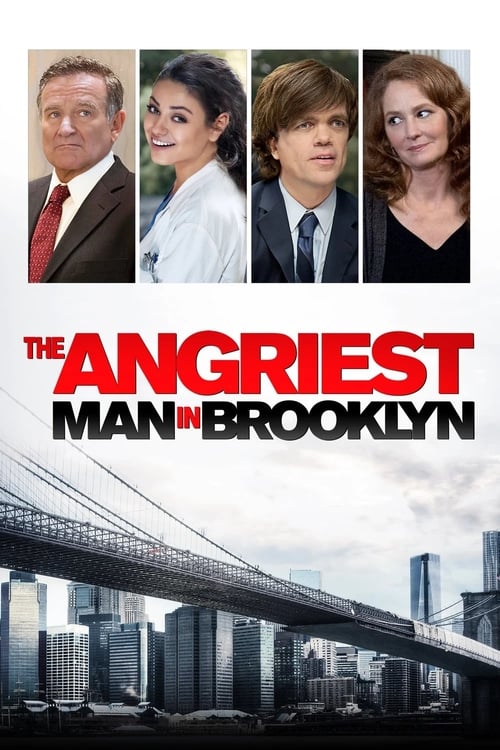
The Angriest Man in Brooklyn (2014)
Directed by Phil Alden Robinson
No — The Angriest Man in Brooklyn is not woke, scoring 5 out of 100 on our wokeness meter.
The Angriest Man in Brooklyn arrived in 2014 on a limited release and a video-on-demand lifeline, carrying the distinct air of a film nobody intended to see twice.
Consciousness Markers
The cast includes Mila Kunis, Peter Dinklage, Melissa Leo and James Earl Jones, providing incidental diversity, but no role is constructed around identity or representation commentary. The diverse faces simply exist in the story without note.
The film gestures at a life-lesson moral about living better and making amends, but it is sentimental character drama rather than preachy social instruction.
A woman plays a doctor and drives part of the plot, but she is largely defined by professional guilt and an affair. There is no feminist thesis or gender-power critique.
No LGBTQ+ characters, relationships, or themes appear anywhere in the plot or subtext.
The film engages no racial themes, commentary, or historical reckoning; the characters' conflicts are purely familial and personal.
There is no environmental content, imagery, or message whatsoever.
A family law firm appears in the background, but the film makes no argument about wealth, class, or capitalism.
Body image, size, and physical self-acceptance are never addressed as themes.
Henry's rage and bitterness are framed as grief and character flaws, not as neurodivergence or a condition to be destigmatized.
No historical events or figures are reinterpreted or corrected.
Why it received this score
The Angriest Man in Brooklyn arrived in 2014 on a limited release and a video-on-demand lifeline, carrying the distinct air of a film nobody intended to see twice. Phil Alden Robinson, who once directed Field of Dreams, here remakes a 1997 Israeli picture about a man informed he has ninety minutes to live. Robin Williams plays Henry Altmann, a Brooklyn attorney who spends those minutes insulting a cab driver, interrupting a deposition, and finding his wife otherwise engaged with the neighbor. The film holds a nine percent approval rating. The critical establishment was not gentle.
The supporting cast is admirably mixed. Mila Kunis plays Dr. Sharon Gill, who invents the ninety-minute figure out of panic and then spends the film chasing her patient to preserve her license. Peter Dinklage, Melissa Leo, and James Earl Jones appear in roles that require no commentary on who they are. This is incidental diversity, which is to say the faces are varied and the screenplay never notices. There is no LGBTQ content, no racial reckoning, no environmental concern, no argument about class, and no meditation on physical self-acceptance. Henry's bitterness is diagnosed as grief over a dead son, not as a condition deserving of destigmatization. The film rewrites no history. Its closing moral, that a man should mend fences before the clock runs out, arrives as sentimental drama, not as instruction.
What remains is a modest humanist exercise. A father learns to dance with his son again. A doctor learns something about honesty. The film means well, and meaning well is not a cultural position. We file it accordingly: sincere, forgettable, and innocent of the decade's ideological preoccupations.
Analysis generated by our Consciousness Algorithm


Synopsis
After learning that a brain aneurysm will kill him in about 90 minutes, a perpetually unhappy man struggles to come to terms with his fate and make amends with everyone he has ever hurt.
Questions about The Angriest Man in Brooklyn
Is The Angriest Man in Brooklyn woke?
No — The Angriest Man in Brooklyn is not woke, scoring 5 out of 100 on our wokeness meter. That earns it a verdict of Ultra Based.
Does The Angriest Man in Brooklyn have any woke elements?
Very few. None of the 10 markers reaches 30, the level where a marker counts as present; the highest is Representation Casting at 15.
How does The Angriest Man in Brooklyn compare to other 2014 movies?
It ranks #212 of the 303 films from 2014 we've scored; their average is 13. The wokest is Selma (68).
How is the Woke Score calculated?
An AI-assisted process researches the film and its reception, scores it 0–100 on ten markers, then combines those into one 0–100 Woke Score. It measures a specific set of 2020s cultural themes, not film quality.