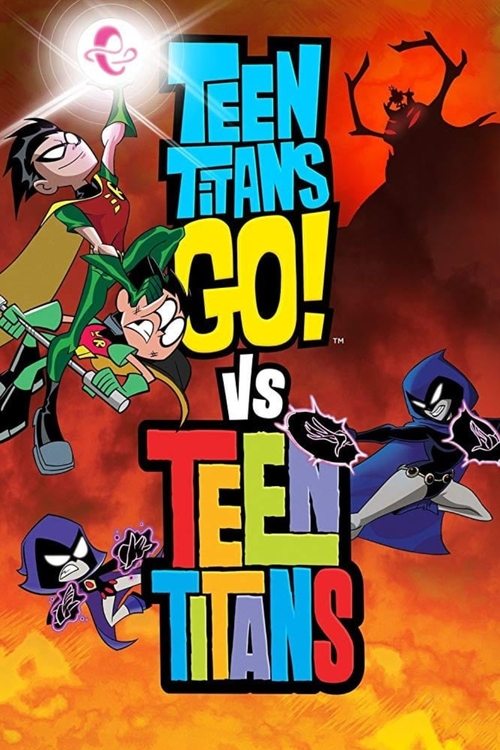
Teen Titans Go! vs. Teen Titans (2019)
Directed by Jeff Mednikow
No — Teen Titans Go! vs. Teen Titans is not woke, scoring 9 out of 100 on our wokeness meter.
The Teen Titans have always been a diverse outfit, and this crossover between the 2013 comedic quintet and their 2003 predecessors does nothing to disturb that inheritance.
Consciousness Markers
The ensemble is inherently diverse — a Black Cyborg, a female Starfire and Raven, and a multi-ethnic voice cast — but this is standard superhero-team composition rather than casting engineered around a representational thesis.
Raven and Starfire carry significant agency, and Raven's arc of accepting her demonic self has a self-actualization flavor, but the film makes no feminist argument and the story remains a boys-and-girls superhero brawl.
Cyborg's presence is simply inherited from the source material; the film engages in no racial commentary or consciousness whatsoever.
This is a gag-driven comedy crossover with essentially no moralizing or preachy monologues; any thematic content is delivered as jokes.
No LGBTQ+ characters, themes, or subtext appear anywhere in the multiverse-hopping plot.
No environmental or climate themes are present.
The film has no economic critique; its villains are demons, a game master, and Santa Claus.
No body-positivity themes or messaging appear.
No neurodivergence is depicted or discussed.
The film plays with multiverse continuity, not historical revisionism.
Why it received this score
The Teen Titans have always been a diverse outfit, and this crossover between the 2013 comedic quintet and their 2003 predecessors does nothing to disturb that inheritance. Cyborg is Black, Starfire and Raven are women, and the voice cast is suitably multi-ethnic. None of it is arranged around a thesis. The composition is simply what a superhero team looks like in the DC catalog, and the film treats it as furniture. We are not being instructed. We are being shown a bank robbery.
The plot sends both teams through the multiverse, pursued by Trigon, a second Trigon, a game master, and Santa Claus, who turns out to be a surprisingly physical antagonist. There is no economic critique here, no environmental sermon, no commentary on race, and no body-positivity messaging. Raven's arc, in which she learns to accept her demonic half, carries a faint self-actualization flavor, but the film makes no argument about gender and the story resolves as a boys-and-girls brawl with dragons. The moralizing that does occur arrives in the form of jokes, which is the preferable delivery system.
This is a gag-driven crossover that knows exactly what it is and declines to lecture anyone about it. The 100 percent approval rating on Rotten Tomatoes suggests audiences were grateful for the restraint. It is a sequel to two separate properties, adapted from comic books, and it features superheroes, all of which the classification ledger records without enthusiasm. A modest artifact. Pleasant, loud, and ideologically inert.
Analysis generated by our Consciousness Algorithm
Part of


Synopsis
The comedic modern-day quintet takes on their 2003 counterparts when villains from each of their worlds join forces to pit the two Titan teams against each other. They'll need to set aside their differences and work together to combat Trigon, Hexagon, Santa Claus (that's right, Santa!) and time itself in order to save the multiverse.
Questions about Teen Titans Go! vs. Teen Titans
Is Teen Titans Go! vs. Teen Titans woke?
No — Teen Titans Go! vs. Teen Titans is not woke, scoring 9 out of 100 on our wokeness meter. That earns it a verdict of Ultra Based.
Does Teen Titans Go! vs. Teen Titans have any woke elements?
1 of the 10 markers register at 30 or above, led by Representation Casting (35). On Representation Casting: The ensemble is inherently diverse — a Black Cyborg, a female Starfire and Raven, and a multi-ethnic voice cast — but this is standard superhero-team composition rather than casting engineered around a representational thesis.
How does Teen Titans Go! vs. Teen Titans compare to other 2019 movies?
It ranks #191 of the 284 films from 2019 we've scored; their average is 22. The wokest is Black Christmas (79).
How is the Woke Score calculated?
An AI-assisted process researches the film and its reception, scores it 0–100 on ten markers, then combines those into one 0–100 Woke Score. It measures a specific set of 2020s cultural themes, not film quality.