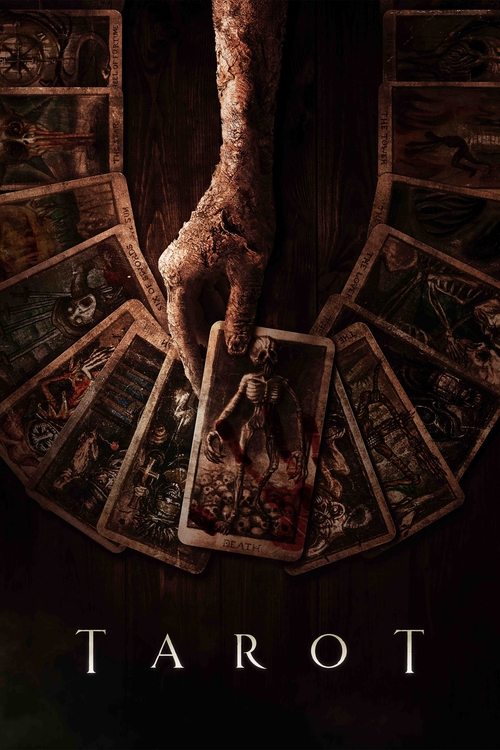
Tarot (2024)
Directed by Spenser Cohen
No — Tarot is not woke, scoring 9 out of 100 on our wokeness meter.
Tarot arrives with the modest ambition of a haunted deck of cards and the even more modest achievement of being a haunted deck of cards.
Consciousness Markers
The ensemble is notably diverse, with Black, South Asian, and Latino actors in prominent roles, but the film never comments on race or identity; they simply exist as generic horror victims.
A female lead and a female co-director are present, but the film advances no feminist themes or commentary; the women are standard slasher fodder.
No LGBTQ+ characters, relationships, or themes appear anywhere in the film.
Race is never addressed, thematized, or made meaningful in the narrative.
No environmental or climate themes whatsoever.
No economic critique or class commentary; the villain is a cursed tarot deck, not a system.
No body-positivity themes; bodies exist only to be gruesomely dispatched.
No neurodivergent characters or themes are present.
The 1798 Hungarian backstory is invented horror lore, not a revisionist reframing of real history.
The film makes no attempt to lecture or moralize; it is a straightforward supernatural slasher.
Why it received this score
Tarot arrives with the modest ambition of a haunted deck of cards and the even more modest achievement of being a haunted deck of cards. A group of college friends rents a mansion in the Catskills, ignores the single rule of tarot reading, and is subsequently dispatched one at a time by manifestations of their own fortunes. The ensemble is admirably varied, with Black, South Asian, and Latino performers filling out the roster of the doomed. The film never mentions this. Race is not a subject here; it is a staffing decision. Everyone dies with equal opportunity.
A female lead and a female co-director sit at the top of the call sheet, and the film does precisely nothing with either fact. The women are killed with the same impersonal efficiency as the men, which may be the most equitable thing about the production. There is no LGBTQ+ presence, no economic grievance, no climate anxiety, no body-positivity framing, no neurodivergent interiority, no attempt to reframe the historical record. The 1798 Hungarian backstory is invented folklore, not a corrective to anything. The villain is a cursed deck, not a system, which spares us the sermon.
The film does not lecture, and that is its lone act of restraint. It wants to kill its cast in inventive ways and then stop. Critics were unkind, audiences were tepid, and the box office was respectable enough for a production of modest means. We are left with a curious specimen: a horror film so devoid of messaging that it achieves a kind of purity. There is nothing to decode here. The cards say what they say, and then the credits roll.
Classification note: the film carries a single thematic tag, that of the literary adaptation, having been drawn from a 1992 young adult novel about horoscopes. It is not a sequel, not a remake, not a superhero picture, and it did not reach the top of the domestic chart, finishing fourth in its opening weekend. No statuettes were involved. The Academy, for once, showed mercy to everyone concerned, including itself. We file it accordingly and move on to the next vintage, which cannot possibly be worse and probably will be. Such is the calling. The cellar is deep, the palate is numb, and the work continues regardless, one cursed deck at a time, with the quiet dignity of a man who has tasted worse and expects to again before the season ends. The notes are entered. The bottle is corked. We descend further into the stacks, where the 2024 horror catalog awaits, patient and indifferent to our suffering, much like the cards themselves, which is perhaps the only thematic consistency the film can honestly claim.
The cards, being cards, do not care what we write about them. That is their power. It is also, in the end, the whole of their personality, and we must score them accordingly, without malice and without joy, as the profession demands. Another entry logged, another evening spent in the dark with strangers who deserved better fates and received worse ones, and a reviewer who will do it all again tomorrow because someone has to keep the ledger, and no one else has volunteered, and the darkness does not, in any case, review itself. The deck is shuffled. The verdict stands. We move on.
Analysis generated by our Consciousness Algorithm


Synopsis
When a group of friends recklessly violate the sacred rule of Tarot readings, they unknowingly unleash an unspeakable evil trapped within the cursed cards. One by one, they come face to face with fate and end up in a race against death.
Questions about Tarot
Is Tarot woke?
No — Tarot is not woke, scoring 9 out of 100 on our wokeness meter. That earns it a verdict of Ultra Based.
Does Tarot have any woke elements?
Very few. None of the 10 markers reaches 30, the level where a marker counts as present; the highest is Representation Casting at 20.
How does Tarot compare to other 2024 movies?
It ranks #142 of the 189 films from 2024 we've scored; their average is 22. The wokest is The Six Triple Eight (92).
How is the Woke Score calculated?
An AI-assisted process researches the film and its reception, scores it 0–100 on ten markers, then combines those into one 0–100 Woke Score. It measures a specific set of 2020s cultural themes, not film quality.