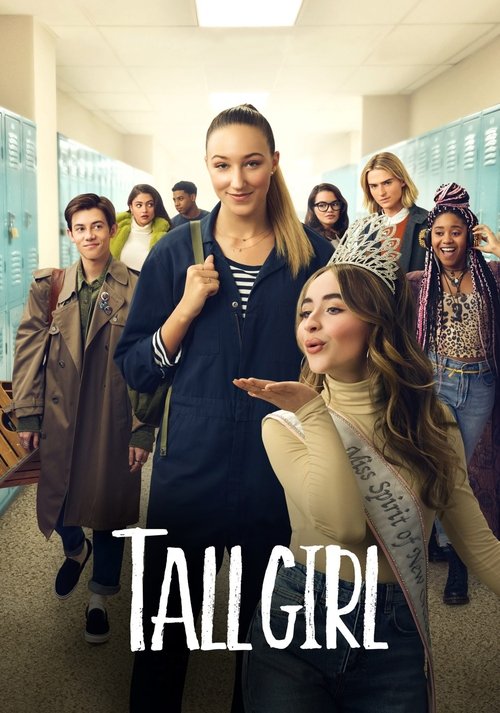
Tall Girl (2019)
Directed by Nzingha Stewart
No — Tall Girl is not especially woke, scoring 34 out of 100 on our wokeness meter.
Jodi Kreyman has been tall since she was three, and the film opens with the accumulated indignities of that condition: the slouching, the jokes, the boys who will not look up.
Consciousness Markers
The entire premise concerns a girl learning to accept her unconventional body (her height), rejecting slouching and shame to 'stand tall' — a clear, if height-specific, body-acceptance message.
A notably diverse ensemble for a teen rom-com, including a Black director (Nzingha Stewart) and Black supporting players (Anjelika Washington as Fareeda), though the casting is presented naturally rather than as a statement.
The film centers a female protagonist's self-confidence journey and features a female director, but its empowerment message is generic teen-movie fare rather than an explicit feminist agenda.
The climactic homecoming speech about self-confidence delivers a mild moral lesson, but the film mostly plays its message through plot rather than preaching.
No LGBTQ+ characters or themes appear anywhere in the film; the romance plot is entirely heterosexual.
Despite a diverse cast, the film engages in no racial commentary or consciousness; race is simply not a subject of the story.
No environmental or climate themes are present.
No economic or class-based critique exists; the film is a conventional Netflix teen romance.
No neurodivergent characters or themes are depicted.
The film is a contemporary fictional story with no historical subject matter to revise.
Why it received this score
Jodi Kreyman has been tall since she was three, and the film opens with the accumulated indignities of that condition: the slouching, the jokes, the boys who will not look up. Her arc is a body-acceptance parable, handled with sincerity. The complication is that the body in question is height, a trait carrying none of the cultural freight the genre usually assigns to such stories, so the lesson arrives pre-softened. Netflix released it in 2019 to mixed notices, and a sequel followed in due course. Nzingha Stewart directs with a clean, unobtrusive competence.
The ensemble is diverse in a manner that feels lived-in. Black performers occupy real roles, the director is a Black woman, and the film never pauses to congratulate itself for any of it. That restraint is worth something. Equally notable is what the film declines to engage: there is no queer presence at all, the romances running strictly boy-meets-girl. Race is present on screen and absent as a subject. Climate, class, and the economic order go unmentioned, which for a Netflix teen romance is neither surprising nor damning.
The climax arrives at homecoming, where Jodi delivers a speech about standing tall, a mild moral delivered with a straight face. Most of the message is carried by plot instead of podium, which keeps the sermonizing brief and tolerable. The final image, a boy producing a milk crate so he can reach her, is the film's best idea. It is a small, tidy, harmless picture that knows its lane and stays in it.
Analysis generated by our Consciousness Algorithm


Synopsis
Jodi, the tallest girl in her high school, has always felt uncomfortable in her own skin. But after years of slouching, being made fun of, and avoiding attention at all costs, Jodi finally decides to find the confidence to stand tall.
Questions about Tall Girl
Is Tall Girl woke?
No — Tall Girl is not especially woke, scoring 34 out of 100 on our wokeness meter. That earns it a verdict of Based.
Does Tall Girl have any woke elements?
3 of the 10 markers register at 30 or above, led by Body Positivity (60), Representation Casting (42) and Feminist Agenda (30). On Body Positivity: The entire premise concerns a girl learning to accept her unconventional body (her height), rejecting slouching and shame to 'stand tall' — a clear, if height-specific, body-acceptance message.
How does Tall Girl compare to other 2019 movies?
It ranks #67 of the 284 films from 2019 we've scored; their average is 22. The wokest is Black Christmas (79).
How is the Woke Score calculated?
An AI-assisted process researches the film and its reception, scores it 0–100 on ten markers, then combines those into one 0–100 Woke Score. It measures a specific set of 2020s cultural themes, not film quality.