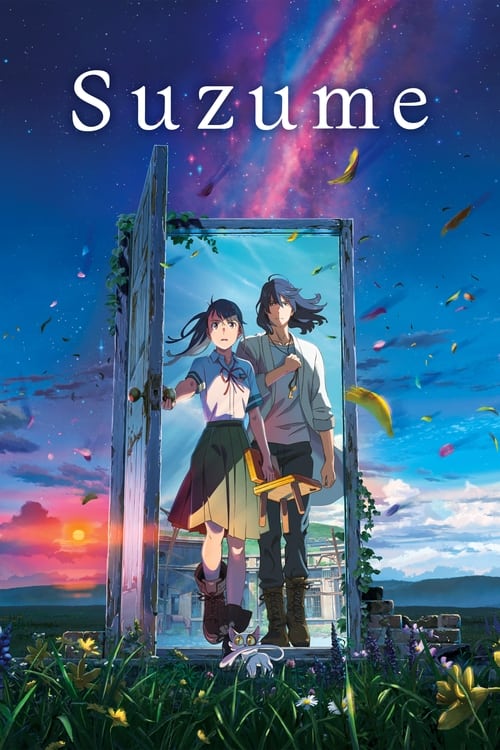
Suzume (2022)
Directed by Makoto Shinkai
No — Suzume is not woke, scoring 6 out of 100 on our wokeness meter.
Makoto Shinkai's Suzume concerns a seventeen-year-old girl, a cursed wooden chair, and a supernatural worm that must be locked behind doors in abandoned places across Japan.
Consciousness Markers
The film centers on a teenage girl and her aunt, but it does not advance an explicit feminist agenda or critique patriarchal structures.
The film carries emotional themes about disaster memory and mourning, but it does not lecture the audience on social or political issues.
Japanese production with an all-Japanese voice cast; no deliberate diversity casting in the modern woke sense.
No LGBTQ+ themes or characters appear in the final film.
No racial consciousness or racial justice themes are present.
Natural disasters and abandoned places feature in the story, but climate change activism or environmental crusading is absent.
No eat-the-rich or anti-capitalist messaging is present.
No body positivity themes or messaging are present.
No neurodivergence themes or representation are present.
The film references real earthquakes, including the 2011 Tōhoku disaster, but does not revise or reinterpret history in a woke manner.
Why it received this score
Makoto Shinkai's Suzume concerns a seventeen-year-old girl, a cursed wooden chair, and a supernatural worm that must be locked behind doors in abandoned places across Japan. The film is the third entry in what the director has termed his disaster trilogy, and it carries the weight of the 2011 Tohoku earthquake the way a sommelier carries a decanter: carefully, and with an awareness that the contents will be examined. There are abandoned onsen resorts, a shuttered school, a ferris wheel that no longer turns. The camera lingers on these ruins not to indict anyone but to mourn them. Mourning is not a political program.
Viewers hoping for the familiar apparatus of contemporary social consciousness will leave unsatisfied. The cast is Japanese, the concerns are Japanese, and the film has no interest in auditing its own demographics. The heroine's journey is driven by grief and curiosity, not by an argument about the structures that shaped her. Her aunt Tamaki offers the film's most pointed adult perspective, and even she is permitted to be tired and resentful instead of correct. A roadside bartender, a boy on a moped, a cat of ambiguous moral standing: these are characters, not positions. The chair, for its part, is a chair.
Where the film does lean toward instruction, it does so gently. The closing passages ask us to remember what the earthquake took, and to hold that memory against the slow erosion of time. This is sentiment, not sermon. There are no villains in the economic sense, no lectures on consumption, no manifesto tucked into the third act. It is a road movie about sealing doors, and it stays on the road. We are left with craftsmanship, a swollen runtime, and the quiet conviction that some things should be remembered simply because they happened.
Analysis generated by our Consciousness Algorithm


Synopsis
Suzume, 17, lost her mother as a little girl. On her way to school, she meets a mysterious young man. But her curiosity unleashes a calamity that endangers the entire population of Japan, and so Suzume embarks on a journey to set things right.
Questions about Suzume
Is Suzume woke?
No — Suzume is not woke, scoring 6 out of 100 on our wokeness meter. That earns it a verdict of Ultra Based.
Does Suzume have any woke elements?
Very few. None of the 10 markers reaches 30, the level where a marker counts as present; the highest is Feminist Agenda at 10.
How does Suzume compare to other 2022 movies?
It ranks #190 of the 223 films from 2022 we've scored; their average is 22. The wokest is Bros (92).
How is the Woke Score calculated?
An AI-assisted process researches the film and its reception, scores it 0–100 on ten markers, then combines those into one 0–100 Woke Score. It measures a specific set of 2020s cultural themes, not film quality.