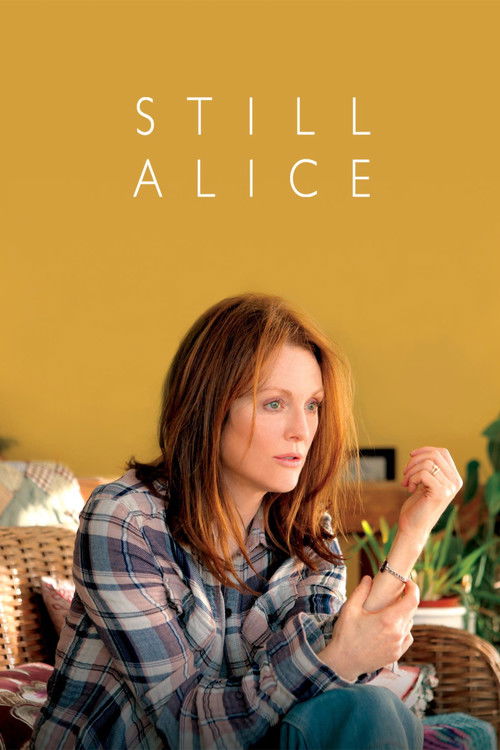
Still Alice (2014)
Directed by Wash Westmoreland
No — Still Alice is not woke, scoring 8 out of 100 on our wokeness meter.
Still Alice concerns itself with a Columbia linguistics professor who forgets a word mid-lecture and then, over the following months, forgets nearly everything else.
Consciousness Markers
The film carries a disease-awareness message, culminating in a conference speech about living with Alzheimer's, but its didacticism is medical/emotional rather than social-justice oriented.
The film centers a woman's professional identity and her struggle to retain it, but it does so as a family tragedy rather than a feminist statement. No explicit gender-politics agenda.
The cast is overwhelmingly white, with a single Black actor (Seth Gilliam) in a minor supporting role as a doctor. No deliberate diverse casting agenda is evident.
Alzheimer's is a neurodegenerative disease treated as tragedy, not the neurodiversity paradigm of autism/ADHD identity. The cognitive theme is present but does not map onto the modern neurodivergence marker.
No LGBTQ+ characters or themes appear anywhere in the narrative.
Race is entirely absent as a theme; the story is a white upper-middle-class family drama with no racial commentary.
No environmental or climate themes are present.
No critique of capitalism, wealth, or class structures; the affluent Howland family is presented sympathetically without economic commentary.
No body-positivity themes; the film concerns cognitive decline, not body image or size acceptance.
No revisionist or reframed historical narrative; the film is a contemporary fictional drama.
Why it received this score
Still Alice concerns itself with a Columbia linguistics professor who forgets a word mid-lecture and then, over the following months, forgets nearly everything else. Julianne Moore plays her with a restraint that has been exhaustively praised, and the praise is warranted. The film is a domestic tragedy of the most traditional kind: a marriage strained, children tested, a career dissolved by biology. It is very sad and very well acted, and it has almost nothing to say about the social order in which any of this occurs.
The picture does grant its heroine a professional identity, and it mourns the loss of that identity with some conviction. Alice defines herself by her mind, by her work at a university, and the disease strips both away. This registers as a portrait of a woman, not an argument about women, and the film never reaches for a broader claim. The same caution applies to its treatment of cognitive decline, which is rendered as medical catastrophe and family grief, never as identity or community. The disease-awareness instinct does surface, most visibly in a conference speech Alice delivers with a highlighter in hand, tracking her own progress down the page. The scene is moving. It is also a public service announcement wearing a good coat.
What the film omits is nearly as complete as what it includes. There is no racial consciousness, no queer presence, no environmental concern, no critique of the comfortable wealth the Howlands inhabit, no body politics, no reframing of history. The single Black performer in the cast appears briefly as a doctor. This is a 2014 prestige drama of an older lineage, and it behaves accordingly. Moore won an Academy Award for it. The film around her stays quiet.
Analysis generated by our Consciousness Algorithm


Synopsis
Alice Howland, happily married with three grown children, is a renowned linguistics professor who starts to forget words. When she receives a devastating diagnosis, Alice and her family find their bonds tested.
Questions about Still Alice
Is Still Alice woke?
No — Still Alice is not woke, scoring 8 out of 100 on our wokeness meter. That earns it a verdict of Ultra Based.
Does Still Alice have any woke elements?
Very few. None of the 10 markers reaches 30, the level where a marker counts as present; the highest is Lecture Energy at 20.
How does Still Alice compare to other 2014 movies?
It ranks #155 of the 303 films from 2014 we've scored; their average is 13. The wokest is Selma (68).
How is the Woke Score calculated?
An AI-assisted process researches the film and its reception, scores it 0–100 on ten markers, then combines those into one 0–100 Woke Score. It measures a specific set of 2020s cultural themes, not film quality.