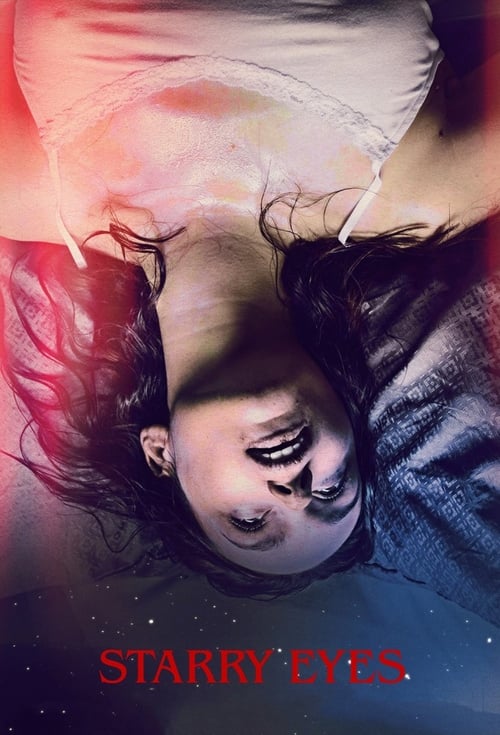
Starry Eyes (2014)
Directed by Kevin Kölsch
No — Starry Eyes is not woke, scoring 17 out of 100 on our wokeness meter.
Starry Eyes presents a particularly grim taxonomy of professional ambition within the entertainment sector.
Consciousness Markers
The Hollywood elite are depicted as a literal demon-worshipping cult that feeds on the vulnerable in exchange for fame, offering a pointed critique of the powerful entertainment industry exploiting the desperate.
The film centers a woman's experience and critiques the sexual exploitation of aspiring actresses via the casting couch and a producer demanding sex for roles, though it frames this through body-horror rather than explicit feminist argument.
The film gestures at themes of ambition and exploitation but delivers them through visceral horror rather than preachy moralizing or direct address.
The cast is almost entirely white, with a female lead in Alex Essoe; there is no meaningful diverse or inclusive casting to speak of.
No LGBTQ+ characters, themes, or subtext appear anywhere in the film.
Race is entirely absent as a theme; the story engages no racial dynamics or commentary.
There is no environmental or climate-related content in the film.
The film is body horror in the opposite direction, dwelling on the protagonist's grotesque physical deterioration, hair loss, and maggot-vomiting rather than any body-positive message.
No neurodivergent characters or themes are present.
The film is a fictional horror story with no historical subject matter to revise.
Why it received this score
Starry Eyes presents a particularly grim taxonomy of professional ambition within the entertainment sector. We witness an aspiring actress whose journey quickly descends from the promise of stardom into a visceral nightmare of bodily decay and occult exploitation. The film offers a stark, albeit highly stylized, critique of Hollywood's predatory mechanisms, portraying the elite as a decadent, secret cult that demands grotesque sacrifices for access to the industry's gilded promise. Its commentary on the exploitation of the vulnerable remains pointed, though the narrative chooses body horror over direct social commentary. The thematic weight rests on Sarah Walker's descent, a path paved with diminishing self-worth and physical deterioration.
When evaluating the film through a lens of contemporary social awareness, it presents a remarkably limited view. The cast remains almost exclusively white, which restricts the scope of any progressive sensibilities the film attempts to project. There is zero engagement with themes of racial dynamics, climate change, or modern progressive identity politics. The film avoids a preachy approach to its themes; the exploitation is shown through increasingly horrific physical and psychological circumstances instead of through direct moralizing. While the protagonist's experience with exploitation is the film's central axis, the lack of diversity or external progressive frameworks keeps the overall level of cultural awareness low.
This is a picture concerned with the cost of fame, a dark fable about the price of ascent. It is not concerned with the contemporary demands of social consciousness. It functions as a bleak, uncompromising piece of genre filmmaking. We observe the mechanics of Hollywood's darker impulses, a necessary but ultimately contained exploration of systemic greed. The visceral horror serves as the primary vehicle for its critique, a self-contained descent that satisfies the desire for darkness while failing to engage with broader cultural conversations.
Analysis generated by our Consciousness Algorithm


Synopsis
A hopeful young starlet uncovers the ominous origins of the Hollywood elite and enters into a deadly agreement in exchange for fame and fortune.
Questions about Starry Eyes
Is Starry Eyes woke?
No — Starry Eyes is not woke, scoring 17 out of 100 on our wokeness meter. That earns it a verdict of Ultra Based.
Does Starry Eyes have any woke elements?
2 of the 10 markers register at 30 or above, led by Eat the Rich (35) and Feminist Agenda (30). On Eat the Rich: The Hollywood elite are depicted as a literal demon-worshipping cult that feeds on the vulnerable in exchange for fame, offering a pointed critique of the powerful entertainment industry exploiting the desperate.
How does Starry Eyes compare to other 2014 movies?
It ranks #73 of the 303 films from 2014 we've scored; their average is 13. The wokest is Selma (68).
How is the Woke Score calculated?
An AI-assisted process researches the film and its reception, scores it 0–100 on ten markers, then combines those into one 0–100 Woke Score. It measures a specific set of 2020s cultural themes, not film quality.