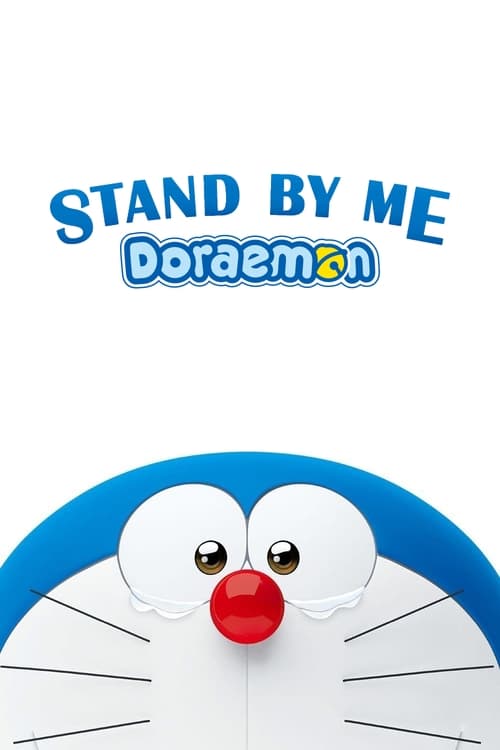
Stand by Me Doraemon (2014)
Directed by Takashi Yamazaki
No — Stand by Me Doraemon is not woke, scoring 3 out of 100 on our wokeness meter.
Stand by Me Doraemon arrives as a CGI retelling of assorted chapters from a manga that has been in print since 1969, stitching the origin of the robotic cat and his eventual farewell into a single sentimental arc.
Consciousness Markers
The film offers gentle moral lessons about hard work, friendship, and not over-relying on gadgets, but these are sentimental humanist beats rather than didactic social lecturing.
The narrative centers on Nobita's pursuit of Shizuka and his desire to marry her, culminating in a marriage-proposal subplot; Shizuka is largely a romantic objective rather than a vehicle for any feminist agenda.
An entirely Japanese-produced animated feature with a homogenous cast of characters originating from the long-running manga; there is no deliberate diverse-casting effort in the modern sense.
No same-sex relationships, queer characters, or LGBTQ+ themes appear anywhere in the story.
A cast of Japanese schoolchildren with no engagement with race, racism, or racial identity as themes.
No environmental or climate themes present.
No critique of capitalism, wealth inequality, or economic systems; the story is a personal coming-of-age tale.
No body-image, self-acceptance, or size-diversity messaging of any kind.
Nobita is characterized as lazy and a poor student, not as neurodivergent; no autism, ADHD, or similar framing appears.
Though an adaptation of several manga chapters, it presents the canonical origin and farewell story without reinterpreting historical events.
Why it received this score
Stand by Me Doraemon arrives as a CGI retelling of assorted chapters from a manga that has been in print since 1969, stitching the origin of the robotic cat and his eventual farewell into a single sentimental arc. It was, by any commercial measure, a juggernaut, the highest-grossing entry in the franchise and a fixture atop the Japanese box office for five consecutive weeks. The film concerns Nobita Nobi, a fifth grader of negligible academic promise, and the time-traveling cat dispatched from the twenty-second century to salvage his descendants from a future of debt and disappointment.
The narrative engine is Nobita's courtship of Shizuka, a classmate who functions less as a character than as a destination. She is the prize, the corrected future, the woman he must earn through study and eventually a proposal on a snowy mountain. Her father's approval is sought and granted. She says yes. That is the extent of her interior life. The film's lessons lean gentle: work hard, cherish your friends, avoid becoming overly reliant on gadgets. These are the moral beats of a bedtime story, delivered without a raised voice or a pointed finger.
What we have, then, is family entertainment of the old school, warm and commercially calculating in equal measure. It asks nothing of the audience beyond tears at the appointed moments. There is no social program tucked into the gadget pouch, no sermon on the structures of the world, no instruction on how we ought to rearrange ourselves. Just a boy, a cat, and a girl who exists to be married. The film is content to be exactly that, and the film is not wrong to be so.
Thematic tags: book_adaptation.
Analysis generated by our Consciousness Algorithm


Synopsis
Sewashi and Doraemon find themselves way back in time and meet Nobita. It is up to Doraemon to take care of Nobita or else he will not return to the present.
Questions about Stand by Me Doraemon
Is Stand by Me Doraemon woke?
No — Stand by Me Doraemon is not woke, scoring 3 out of 100 on our wokeness meter. That earns it a verdict of Ultra Based.
Does Stand by Me Doraemon have any woke elements?
Very few. None of the 10 markers reaches 30, the level where a marker counts as present; the highest is Lecture Energy at 8.
How does Stand by Me Doraemon compare to other 2014 movies?
It ranks #256 of the 303 films from 2014 we've scored; their average is 13. The wokest is Selma (68).
How is the Woke Score calculated?
An AI-assisted process researches the film and its reception, scores it 0–100 on ten markers, then combines those into one 0–100 Woke Score. It measures a specific set of 2020s cultural themes, not film quality.