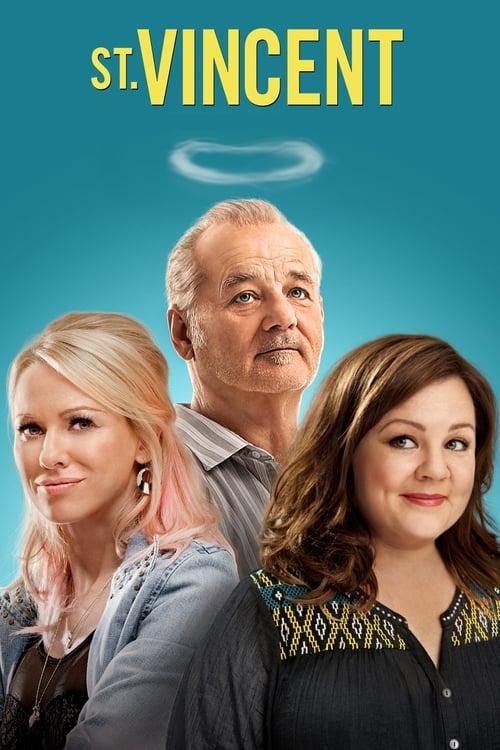
St. Vincent (2014)
Directed by Theodore Melfi
No — St. Vincent is not woke, scoring 9 out of 100 on our wokeness meter.
St. Vincent arrives with the tired confidence of a film that knows precisely which buttons it intends to press.
Consciousness Markers
The cast includes Terrence Howard as a loan shark and Maria Elena Ramirez as a nanny, with Naomi Watts playing a Russian immigrant, but these are largely incidental to a character study centered on a white veteran and a white boy.
The climactic 'Saints Among Us' assembly speech delivers a sentimental moral about commitment, dedication, and sacrifice, but it plays as warm-hearted homily rather than ideological preaching.
Melissa McCarthy's Maggie is a hardworking single mother navigating a bitter divorce and custody battle, but the film is ultimately a male-centered redemption story told through Vincent's and Oliver's arcs.
Vincent's gambling debts, the loan sharks who threaten him, and the nursing-home fees he cannot pay gesture at economic precarity, but the film treats these as personal misfortune rather than systemic critique.
No LGBTQ+ characters or themes appear anywhere in the film.
Race is never a subject of the narrative; the diverse supporting players exist without commentary.
There is no environmental or climate content in the film.
No body-positivity themes or messaging are present.
Oliver is described as intelligent and kind, but the film makes no explicit neurodivergence narrative.
The Vietnam War is referenced only as biographical backstory for Vincent; no historical revisionism is attempted.
Why it received this score
St. Vincent arrives with the tired confidence of a film that knows precisely which buttons it intends to press. Bill Murray plays Vincent MacKenna, a misanthropic Vietnam veteran in Sheepshead Bay who smokes, gambles, drinks, and swears, and who becomes redeemable the moment a small boy needs a babysitter. The machinery shows in the first frame. A divorced mother works late shifts. A lonely child requires supervision. A gruff neighbor with a buried heart answers the call. Theodore Melfi writes and directs with a sentimental streak he never apologizes for, and the result is warm, watchable, and thoroughly familiar.
The supporting cast supplies variety without comment. Terrence Howard menaces as a loan shark, Naomi Watts labors under a Russian accent as a pregnant sex worker, and Maria Elena Ramirez appears as a nanny. They are texture around a white veteran and a white boy, and the film never asks a question about any of it. Melissa McCarthy's Maggie carries a bitter divorce and a custody battle with genuine fatigue, though the story's affections belong to Vincent and to Oliver. Race stays off the table entirely. So does the environment, the body, the mind, and the historical record, all of which the film declines to notice.
Money troubles do surface: gambling debts, threatening collectors, nursing-home fees Vincent cannot pay. The film frames these as one man's bad luck, not as a system worth examining. The closing assembly speech, in which Oliver nominates Vincent for sainthood on grounds of commitment, dedication, and sacrifice, lands as a warm homily. It wants a tear, not a conversion. St. Vincent is a gentle film about a difficult man, and gentle is the operative word. It preaches softly, to no one in particular, and mostly to itself.
{"thematic_tags": []}
Analysis generated by our Consciousness Algorithm


Synopsis
A young boy whose parents just divorced finds an unlikely friend and mentor in the misanthropic, bawdy, hedonistic, war veteran who lives next door.
Questions about St. Vincent
Is St. Vincent woke?
No — St. Vincent is not woke, scoring 9 out of 100 on our wokeness meter. That earns it a verdict of Ultra Based.
Does St. Vincent have any woke elements?
Very few. None of the 10 markers reaches 30, the level where a marker counts as present; the highest is Representation Casting at 20.
How does St. Vincent compare to other 2014 movies?
It ranks #139 of the 303 films from 2014 we've scored; their average is 13. The wokest is Selma (68).
How is the Woke Score calculated?
An AI-assisted process researches the film and its reception, scores it 0–100 on ten markers, then combines those into one 0–100 Woke Score. It measures a specific set of 2020s cultural themes, not film quality.