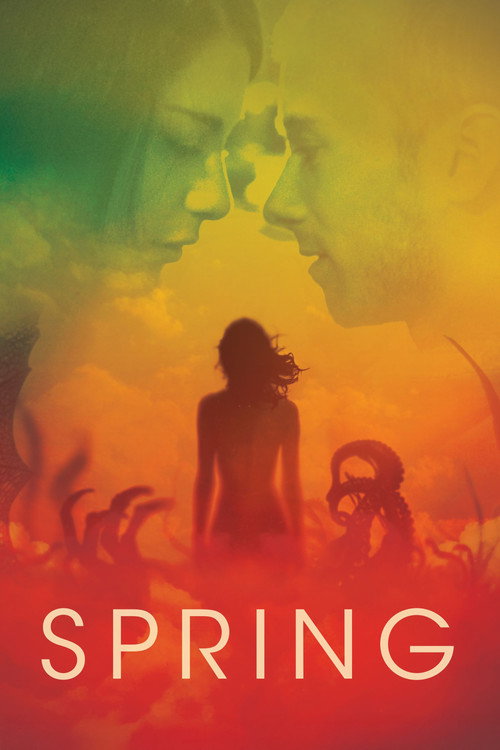
Spring (2014)
Directed by Aaron Moorhead
No — Spring is not woke, scoring 4 out of 100 on our wokeness meter.
Spring arrives from 2014, a year when a romantic horror film could still be about a man falling for a two-thousand-year-old mutant in southern Italy and nothing else.
Consciousness Markers
Louise possesses immense power and autonomy, though this power is rooted in her monstrous, non-human biology rather than a social critique.
The film features a predominantly white cast and setting, offering minimal commentary on diverse representation.
The subplot of Evan working illegally on a farm offers a minor, tangential nod to labor issues.
The film draws upon ancient myths and history (Pompeii, 2000-year-old entity) but does not offer a modern, progressive revision of those narratives.
There are no discernible LGBTQ+ themes or characters present in the narrative.
The film does not engage with issues of race or racial injustice.
While set in Italy, the narrative focuses on biological mutation and immortality, not environmental activism or climate change.
The film utilizes body horror to depict Louise's grotesque mutations, which is a critique of form, not an affirmation of body positivity.
There is no evidence of characters exhibiting neurodivergent traits.
The dialogue is atmospheric and existential, lacking the didactic, lecture-style delivery associated with modern social commentary.
Why it received this score
Spring arrives from 2014, a year when a romantic horror film could still be about a man falling for a two-thousand-year-old mutant in southern Italy and nothing else. Evan, freshly orphaned and unemployed, flees to a small town, takes illegal work on a farm, and courts Louise, who sheds her skin every twentieth spring into an octopus, a reptile, or something worse. The camera regards her transformations with genuine revulsion. This is body horror as a study of form, not an affirmation of it. The film has no interest in telling us how to feel about our bodies. It only wants to show us one that refuses to stay put.
On the matter of modern social consciousness, the film is a near-total blank, and it seems content to be so. Its cast is white, its setting Italian, and its screenplay never pauses to interrogate either fact. Race goes unmentioned. So does climate, despite a volcano that eventually makes its presence known. There is a brief nod toward labor, in Evan's undocumented farm work and the immigration police who scatter the crew, but the film treats this as plot machinery, not as an argument. Louise holds enormous power and wields it without apology, though the power flows from her biology and not from any social thesis.
No LGBTQ+ themes surface. No neurodivergent characters appear. The film borrows Pompeii and ancient myth for atmosphere, and it revises nothing. It offers mood instead, patience, and a willingness to let its monster remain monstrous. It never lectures. No character explains the correct politics of the moment. No sermon is delivered over a kitchen table. For audiences conditioned to expect such things, the silence may register as an absence. For the rest of us, it reads as confidence. The volcano erupts. Nobody learns a lesson about representation. The credits roll. We are left with a strange, quiet romance about a woman who will not surrender her immortality for anyone, which is its own kind of statement, though not the kind that files neatly under anything.
Analysis generated by our Consciousness Algorithm


Synopsis
A young man in a personal tailspin flees the US to Italy, where he sparks up a romance with a woman harboring a dark, primordial secret.
Questions about Spring
Is Spring woke?
No — Spring is not woke, scoring 4 out of 100 on our wokeness meter. That earns it a verdict of Ultra Based.
Does Spring have any woke elements?
Very few. None of the 10 markers reaches 30, the level where a marker counts as present; the highest is Feminist Agenda at 10.
How does Spring compare to other 2014 movies?
It ranks #224 of the 303 films from 2014 we've scored; their average is 13. The wokest is Selma (68).
How is the Woke Score calculated?
An AI-assisted process researches the film and its reception, scores it 0–100 on ten markers, then combines those into one 0–100 Woke Score. It measures a specific set of 2020s cultural themes, not film quality.