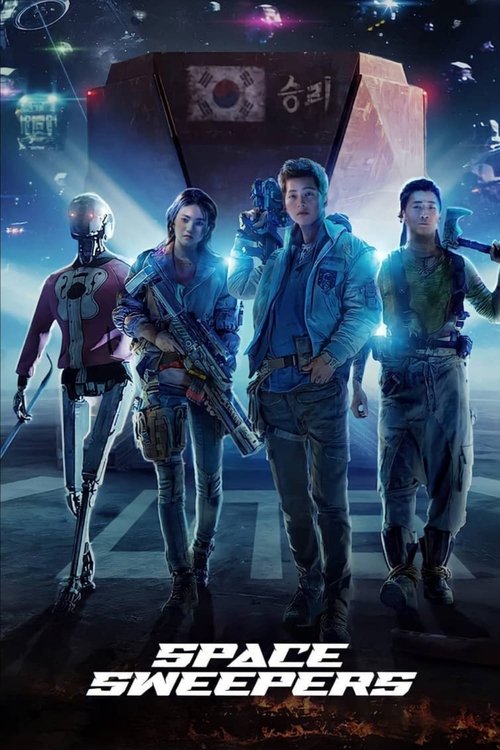
Space Sweepers (2021)
Directed by Jo Sung-hee
Partly — Space Sweepers is somewhat woke, scoring 57 out of 100 on our wokeness meter.
Space Sweepers arrives as the first Korean space blockbuster, a distinction it wears lightly, and spends most of its runtime sorting through the wreckage of a dying planet.
Consciousness Markers
The film explicitly criticizes capitalism: the UTS corporation hoards an idyllic off-world existence for the wealthy while 90% of humanity languishes in poverty, and the Mars colonization plot is likened to billionaires prepping for the apocalypse.
The cast is deliberately polyglot and multinational, with characters from dissolved nations speaking a mix of native languages and English reserved for the white power structure; critics singled out its 'casual multiculturalism' as more international than most Hollywood blockbusters.
Earth is rendered uninhabitable by ecological collapse, the 'Black Foxes' are revealed to be environmentalists rather than terrorists, and the nanobots' potential to restore the planet is the central MacGuffin.
The film positions English as the language of power and its chief antagonist as a white UTS CEO, while a multiethnic underclass of refugees and spacers is massacred and framed; the racial hierarchy of the orbital utopia is a visible subtext.
The android Bubs is coded as a trans figure, saving for a costly 'skin graft' to obtain a body matching their identity, and the film's resolution grants Bubs a female human form; critics explicitly framed this as transgender representation and a critique of barriers to trans healthcare.
Captain Jang is a former Special Forces officer turned pirate leader who commands the crew and drives the action, providing a genuine female authority figure, though the film does not foreground a feminist thesis.
The capitalist critique and environmentalist reveal are present but delivered through plot mechanics and villainy rather than direct sermonizing, keeping the tone closer to a space adventure than a lecture.
No evidence of body-positivity themes; Bubs' desire for a new body is framed through trans-identity and labor exploitation rather than body acceptance.
No characters or themes addressing neurodivergence are present.
The film is set in a fictional 2092 and makes no revisionist claims about real historical events.
Why it received this score
Space Sweepers arrives as the first Korean space blockbuster, a distinction it wears lightly, and spends most of its runtime sorting through the wreckage of a dying planet. The crew of the Victory scrap debris above an Earth rendered uninhabitable by ecological collapse, and the film's most distinctive texture is linguistic. Characters from dissolved nations address each other in a mash of native tongues, while English is reserved for the UTS executives who hoard an orbital paradise and lecture the poor about their debts. It is a small, confident inversion of the usual blockbuster grammar, and it does more for the film's sense of a genuinely international future than any amount of set dressing.
The villain, James Sullivan, is a white CEO who survived the Second World War and now intends to abandon the species he has grown to despise, terraforming Mars for his followers while ninety percent of humanity squats in the ruins. The film's contempt for this arrangement is undisguised. Mars colonization gets framed as billionaire apocalypse prep, and the Black Foxes, branded terrorists by the state, turn out to be environmentalists trying to restore the planet. The android Bubs saves for a costly skin graft, a body that matches their identity, and the resolution grants it. That arc reads as a trans narrative about the cost of healthcare, and the film treats it with a shrug of acceptance, which is its own quiet argument.
Where the film holds back is in the sermon. Its politics arrive through plot mechanics, villainous monologue and the fate of a child, never through a direct address to the audience. The result is a space adventure with a conscience it mostly declines to explain. Captain Jang commands the ship with authority and little commentary. The multiethnic underclass is massacred and framed, and the film notes it without stopping to instruct. This is the sort of social consciousness that trusts the audience, and if the third act collapses into a familiar bomb-defusal scramble, the convictions underneath remain legible. A weary, competent, quietly opinionated outing.
Analysis generated by our Consciousness Algorithm


Synopsis
When the crew of a space junk collector ship called The Victory discovers a humanoid robot named Dorothy that's known to be a weapon of mass destruction, they get involved in a risky business deal which puts their lives at stake.
Questions about Space Sweepers
Is Space Sweepers woke?
Partly — Space Sweepers is somewhat woke, scoring 57 out of 100 on our wokeness meter. That earns it a verdict of Woke-Adjacent.
What makes Space Sweepers woke?
7 of the 10 markers register at 30 or above, led by Eat the Rich (72), Representation Casting (68) and Climate Crusade (60). On Eat the Rich: The film explicitly criticizes capitalism: the UTS corporation hoards an idyllic off-world existence for the wealthy while 90% of humanity languishes in poverty, and the Mars colonization plot is likened to billionaires prepping for the apocalypse.
How does Space Sweepers compare to other 2021 movies?
It ranks #21 of the 242 films from 2021 we've scored; their average is 23. The wokest is The Forever Purge (83).
How is the Woke Score calculated?
An AI-assisted process researches the film and its reception, scores it 0–100 on ten markers, then combines those into one 0–100 Woke Score. It measures a specific set of 2020s cultural themes, not film quality.