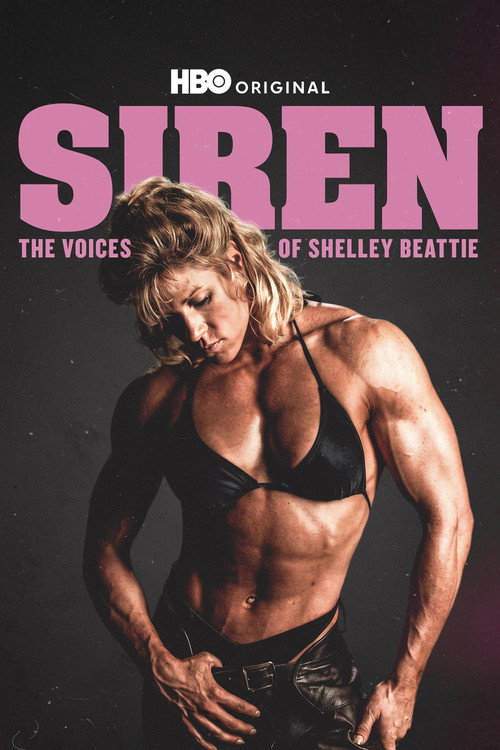
Siren: The Voices of Shelley Beattie (2025)
Directed by Irene Taylor
Irene Taylor's documentary arrives with the quiet certainty of a film that knows exactly what it wants to say and has arranged its evidence accordingly.
Consciousness Markers
The film is architecturally organized around Deaf visibility in mainstream media, with both its subject and its framing narrator being Deaf women. HBO's decision to release a standalone ASL-dubbed version confirms that representation is treated here as a structural imperative, not an afterthought.
Mental illness, addiction, and disability are not background details here but the central thesis. Matlin explicitly framed the project around demonstrating systemic failure in mental health and disability support, which is the modern advocacy template applied with full conviction.
The documentary reframes Beattie's hyper-muscular physique as emotional armor hiding personal suffering, and situates her story within a critique of how a hearing-dominated, male-gaze-driven entertainment industry processed a powerful woman it could not quite categorize. The lens is modern and gendered.
Matlin's stated motivation for making the film is to demonstrate 'how the system failed her,' which is an advocacy thesis, not an open question. The film arrives at its conclusions with the confidence of a keynote address, though the genuine emotional weight of Beattie's story keeps it from tipping into pure sermon.
Body image is a named concern: the film interrogates how Beattie's physique was read by the public and how she used it as psychological protection. The re-evaluation of 1990s body politics through a modern disability and trauma framework is a concrete and sustained thread.
The documentary consciously re-examines 1990s celebrity culture and athletics through the corrective lenses of disability rights, trauma awareness, and institutional accountability. The past is being audited by the present, and the past is not passing the audit.
The critique of how hearing-dominated media treated Beattie as a logistical inconvenience implies some institutional skepticism, and the systemic failure narrative gestures toward structures larger than any individual. The anti-capitalist framing is ambient rather than explicit.
The overview gestures toward 'questions of her own identity,' but the research does not develop this into any explicit LGBTQ thematic content. The score reflects a faint trace, nothing more.
No evidence of racial consciousness themes in the film's content, framing, or critical reception.
No evidence of climate or environmental themes of any kind.
Why it received this score
Irene Taylor's documentary arrives with the quiet certainty of a film that knows exactly what it wants to say and has arranged its evidence accordingly. Shelley Beattie, Deaf champion bodybuilder and 1990s television phenomenon, is a genuinely compelling subject: a woman whose physical power was spectacular and whose interior life was, by all accounts, in continuous crisis. The film frames her story through Marlee Matlin, whose parallel experience as a Deaf woman navigating a hearing industry provides both structural elegance and a useful second data point for the documentary's broader argument about systemic failure. The argument, to be clear, is that the system failed Shelley Beattie. The film will not be leaving you to work that out yourself.
The re-evaluation of 1990s celebrity culture is the documentary's most interesting operation. It takes the archive footage of a woman being celebrated for her body and asks, with the measured patience of a prosecutor, what that celebration was actually doing to her. The "armor" thesis, that Beattie's muscularity was a psychological fortification rather than a triumph, is applied with the confidence of a retrospective diagnosis. This is not without insight. It is also not without the particular self-satisfaction that attaches to modern frameworks when applied to defenseless decades. The 1990s, as always, are found guilty.
HBO's release of a standalone ASL-dubbed version of the film is a logistical commitment to the very community the documentary argues was underserved by the original media landscape. The irony is noted and, one suspects, intended. Taylor, herself a child of Deaf adults, brings an insider's fluency to the material that prevents it from collapsing into pure advocacy product. Beattie's story is sad and strange and worth telling, and the film tells it with evident care. The lecture energy is present, but it is at least a lecture delivered by people who did the reading.
Analysis generated by our Consciousness Algorithm

Synopsis
Shelley Beattie, a Deaf woman and champion bodybuilder, found fame in the 1990s on the hit TV show American Gladiators, where she competed under the name "Siren" before her untimely death in 2008. While charismatic, gorgeous, and a fierce competitor, Beattie also battled personal demons, struggling with mental illness, addiction, and questions of her own identity. Framed by the insight of another Deaf woman in Hollywood who found herself in the spotlight at the same time, Academy Award-winning actress Marlee Matlin, the documentary unpacks the story of Shelley "Siren" Beattie and her complex legacy entwined with beauty, mental illness, and love.
Critic Reviews
“Bishop isn't afraid to leave the club behind, confidently expanding beyond the seedy premise to become a three-way chase among the bachelor party guys, the club management, and a ferocious supernatural force.”
“For the most part this is a clever and confident expansion of a terrific short. It stings less but packs plenty of poison.”
“The screenplay finds ways to make this more involving than the average flee-the-monster storyline and, by the genre's standards, direction and performances rate reasonably well.”
“It's a movie lost somewhere in the middle: too weird to be believable, not weird enough to be memorable.”