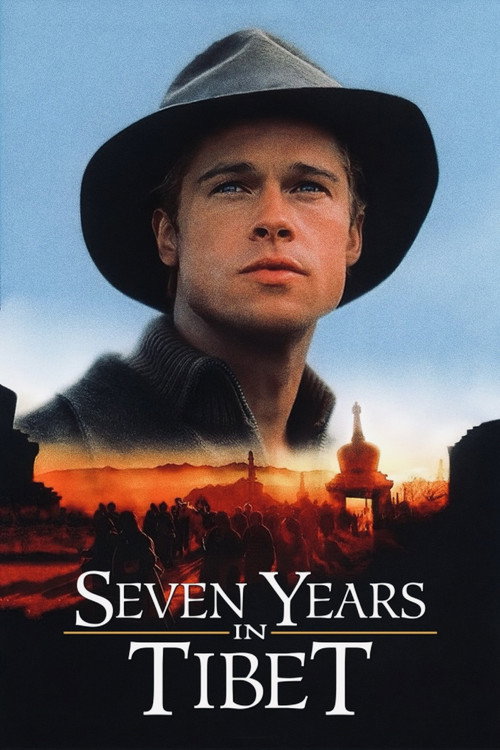
Seven Years in Tibet (1997)
Directed by Jean-Jacques Annaud
No — Seven Years in Tibet is not especially woke, scoring 24 out of 100 on our wokeness meter.
Jean-Jacques Annaud's 1997 adaptation of Heinrich Harrer's memoir arrives with the full apparatus of prestige: sweeping Himalayan vistas, a John Williams score, Yo-Yo Ma on cello, and Brad Pitt in the role of a man who learns humility at altitude.
Consciousness Markers
The film substantially rewrites its source: it makes the real SS sergeant Heinrich Harrer openly anti-Nazi, invents a Chinese negotiating visit and a 'religion is poison' scene, and reorders the Dalai Lama's enthronement relative to the Seventeen Point Agreement.
The production notably cast Tibetan and Asian actors (Jamyang Jamtsho Wangchuk, Lhakpa Tsamchoe, Danny Denzongpa, BD Wong, Mako) in Tibetan and Asian roles, a genuine effort for 1997, though the film remains anchored by a white Western lead in a classic outsider-gazes-inward structure.
The film carries a soft political sermon about Tibetan innocence and Chinese aggression, but delivers it through drama and scenery rather than explicit moralizing speeches.
The film touches on Chinese occupation and Tibetan sovereignty, but frames everything through a European protagonist's spiritual awakening rather than any racial or decolonial consciousness.
No LGBTQ+ characters, themes, or subtext appear anywhere in the narrative.
Women appear only as wives and love interests (Ingrid, Pema Lhaki) serving the male protagonists' arcs; no feminist framework is present.
The Himalayan setting is scenery, not an environmentalist argument; no climate themes are present.
No critique of capitalism, wealth, or class appears in the film.
No body-positivity themes or messaging are present.
No neurodivergent characters or themes are depicted.
Why it received this score
Jean-Jacques Annaud's 1997 adaptation of Heinrich Harrer's memoir arrives with the full apparatus of prestige: sweeping Himalayan vistas, a John Williams score, Yo-Yo Ma on cello, and Brad Pitt in the role of a man who learns humility at altitude. The film concerns an Austrian mountaineer who escapes a British prisoner-of-war camp, walks into Tibet, and becomes tutor to a teenage Dalai Lama. It is a handsome production and a slow one, more interested in the journey than the arrival, which is the sort of complaint critics have been lodging against travel epics since the form was invented.
The production made a genuine effort with its Tibetan roles, casting Jamyang Jamtsho Wangchuk, Lhakpa Tsamchoe, Danny Denzongpa, and others in parts a lazier studio might have filled with makeup and affectation. Credit where it is due. The structure, however, remains the familiar one: a Westerner arrives, absorbs a foreign culture, and serves as the lens through which we are permitted to see it. The women in the film exist to marry the supporting Austrian or to send divorce papers from Vienna. Nobody involved appears to have considered that a problem, and in 1997 nobody much did.
Where the film grows more interesting is in its handling of the record. The screenplay turns the real Harrer, an SS sergeant, into a man who sniffs at Nazi salutes, invents a Chinese negotiating visit complete with a sand mandala desecration and a remark about religion being poison, and shuffles the Dalai Lama's enthronement into a sequence the calendar does not support. The politics arrive gently, wrapped in scenery and friendship, but they arrive. The result is a well-mounted film that asks us to admire Tibet and distrust Beijing, and does so with enough craft to make the asking pleasant.
Analysis generated by our Consciousness Algorithm


Synopsis
Austrian mountaineer Heinrich Harrer journeys to the Himalayas without his family to head an expedition in 1939. But when World War II breaks out, the arrogant Harrer falls into Allied forces' hands as a prisoner of war. He escapes with a fellow detainee and makes his way to Lhasa, Tibet, where he meets the 14-year-old Dalai Lama, whose friendship ultimately transforms his outlook on life.
Questions about Seven Years in Tibet
Is Seven Years in Tibet woke?
No — Seven Years in Tibet is not especially woke, scoring 24 out of 100 on our wokeness meter. That earns it a verdict of Based.
Does Seven Years in Tibet have any woke elements?
2 of the 10 markers register at 30 or above, led by Revisionist History (45) and Representation Casting (40). On Revisionist History: The film substantially rewrites its source: it makes the real SS sergeant Heinrich Harrer openly anti-Nazi, invents a Chinese negotiating visit and a 'religion is poison' scene, and reorders the Dalai Lama's enthronement relative to the Seventeen Point Agreement.
How does Seven Years in Tibet compare to other 1997 movies?
It ranks #12 of the 109 films from 1997 we've scored; their average is 12. The wokest is Happy Together (65).
How is the Woke Score calculated?
An AI-assisted process researches the film and its reception, scores it 0–100 on ten markers, then combines those into one 0–100 Woke Score. It measures a specific set of 2020s cultural themes, not film quality.