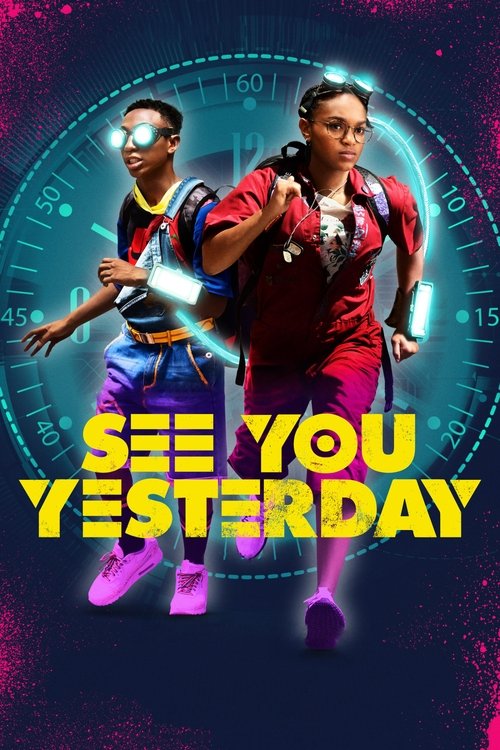
See You Yesterday (2019)
Directed by Stefon Bristol
Yes — See You Yesterday is woke, scoring 60 out of 100 on our wokeness meter.
The narrative concerns two prodigious students who experiment with temporal mechanics, an endeavor that spirals into a cautionary tale of urban violence and systemic failure.
Consciousness Markers
The entire plot is catalyzed by the police killing of an unarmed Black man and the protagonist's repeated attempts to undo that racialized violence. Racial consciousness is the film's engine.
A Black teenage girl leads the film as a science prodigy, supported by a predominantly Black cast and a Latino classmate, with Spike Lee's 40 Acres and a Mule producing. Representation is central and deliberate.
The film carries an urgent social message about police violence against Black Americans, though it delivers it through narrative tragedy rather than explicit sermonizing.
C.J. is a driven female STEM protagonist who anchors the story and outsmarts the adults around her, though the film's feminism is incidental rather than programmatic.
No LGBTQ+ characters or themes appear in the narrative.
No environmental or climate themes are present.
No critique of capitalism or economic class structures figures into the story.
No body positivity or body-image themes appear.
No neurodivergence is depicted or referenced.
The film is speculative fiction, not a reworking of historical events, so no revisionist history is at play.
Why it received this score
The narrative concerns two prodigious students who experiment with temporal mechanics, an endeavor that spirals into a cautionary tale of urban violence and systemic failure. The film operates as a deliberate exercise in social consciousness, using speculative fiction as its primary vehicle. We are presented with C.J., a central female protagonist who anchors the film through her intellect and her role as a scientific anomaly in a world of adult indifference. The entire plot is predicated upon the fatal shooting of a Black man by law enforcement, making racial awareness the film’s operational spine.
While the central premise involves complex loops of causality, the film’s primary concern is not the mechanics of time travel but the enduring sting of racial injustice. The protagonist’s drive to undo the fatal incident showcases a powerful, if highly focused, progressive sensibility. Her efforts are not merely personal vengeance; they are a cultural reckoning. The presentation of this story, with a predominantly Black cast and production backing, is a clear and intentional statement about representation in contemporary cinema.
This is not a didactic piece of filmmaking, nor does it attempt to broadly critique economic structures or global climate collapse. The social message arrives through narrative tragedy rather than a sermon. It is a contained, urgent examination of localized trauma. The film succeeds in being a highly concentrated dose of cultural awareness, even if it does not attempt to expand its scope beyond the immediate, devastating consequences of racialized violence.
Analysis generated by our Consciousness Algorithm


Synopsis
As two teen prodigies try to master the art of time travel, a tragic police shooting sends them on a series of dangerous trips to the past.
Questions about See You Yesterday
Is See You Yesterday woke?
Yes — See You Yesterday is woke, scoring 60 out of 100 on our wokeness meter. That earns it a verdict of Woke.
What makes See You Yesterday woke?
4 of the 10 markers register at 30 or above, led by Racial Consciousness (85), Representation Casting (80) and Lecture Energy (50). On Racial Consciousness: The entire plot is catalyzed by the police killing of an unarmed Black man and the protagonist's repeated attempts to undo that racialized violence.
How does See You Yesterday compare to other 2019 movies?
It ranks #15 of the 284 films from 2019 we've scored; their average is 22. The wokest is Black Christmas (79).
How is the Woke Score calculated?
An AI-assisted process researches the film and its reception, scores it 0–100 on ten markers, then combines those into one 0–100 Woke Score. It measures a specific set of 2020s cultural themes, not film quality.