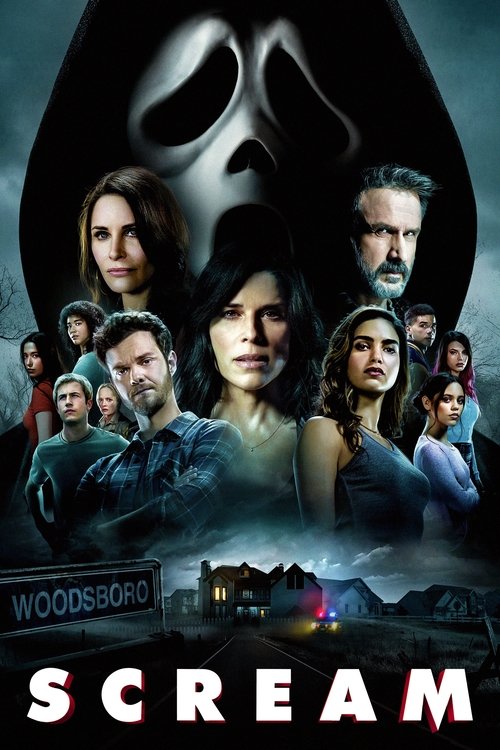
Scream (2022)
Directed by Tyler Gillett
No — Scream is not especially woke, scoring 29 out of 100 on our wokeness meter.
Twenty-five years after the original Woodsboro killings, a new Ghostface stalks a fresh crop of teenagers whose parents survived the first massacre, and the film's chief business is sorting out which of them will live.
Consciousness Markers
The new generation cast is notably diverse for a slasher sequel, led by Latina actresses Melissa Barrera and Jenna Ortega, with Black actors Mason Gooding and Jasmin Savoy Brown in prominent supporting roles. The diversity largely exists naturally in the ensemble rather than being foregrounded as commentary.
Mindy Meeks-Martin is openly queer and makes passing reference to her girlfriend, a small but concrete instance of non-heteronormative representation in the franchise. It is present but not a central thematic concern.
Mindy delivers an extended monologue defining the 'requel' — a lecture on horror-genre taxonomy and franchise rules. It functions as expository genre commentary rather than social moralizing, but it is unmistakably a character stopping the film to explain a thesis.
The film centers on strong female protagonists (Sam, Tara, Sidney) and features female killers, following the franchise's tradition of capable final girls. There is no explicitly feminist thesis driving the narrative.
The film gestures at franchise-milking and Hollywood's appetite for relaunching IP via its 'requel' meta-commentary, but the killers' motive is about fandom obsession, not economic critique. Any anti-capitalist reading is faint and indirect.
The movie contains a racially diverse cast but makes essentially no commentary on race or racial dynamics; characters' ethnicities are incidental to the plot.
No environmental or climate themes appear anywhere in the film.
No body-positive themes or messaging regarding body image appear in the film.
Sam's hallucinations of her biological father Billy Loomis are presented as a trauma/horror device rather than a depiction of neurodivergence. No neurodivergent representation is present.
The film is a self-aware sequel referencing its own franchise history, but it does not revise or reinterpret historical events or figures.
Why it received this score
Twenty-five years after the original Woodsboro killings, a new Ghostface stalks a fresh crop of teenagers whose parents survived the first massacre, and the film's chief business is sorting out which of them will live. The young ensemble is noticeably diverse, led by Melissa Barrera and Jenna Ortega, with Mason Gooding and Jasmin Savoy Brown in support. None of them remarks on it. The casting is a matter of arithmetic, not argument, and the movie proceeds as though ethnicity were part of the furniture. That is the quiet kind of representation, present in the faces and absent from the dialogue.
Mindy Meeks-Martin is openly queer and mentions a girlfriend in passing, which the film treats as unremarkable and then sets aside. The women carry the heavy lifting: Sam, Tara, Sidney, and one of the killers, all competent with weapons and grudges. No thesis accompanies them. Sam's visions of her biological father, Billy Loomis, register as trauma and horror staging, not as a study of any mind. There is no climate anxiety here, no sermon about bodies, no reimagining of the historical record. The film has other interests.
Its one sustained stretch of instruction arrives when Mindy halts the party to define the requel, explaining how legacy sequels recycle old characters to legitimize new ones. The speech is genre taxonomy, not moral instruction, though it is unmistakably a character stopping the film to deliver a thesis. The killers' grievance is fandom disappointment, with only the faintest swipe at studios that milk a franchise until the udder squeaks. That swipe is not an economic argument. The film behaves itself. It knows its own history and repeats it with better manners.
Analysis generated by our Consciousness Algorithm
Part of


Synopsis
Twenty-five years after a streak of brutal murders shocked the quiet town of Woodsboro, a new killer has donned the Ghostface mask and begins targeting a group of teenagers to resurrect secrets from the town’s deadly past.
Questions about Scream
Is Scream woke?
No — Scream is not especially woke, scoring 29 out of 100 on our wokeness meter. That earns it a verdict of Based.
Does Scream have any woke elements?
3 of the 10 markers register at 30 or above, led by Representation Casting (50), LGBTQ+ Themes (45) and Lecture Energy (35). On Representation Casting: The new generation cast is notably diverse for a slasher sequel, led by Latina actresses Melissa Barrera and Jenna Ortega, with Black actors Mason Gooding and Jasmin Savoy Brown in prominent supporting roles.
How does Scream compare to other 2022 movies?
It ranks #58 of the 223 films from 2022 we've scored; their average is 22. The wokest is Bros (92).
Is Scream the most woke Scream movie?
No. It ranks #3 of the 7 Scream films we've scored; the wokest is Scream 7 (52).