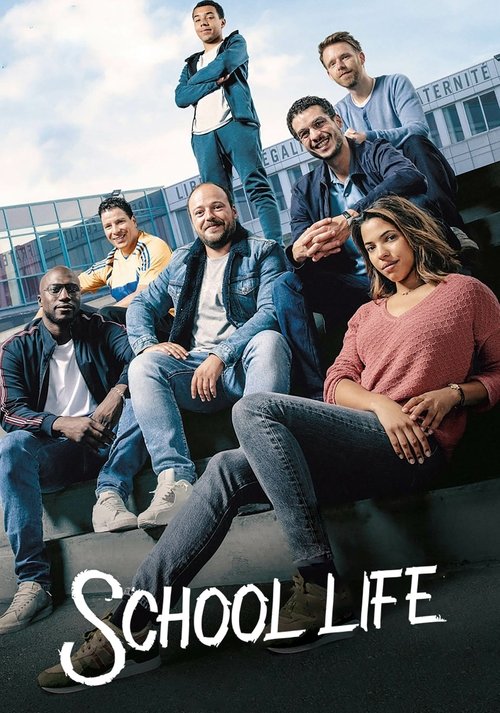
School Life (2019)
Directed by Mehdi Idir
Partly — School Life is somewhat woke, scoring 45 out of 100 on our wokeness meter.
Saint-Denis provides the backdrop, and the film wears it without ceremony.
Consciousness Markers
The cast is largely composed of actors from North African, Black, and mixed-race backgrounds, reflecting the diverse Parisian banlieue setting. This is a notable representational choice, though it arises naturally from the film's social-realist milieu.
The film depicts disadvantaged students in a poor, largely immigrant suburb of Paris and touches on social exclusion and systemic neglect. However, race is not the central explicit focus of its critique.
The film carries a social message about education and disadvantaged youth, but it delivers it through character and story rather than heavy-handed lecturing.
The film critiques underfunded public education and social inequality in a poor suburb, but it does not advance a direct anti-capitalist or eat-the-rich message.
The protagonist is a woman in a position of authority who challenges her colleagues, but the film does not explicitly engage with feminist themes or gender inequality.
There is no evidence of LGBTQ+ themes, characters, or storylines in the film.
There is no engagement with climate change or environmental themes.
There is no evidence of body positivity themes or narratives.
There is no evidence of neurodivergence themes or characters.
The film does not engage in historical revisionism or reimagining of past events.
Why it received this score
Saint-Denis provides the backdrop, and the film wears it without ceremony. A new vice principal named Samia arrives at a middle school where the staff have already surrendered, and she declines to accept their surrender. The students are largely of North African, Black, and mixed-race descent, a casting reality that follows from the setting instead of being arranged for our approval. The film does not pause to congratulate itself on this. It simply lets the corridors fill with the people who actually live there.
The social argument is present and it is genuine. These are underfunded schools in poor immigrant suburbs, and the film understands that the deck is stacked against Yanis, a sharp boy who has decided the world has already dismissed him. Samia is a woman with authority who argues with her colleagues and occasionally wins, which is a quiet sort of progress and nothing more. The critique lands on public education funding and social neglect. It stops short of a broader indictment of capital, and it never turns its characters into mouthpieces. The message arrives through a boy who wants to make movies, a more effective delivery system than a speech.
What the film declines to do is equally instructive. There is no romantic thread outside the conventional register, no environmental sermon, no meditation on body image, no neurodivergent subplot, no reworking of history to suit present taste. It is also funny in places, gently so. This is a humanist social drama, and humanism is an old garment. It fits well. It is not the same thing as a modern ideological program, and the distinction matters to anyone keeping careful records. I keep careful records. School Life is warm, well-observed, and only mildly preachy at the edges. It earns its sentiment honestly and asks for very little in return.
Analysis generated by our Consciousness Algorithm
Synopsis
In one of the poorest areas of Paris, a school counselor devotes herself to working with disadvantaged students, while facing challenges of her own.
Questions about School Life
Is School Life woke?
Partly — School Life is somewhat woke, scoring 45 out of 100 on our wokeness meter. That earns it a verdict of Woke-Adjacent.
What makes School Life woke?
3 of the 10 markers register at 30 or above, led by Representation Casting (60), Racial Consciousness (45) and Lecture Energy (30). On Representation Casting: The cast is largely composed of actors from North African, Black, and mixed-race backgrounds, reflecting the diverse Parisian banlieue setting.
How does School Life compare to other 2019 movies?
It ranks #37 of the 284 films from 2019 we've scored; their average is 22. The wokest is Black Christmas (79).
How is the Woke Score calculated?
An AI-assisted process researches the film and its reception, scores it 0–100 on ten markers, then combines those into one 0–100 Woke Score. It measures a specific set of 2020s cultural themes, not film quality.