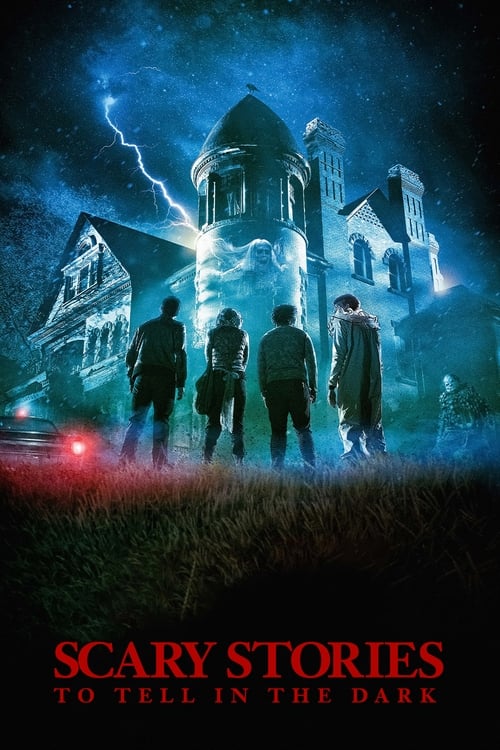
Scary Stories to Tell in the Dark (2019)
Directed by André Øvredal
No — Scary Stories to Tell in the Dark is not especially woke, scoring 26 out of 100 on our wokeness meter.
Mill Valley, Pennsylvania, 1968.
Consciousness Markers
The film features a Latino co-lead in Michael Garza's Ramón and a Black supporting character in Lorraine Toussaint's Lou-Lou Baptiste, but the casting is not framed as a diversity statement.
Ramón faces racist intimidation and police suspicion as a Mexican-American draft dodger in 1968, and the film briefly acknowledges the era's prejudice, but race is not a central focus.
The wealthy Bellows family owns the paper mill and frames Sarah to protect their reputation after poisoning children, offering a critique of corporate power and elite impunity.
Stella is a female lead and aspiring writer who ultimately gives voice to Sarah Bellows, a woman silenced and abused by male authority figures, though the film does not articulate an explicit feminist agenda.
The film carries a mild didactic thread about the redemptive power of truth and the danger of controlling narratives, but it remains a genre horror rather than a preachy social lecture.
The Bellows family's paper mill poisons the town's water with mercury, an environmental crime that drives the plot, but the film treats it as a local cover-up rather than a climate crusade.
There are no LGBTQ+ characters, themes, or subtext in the film.
Sarah's albinism is a source of ostracism and horror imagery, but the film does not promote body positivity or self-acceptance themes.
Sarah is subjected to abusive electroshock therapy, but this is depicted as historical cruelty rather than an exploration of neurodivergence.
The story is fictional and set in a fictional town; it does not revise or reinterpret real historical events.
Why it received this score
Mill Valley, Pennsylvania, 1968. A paper mill, a haunted house, a book that writes you into it. André Øvredal's adaptation of the Alvin Schwartz children's books arrives dressed as period horror and largely stays that way. The plot's engine is a genuine grievance: the Bellows family's mill poisoned the town's water with mercury, killing children, and the family pinned the deaths on Sarah, their own daughter, a girl already ostracized for her albinism. That is a story about elite impunity, and the film does not pretend otherwise.
The picture carries a soft social conscience without waving it around. Stella, the aspiring writer at the center, spends the back half of the film giving voice to a woman that male authority silenced, which registers as a modest feminine current. Ramón, a Mexican-American draft dodger, absorbs racist suspicion from the town and its police, and the film notes the era's prejudice without staging a seminar on it. Lorraine Toussaint turns up as Lou-Lou Baptiste, the maid's daughter, and the role is played straight, a supporting part, not a statement.
Where the film declines to participate is instructive. There is no queer presence. Sarah's albinism is deployed for atmosphere and revulsion, not for any lesson about self-acceptance. Her electroshock abuse is period cruelty, not a study of neurodivergence. The town is invented, so no history gets revised. The closing moral about truth and controlling narratives is delivered gently enough to pass as plot. A genre exercise with a mild pulse of conscience, competently assembled and content to frighten rather than instruct.
Analysis generated by our Consciousness Algorithm


Synopsis
Mill Valley, Pennsylvania, Halloween night, 1968. After playing a joke on a school bully, Stella and her friends decide to sneak into a supposedly haunted house that once belonged to the powerful Bellows family, unleashing dark forces that they will be unable to control.
Questions about Scary Stories to Tell in the Dark
Is Scary Stories to Tell in the Dark woke?
No — Scary Stories to Tell in the Dark is not especially woke, scoring 26 out of 100 on our wokeness meter. That earns it a verdict of Based.
Does Scary Stories to Tell in the Dark have any woke elements?
4 of the 10 markers register at 30 or above, led by Representation Casting (40), Eat the Rich (35) and Racial Consciousness (35). On Representation Casting: The film features a Latino co-lead in Michael Garza's Ramón and a Black supporting character in Lorraine Toussaint's Lou-Lou Baptiste, but the casting is not framed as a diversity statement.
How does Scary Stories to Tell in the Dark compare to other 2019 movies?
It ranks #84 of the 284 films from 2019 we've scored; their average is 22. The wokest is Black Christmas (79).
How is the Woke Score calculated?
An AI-assisted process researches the film and its reception, scores it 0–100 on ten markers, then combines those into one 0–100 Woke Score. It measures a specific set of 2020s cultural themes, not film quality.