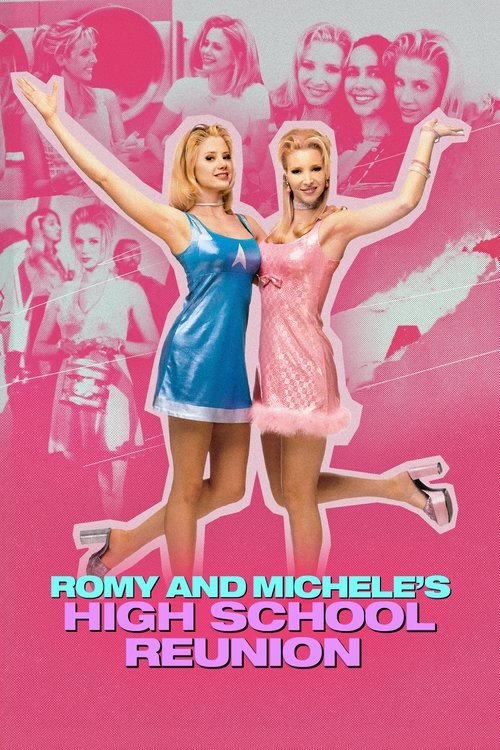
Romy and Michele's High School Reunion (1997)
Directed by David Mirkin
No — Romy and Michele's High School Reunion is not woke, scoring 18 out of 100 on our wokeness meter.
Romy and Michele's High School Reunion is a 1997 comedy about two women who fabricate careers as the inventors of Post-It notes for their ten-year reunion.
Consciousness Markers
The film centers a female friendship and has the women ultimately reject male approval and outgrow the status-obsessed clique, but it does so as light comedy rather than an articulated feminist statement.
A female-led buddy comedy with two women as co-protagonists, which was notable for 1997, but the cast is almost entirely white and no diversity-conscious casting markers are present.
Michele's backstory references being an overweight child taunted at school, and the film sympathizes with feeling out of place, but it never develops a sustained body-positivity argument.
The 'be yourself' moral arrives late and lightly, delivered through plot resolution rather than sermonizing; the film is overwhelmingly comedic in tone.
The film gently satirizes status and materialism (the borrowed Jaguar, the fabricated careers), but it ends by celebrating entrepreneurial success rather than critiquing capitalism.
No LGBTQ+ characters or themes. Alan Cumming appears in the cast, but his character Sandy Frink is a straight love interest with no queer content.
No engagement with race or racial inequality. The characters and milieu are uniformly white suburban Arizona.
No environmental or climate-related content whatsoever.
The leads are portrayed as 'not-too-bright,' but this is comic ditziness, not a depiction or advocacy of neurodivergence.
No historical revisionism; the film is a contemporary-set comedy with no engagement with historical narrative.
Why it received this score
Romy and Michele's High School Reunion is a 1997 comedy about two women who fabricate careers as the inventors of Post-It notes for their ten-year reunion. The film is a female-led buddy comedy with two women as co-protagonists, which counts for something in its era. The cast, however, is uniformly white, and the film makes no diversity-conscious gestures. Alan Cumming appears, but his Sandy Frink is a straight romantic interest and carries no queer content. The social awareness here is ambient at best. The film watches status anxiety in white suburban Arizona without asking who gets excluded from that suburb.
That female friendship is the film's mild progressive pulse. Romy and Michele reject male approval, outgrow the status-obsessed clique, and choose each other. The treatment is light comedy, not an articulated statement. Body positivity surfaces in Michele's memory of being an overweight child taunted at school. The film sympathizes with feeling out of place, then moves on. The anti-capitalist material is similarly faint: a borrowed Jaguar, fabricated careers, a gentle satire of status, and a final celebration of entrepreneurial success. Race, climate, neurodivergence, and historical revision get nothing. The film is contemporary, apolitical, and mostly interested in jokes about fashion and Post-It notes.
The moral arrives late and lightly. Be yourself, the film says, but it says so through plot resolution instead of sermonizing. That restraint is the saving grace. The film has heart, a cult following, and no interest in lecturing its audience. It is a comedy of manners for people who have not thought about high school in years. The cultural awareness is low, the jokes are silly, and the whole enterprise remains amiable. A reasonable classification: pleasant, period-specific, and only accidentally progressive.
Analysis generated by our Consciousness Algorithm


Synopsis
Two not-too-bright party girls reinvent themselves for their high school reunion. Armed with a borrowed Jaguar, new clothes and the story of their success as the inventors of Post-It notes, Romy and Michele descend on their alma mater, but their façade crumbles quickly.
Questions about Romy and Michele's High School Reunion
Is Romy and Michele's High School Reunion woke?
No — Romy and Michele's High School Reunion is not woke, scoring 18 out of 100 on our wokeness meter. That earns it a verdict of Ultra Based.
Does Romy and Michele's High School Reunion have any woke elements?
2 of the 10 markers register at 30 or above, led by Feminist Agenda (32) and Representation Casting (30). On Feminist Agenda: The film centers a female friendship and has the women ultimately reject male approval and outgrow the status-obsessed clique, but it does so as light comedy rather than an articulated feminist statement.
How does Romy and Michele's High School Reunion compare to other 1997 movies?
It ranks #21 of the 109 films from 1997 we've scored; their average is 12. The wokest is Happy Together (65).
How is the Woke Score calculated?
An AI-assisted process researches the film and its reception, scores it 0–100 on ten markers, then combines those into one 0–100 Woke Score. It measures a specific set of 2020s cultural themes, not film quality.