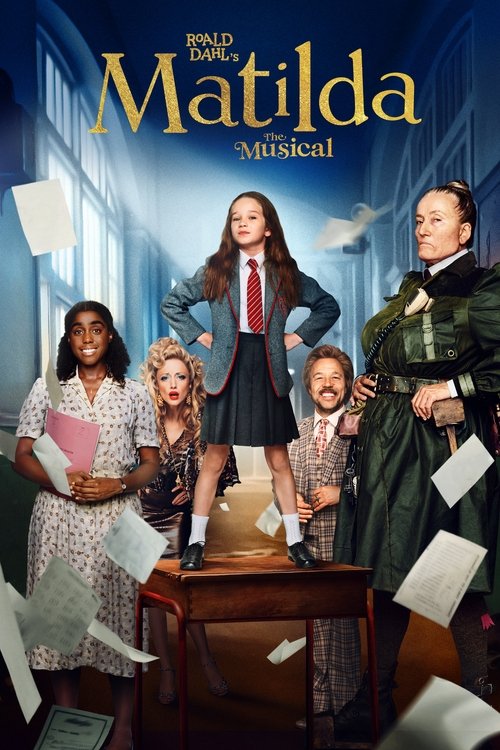
Roald Dahl's Matilda the Musical (2022)
Directed by Matthew Warchus
No — Roald Dahl's Matilda the Musical is not especially woke, scoring 26 out of 100 on our wokeness meter.
Roald Dahl's Matilda the Musical arrives as the second cinematic treatment of the novel, filtered this time through Tim Minchin and Dennis Kelly's stage production, and it conducts itself with a restraint that feels almost antique.
Consciousness Markers
Color-conscious casting includes Lashana Lynch as Miss Honey and Sindhu Vee as Mrs. Phelps, diversifying roles traditionally portrayed as white, though the film makes no explicit comment on this.
Centers on a brilliant girl who defies patriarchal neglect and a tyrannical female headmistress, forming a bond of female solidarity, but without explicit feminist rhetoric.
Delivers moral lessons about standing up to bullies and found family, but in a playful musical manner rather than preachy social-justice lecture.
No LGBTQ+ characters, themes, or subtext are present.
No engagement with racial themes, systemic racism, or racial identity; diversity in casting is present but not narratively addressed.
No environmental or climate-related themes.
No critique of capitalism or wealth inequality; the villainy is personal and authoritarian, not economic.
No body-positive themes or messaging.
Matilda's prodigy and telekinesis are fantastical, not framed as neurodivergence.
No historical revisionism; it is a fantasy adaptation of a children's book.
Why it received this score
Roald Dahl's Matilda the Musical arrives as the second cinematic treatment of the novel, filtered this time through Tim Minchin and Dennis Kelly's stage production, and it conducts itself with a restraint that feels almost antique. Here is a 2022 family musical about a gifted girl, a cruel headmistress, and a school built on terror, and at no point does it pause to instruct the audience on the correct politics of the moment. The children sing, the villain rages, the telekinesis arrives on schedule. It is, by the standards of its release year, a curiously unburdened piece of work.
The film does carry a mild progressive charge, mostly in its casting. Lashana Lynch plays Miss Honey and Sindhu Vee plays the librarian Mrs. Phelps, roles historically rendered in paler hues, and the film simply lets them be. No dialogue acknowledges the shift. No character explains it. The story concerns a brilliant girl dismissed by a father who wanted a son, who finds in Miss Honey a bond of female solidarity strong enough to topple a tyrant. That is a feminist shape, arrived at through plot instead of proclamation. Race never enters the narrative, and the film seems content to leave it there.
What moral instruction exists concerns bullies, courage, and the comforts of a chosen family, delivered through song and slapstick. Emma Thompson's Trunchbull is a monster of appetite and spite, not an ideological target. The result is a children's entertainment that trusts its audience to absorb the lesson without a lecture. Refreshing, if faintly nostalgic.
Analysis generated by our Consciousness Algorithm


Synopsis
An extraordinary young girl discovers her superpower and summons the remarkable courage, against all odds, to help others change their stories, whilst also taking charge of her own destiny. Standing up for what's right, she's met with miraculous results.
Questions about Roald Dahl's Matilda the Musical
Is Roald Dahl's Matilda the Musical woke?
No — Roald Dahl's Matilda the Musical is not especially woke, scoring 26 out of 100 on our wokeness meter. That earns it a verdict of Based.
Does Roald Dahl's Matilda the Musical have any woke elements?
2 of the 10 markers register at 30 or above, led by Representation Casting (45) and Feminist Agenda (40). On Representation Casting: Color-conscious casting includes Lashana Lynch as Miss Honey and Sindhu Vee as Mrs.
How does Roald Dahl's Matilda the Musical compare to other 2022 movies?
It ranks #69 of the 223 films from 2022 we've scored; their average is 22. The wokest is Bros (92).
How is the Woke Score calculated?
An AI-assisted process researches the film and its reception, scores it 0–100 on ten markers, then combines those into one 0–100 Woke Score. It measures a specific set of 2020s cultural themes, not film quality.