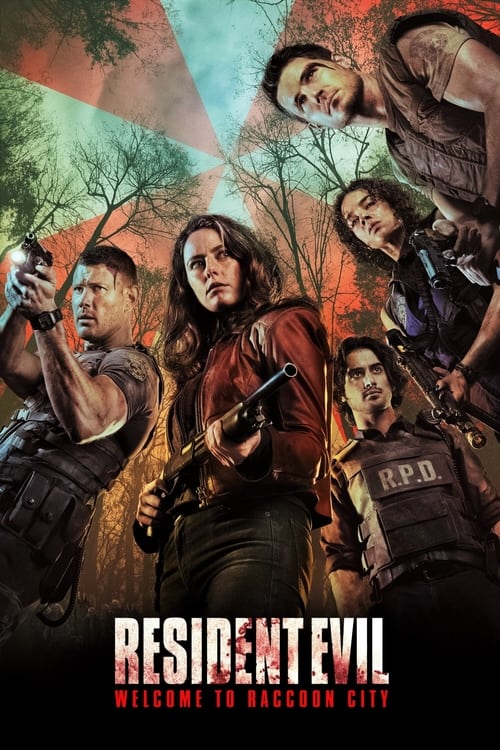
Resident Evil: Welcome to Raccoon City (2021)
Directed by Johannes Roberts
No — Resident Evil: Welcome to Raccoon City is not woke, scoring 17 out of 100 on our wokeness meter.
Resident Evil: Welcome to Raccoon City arrives as a reboot with the solemn duty of adapting the first two games and the additional duty of reminding us that a Midwestern ghost town can still smell of corporate malfeasance.
Consciousness Markers
The film race-swaps several video-game characters, including Avan Jogia as Leon S. Kennedy and Hannah John-Kamen as Jill Valentine, and casts Lily Gao as Ada Wong, though the diversity is presented without comment.
Umbrella is a sinister pharmaceutical corporation that experiments on children and abandons Raccoon City, but the critique is standard horror-villain corporate malfeasance rather than a systemic anti-capitalist argument.
Claire Redfield and Jill Valentine are capable action leads, but the film offers no explicit gender politics or feminist messaging.
There are no preachy monologues; conspiracy warnings function as plot mechanics rather than moral instruction.
No LGBTQ+ characters, themes, or subtext are present.
The film has a diverse cast but engages in no racial commentary or consciousness.
No environmental or climate themes are present.
No body-positivity themes or messaging are present.
No neurodivergence themes or representation are present.
The film is a fictional video-game adaptation with no historical revisionism.
Why it received this score
Resident Evil: Welcome to Raccoon City arrives as a reboot with the solemn duty of adapting the first two games and the additional duty of reminding us that a Midwestern ghost town can still smell of corporate malfeasance. Johannes Roberts stages the Spencer Mansion and the police station with affection for fixed camera angles and rain-slicked dread. The film is a zombie picture first and a social text a distant fourth. Its diverse casting, including Avan Jogia as Leon and Hannah John-Kamen as Jill, proceeds without editorial comment, which is either confidence or indifference. Claire and Jill handle firearms and exposition with competence, but the film has no gender-politics seminar to deliver. Umbrella remains a pharmaceutical company that experiments on children and abandons a city, yet the critique stops at the familiar threshold of horror-villain corporate malfeasance. There is no systemic argument, just a laboratory full of bad decisions and a rocket launcher.
The film does not engage in racial commentary, climate anxiety, body positivity, neurodivergence, or historical revisionism. Its conspiracy warnings are plot mechanics, not sermons. The result is a modest genre exercise that treats progressive sensibilities as casting decisions and nothing more. This is not a criticism; it is a classification. The cultural awareness on display is largely administrative. Even the corporate villainy is standard issue: Umbrella is bad because it ruins a town and makes monsters, not because it represents an economic order. The film has no interest in lecturing us about any of this, and its restraint is almost restful.
As a reboot, it carries the burden of fan service, and it bears that burden with a shrug. The action is competent, the atmosphere is damp, and the dialogue exists to move people toward the next locked door. It is the kind of picture that casts a diverse ensemble and then asks them to run from zombies, which is a perfectly reasonable use of a diverse ensemble. For those keeping a ledger of cultural markers, the entries are sparse and the margins are wide. The film wants to be a faithful adaptation, not a sermon, and on that modest point it succeeds.
Analysis generated by our Consciousness Algorithm


Synopsis
Once the booming home of pharmaceutical giant Umbrella Corporation, Raccoon City is now a dying Midwestern town. The company’s exodus left the city a wasteland…with great evil brewing below the surface. When that evil is unleashed, the townspeople are forever…changed…and a small group of survivors must work together to uncover the truth behind Umbrella and make it through the night.
Questions about Resident Evil: Welcome to Raccoon City
Is Resident Evil: Welcome to Raccoon City woke?
No — Resident Evil: Welcome to Raccoon City is not woke, scoring 17 out of 100 on our wokeness meter. That earns it a verdict of Ultra Based.
Does Resident Evil: Welcome to Raccoon City have any woke elements?
2 of the 10 markers register at 30 or above, led by Representation Casting (45) and Eat the Rich (35). On Representation Casting: The film race-swaps several video-game characters, including Avan Jogia as Leon S.
How does Resident Evil: Welcome to Raccoon City compare to other 2021 movies?
It ranks #120 of the 242 films from 2021 we've scored; their average is 23. The wokest is The Forever Purge (83).
How is the Woke Score calculated?
An AI-assisted process researches the film and its reception, scores it 0–100 on ten markers, then combines those into one 0–100 Woke Score. It measures a specific set of 2020s cultural themes, not film quality.