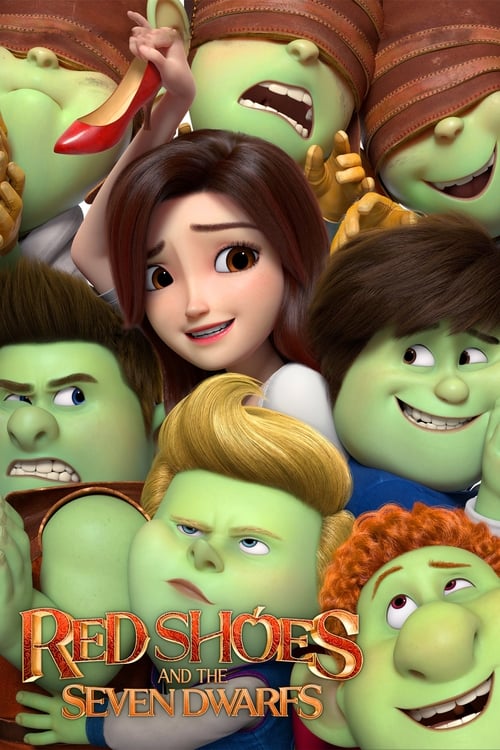
Red Shoes and the Seven Dwarfs (2019)
Directed by Hong Sung-ho
Partly — Red Shoes and the Seven Dwarfs is somewhat woke, scoring 42 out of 100 on our wokeness meter.
A South Korean animation outfit takes the Brothers Grimm, borrows a title from Hans Christian Andersen, and hands the result to an English-language voice cast of mostly pale complexion.
Consciousness Markers
The film's central thesis is that inner beauty matters more than physical appearance, with an overweight Snow White and a curse tied to judging others by looks; it explicitly promotes body image and self-acceptance.
The film is openly didactic about its inner-beauty and self-acceptance moral, delivering the lesson fairly directly, though wrapped in comedy and adventure.
Snow is reimagined as a strong, selfless hand-to-hand fighter and the film subverts the passive 'beautiful princess' trope, though the plot still resolves through romance and a redemptive kiss.
A South Korean production with a largely white English-language voice cast; no meaningful push for diverse or nontraditional casting in the woke sense.
No LGBTQ+ characters, themes, or subtext anywhere in the story.
No engagement with race, racism, or racial identity; the conflict is entirely about appearance and beauty standards.
No environmental or climate themes present.
No critique of wealth, class, or capitalism; the monarchy and princes are treated as a benign fairy-tale backdrop.
No neurodivergent characters or themes are depicted.
A fairy-tale reimagining, not a revision of historical events or figures.
Why it received this score
A South Korean animation outfit takes the Brothers Grimm, borrows a title from Hans Christian Andersen, and hands the result to an English-language voice cast of mostly pale complexion. The Fearless Seven, a squad of princes, are cursed into green dwarfs after mistaking a fairy for a witch, and only a kiss from the most beautiful woman alive will restore them. Enter Snow White, here rendered as a heavyset young woman who can throw a punch and wears enchanted red shoes that slim her into the conventional ideal. The film arrived with a Cannes billboard that was swiftly withdrawn after accusations of body shaming, which the producers blamed on a marketing department that had apparently not watched the movie.
The movie, as it turns out, is about exactly that. Its thesis, stated early and repeated often, is that inner beauty outranks the surface, and it pursues this with the tirelessness of a motivational seminar. Merlin, our hero, must learn to love Snow as she actually is. Snow must learn the same about herself. The shoes come off. The lesson lands. There is a talking mirror, a large wooden bunny, and a romance that still closes on a redemptive kiss, so the subversion of the passive princess only goes so far. Snow fights well and saves people, which is progress of a modest and thoroughly merchandised kind.
Absent from the proceedings: any engagement with race, any environmental concern, any class critique, any queer presence, any neurodivergent character. The kingdom's monarchy sits there as furniture. The remainder is a single-issue parable about mirrors and scales, delivered with a straight face and a song. Commendable in its narrow way. Exhausting in its narrow way.
Analysis generated by our Consciousness Algorithm


Synopsis
Princes who have been turned into Dwarfs seek the red shoes of a lady in order to break the spell, although it will not be easy.
Questions about Red Shoes and the Seven Dwarfs
Is Red Shoes and the Seven Dwarfs woke?
Partly — Red Shoes and the Seven Dwarfs is somewhat woke, scoring 42 out of 100 on our wokeness meter. That earns it a verdict of Woke-Adjacent.
What makes Red Shoes and the Seven Dwarfs woke?
3 of the 10 markers register at 30 or above, led by Body Positivity (85), Lecture Energy (45) and Feminist Agenda (38). On Body Positivity: The film's central thesis is that inner beauty matters more than physical appearance, with an overweight Snow White and a curse tied to judging others by looks; it explicitly promotes body image and self-acceptance.
How does Red Shoes and the Seven Dwarfs compare to other 2019 movies?
It ranks #45 of the 284 films from 2019 we've scored; their average is 22. The wokest is Black Christmas (79).
How is the Woke Score calculated?
An AI-assisted process researches the film and its reception, scores it 0–100 on ten markers, then combines those into one 0–100 Woke Score. It measures a specific set of 2020s cultural themes, not film quality.