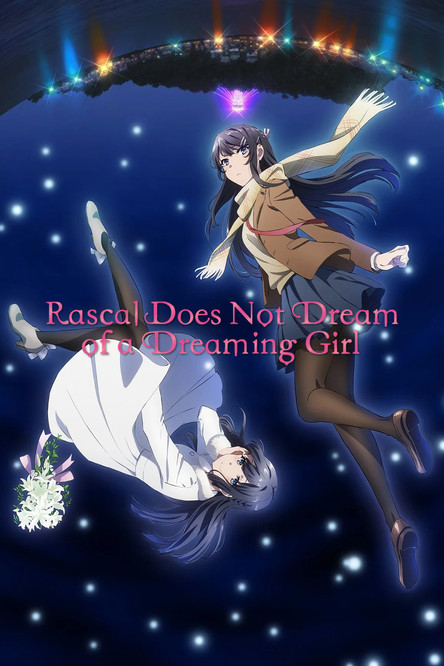
Rascal Does Not Dream of a Dreaming Girl (2019)
Directed by Soichi Masui
No — Rascal Does Not Dream of a Dreaming Girl is not woke, scoring 0 out of 100 on our wokeness meter.
Rascal Does Not Dream of a Dreaming Girl arrives as a theatrical sequel to a television series about a young man whose romantic life is complicated by a condition called puberty syndrome, which manifests as supernatural phenomena.
Consciousness Markers
The film features a homogeneously Japanese voice cast and characters, with no deliberate modern representation-casting agenda.
There are no LGBTQ+ themes, characters, or relationships in the story.
Female characters have emotional and narrative agency, but the film does not advance a feminist agenda or critique patriarchal structures.
Race and racial identity are not addressed or made thematically relevant.
There is no environmental or climate-crisis messaging.
The film contains no critique of capitalism, wealth inequality, or class structures.
Body image, size acceptance, and related themes are absent.
The supernatural 'puberty syndrome' is not framed as neurodivergence or a neurodiversity narrative.
Time manipulation and alternate timelines are used for romance and tragedy, not to revise historical narratives.
The film is an emotional romantic drama and does not lecture the audience on social or political issues.
Why it received this score
Rascal Does Not Dream of a Dreaming Girl arrives as a theatrical sequel to a television series about a young man whose romantic life is complicated by a condition called puberty syndrome, which manifests as supernatural phenomena. This is, we are told, the grand climax. The plot involves two versions of the same girl, a heart transplant, a fatal traffic accident, and a willingness to rewrite causality itself so that love might persist. It is earnest, it is convoluted, and it moves at the pace of a student cramming for exams.
For the purposes of classification, the film presents remarkably little to catalogue. The cast is homogeneously Japanese, and no effort is made to assemble it along contemporary representational lines. Female characters carry real emotional weight, Mai and the two Shokos among them, yet the story has no interest in critiquing the structures that surround them. Race, class, climate, body image: these subjects never surface. The supernatural affliction at the center is played for pathos, not as an allegory for neurodivergence, and the time travel serves romance and grief exclusively. No alternate history is being corrected here.
What remains is a melodrama that wants badly to make you cry, and by most accounts succeeds. It is a film about sacrifice told with a straight face and an abundance of tears, and it asks nothing of the audience beyond feeling. The sermon is absent. The lecture never arrives. There is only a boy, a girl, and a car that keeps hitting the wrong person. We record the results without complaint, and we move on to the next screening.
Analysis generated by our Consciousness Algorithm

Synopsis
In Fujisawa, Sakuta Azusagawa is in his second year of high school. Blissful days with his girlfriend and upperclassman, Mai Sakurajima, are interrupted by the appearance of his first crush, Shoko Makinohara.
Questions about Rascal Does Not Dream of a Dreaming Girl
Is Rascal Does Not Dream of a Dreaming Girl woke?
No — Rascal Does Not Dream of a Dreaming Girl is not woke, scoring 0 out of 100 on our wokeness meter. That earns it a verdict of Ultra Based.
Does Rascal Does Not Dream of a Dreaming Girl have any woke elements?
No. All 10 markers score zero.
How does Rascal Does Not Dream of a Dreaming Girl compare to other 2019 movies?
It ranks #267 of the 284 films from 2019 we've scored; their average is 22. The wokest is Black Christmas (79).
How is the Woke Score calculated?
An AI-assisted process researches the film and its reception, scores it 0–100 on ten markers, then combines those into one 0–100 Woke Score. It measures a specific set of 2020s cultural themes, not film quality.