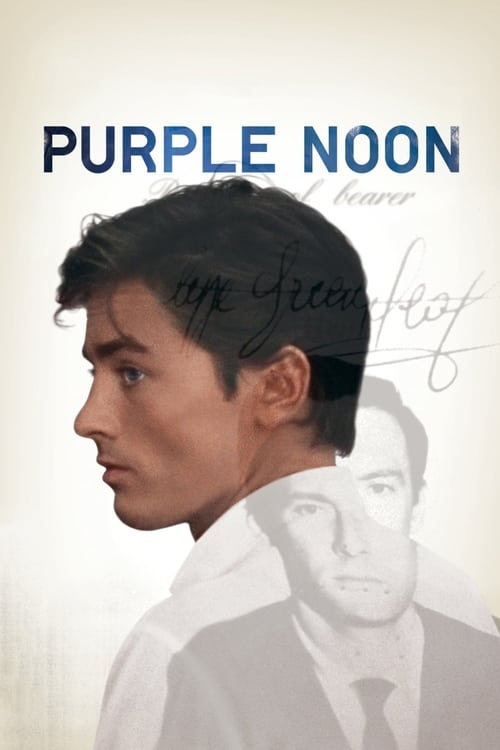
Purple Noon (1960)
Directed by René Clément
No — Purple Noon is not woke, scoring 0 out of 100 on our wokeness meter.
Purple Noon, René Clément's 1960 adaptation of Patricia Highsmith's The Talented Mr. Ripley, comes to us from a distant country where a crime film was permitted to remain a crime film.
Consciousness Markers
The cast is entirely white European actors, with no modern emphasis on diverse representation.
Any homoerotic subtext in Ripley's obsession with Philippe is implicit and not framed as LGBTQ+ themes.
Marge is a passive girlfriend figure, and the film offers no feminist critique or agency-driven narrative.
The film has no engagement with race, racial identity, or racial justice.
There is no environmental or climate-related content.
While the plot involves wealth and social climbing, it is a psychological crime thriller, not a critique of capitalism.
No body-positive themes or messaging are present.
The film does not address neurodivergence or mental health in a modern advocacy sense.
The story is not historical and makes no revisionist historical claims.
The film is a cool, amoral thriller with no preachy or didactic tone.
Why it received this score
Purple Noon, René Clément's 1960 adaptation of Patricia Highsmith's The Talented Mr. Ripley, comes to us from a distant country where a crime film was permitted to remain a crime film. Alain Delon, in his first major role, plays Tom Ripley, an American con artist dispatched to Italy to retrieve a wealthy playboy and instead deciding to become him. The plot proceeds by forgery, seduction, and a knife. Nobody apologizes for any of it.
Seen through the lens of present-day cultural expectations, the film is a barren field. The cast is entirely white and European, and the question of representation never arises. Marge, the fiancée, exists to be deceived and eventually seduced. She is given no interiority worth naming. Race, climate, body image, neurodivergence: none of these concerns have been invented for the screen yet, and the film does not anticipate them. The homoerotic charge in Ripley's fixation on Philippe is present but unspoken, folded into atmosphere instead of identity. The story involves great wealth and a man clawing his way toward it, yet it never pauses to indict the system that produced the fortune. It simply wants the fortune.
What remains is a cool, amoral entertainment with no interest in instructing anybody. Ripley murders two people and the camera regards him with the same even gaze it gives the Mediterranean. There is no sermon, no moral ledger, no third act in which someone explains the theme aloud. The ending, which Highsmith herself despised as a concession to public morality, is the closest the film comes to a statement, and it is a cynical one. A viewer hoping to be told what to think will leave unsatisfied. A viewer hoping to watch a beautiful man get away with everything, briefly, will be well served.
Analysis generated by our Consciousness Algorithm


Synopsis
Tom Ripley is a talented mimic, moocher, forger and all-around criminal improviser; but there's more to Tom Ripley than even he can guess.
Questions about Purple Noon
Is Purple Noon woke?
No — Purple Noon is not woke, scoring 0 out of 100 on our wokeness meter. That earns it a verdict of Ultra Based.
Does Purple Noon have any woke elements?
No. All 10 markers score zero.
How does Purple Noon compare to other 1960 movies?
It ranks #12 of the 17 films from 1960 we've scored; their average is 7. The wokest is Rocco and His Brothers (29).
How is the Woke Score calculated?
An AI-assisted process researches the film and its reception, scores it 0–100 on ten markers, then combines those into one 0–100 Woke Score. It measures a specific set of 2020s cultural themes, not film quality.