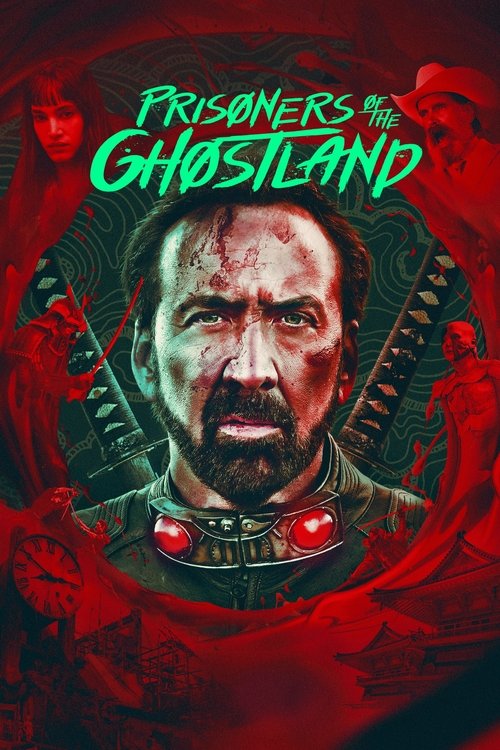
Prisoners of the Ghostland (2021)
Directed by Sion Sono
No — Prisoners of the Ghostland is not especially woke, scoring 22 out of 100 on our wokeness meter.
Sion Sono's first English-language production arrives wearing its influences like a borrowed coat, and the coat is loud.
Consciousness Markers
A Japanese-American co-production featuring a heavily Japanese supporting cast and Algerian-French lead Sofia Boutella alongside Nicolas Cage. The diversity is largely a natural consequence of the setting and director rather than a deliberate representation agenda.
The Governor keeps a harem of adopted 'granddaughters' as sex slaves, and the women ultimately take violent revenge — Bernice shoots the Governor and Susie massacres his guards. Female liberation-through-revenge elements exist but within a gonzo exploitation framework, not a coherent feminist thesis.
The despotic Governor is a wealthy ruler who exploits and enslaves the downtrodden, and the Ghostland outcasts rise in revolt against him — a class-oppression rebellion, though framed as genre spectacle rather than economic critique.
A nuclear waste spill creates an irradiated wasteland driving the plot, giving the film environmental-catastrophe imagery, though it functions as a genre device rather than a climate-message.
An arthouse acid-Western exploitation mashup more interested in spectacle and madness than moral instruction; it lectures no one.
The film blends Japanese and Western cultural aesthetics as a stylistic exercise, but it engages no explicit racial consciousness or commentary on race.
No LGBTQ+ characters or themes appear; the Governor's exploitation is framed entirely in heterosexual terms.
The mutated, irradiated outcasts are treated as monstrous or pitiable rather than as a body-positivity statement; no body-image themes are present.
Bernice is catatonic from trauma, but the film treats this as psychological injury, not neurodivergence as identity or advocacy.
The film is set in a wholly fictional dystopian future and makes no claims about or revisions to real history.
Why it received this score
Sion Sono's first English-language production arrives wearing its influences like a borrowed coat, and the coat is loud. A bank robber named Hero is sprung from a cell, strapped into a leather suit rigged to detonate, and dispatched into a nuclear-scarred wasteland to recover the adopted granddaughter of a warlord who has fused the old West and feudal Japan into a single garish fever dream. The film is a co-production with a Japanese creative spine and a Japanese supporting cast of real substance, though the multiculturalism here reads as geography, not agenda. Algeria-born Sofia Boutella stands beside Nicolas Cage, and nobody in the frame pauses to explain it. That is the honest way to assemble a cast, and it earns a modest nod.
Beneath the kabuki and the miniguns, the politics are exploitative and proud of it. The Governor keeps a harem of adopted granddaughters, and the women eventually answer with gunfire, Bernice putting a bullet in the despot while Susie rakes his guards with a minigun. Revenge is served, though the film's investment is in velocity, not in a thesis about liberation. The irradiated outcasts rise against their rich overseer, which gestures toward class resentment, and the nuclear spill that made the Ghostland lends the imagery an environmental hue. Neither thread is argued. They are texture, styled for the frame.
Where the film proves most useful for our purposes is in what it declines to do. It does not lecture. There is no sermon tucked inside the leather suit, no moral delivered with a straight face, no instruction offered to a paying audience. The mutants are monsters, the trauma is trauma, the history is invented wholesale. This is a movie that wants to be strange and succeeds unevenly. A curiosity, then. Loud, bloody, and blessedly free of homily.
Analysis generated by our Consciousness Algorithm


Synopsis
In the treacherous frontier city of Samurai Town, a ruthless bank robber is sprung from jail by wealthy warlord The Governor, whose adopted granddaughter Bernice has gone missing. The Governor offers the prisoner his freedom in exchange for retrieving the runaway. Strapped into a leather suit that will self-destruct within five days, the bandit sets off on a journey to find the young woman—and his own path to redemption.
Questions about Prisoners of the Ghostland
Is Prisoners of the Ghostland woke?
No — Prisoners of the Ghostland is not especially woke, scoring 22 out of 100 on our wokeness meter. That earns it a verdict of Based.
Does Prisoners of the Ghostland have any woke elements?
3 of the 10 markers register at 30 or above, led by Representation Casting (40), Feminist Agenda (35) and Eat the Rich (30). On Representation Casting: A Japanese-American co-production featuring a heavily Japanese supporting cast and Algerian-French lead Sofia Boutella alongside Nicolas Cage.
How does Prisoners of the Ghostland compare to other 2021 movies?
It ranks #90 of the 242 films from 2021 we've scored; their average is 23. The wokest is The Forever Purge (83).
How is the Woke Score calculated?
An AI-assisted process researches the film and its reception, scores it 0–100 on ten markers, then combines those into one 0–100 Woke Score. It measures a specific set of 2020s cultural themes, not film quality.