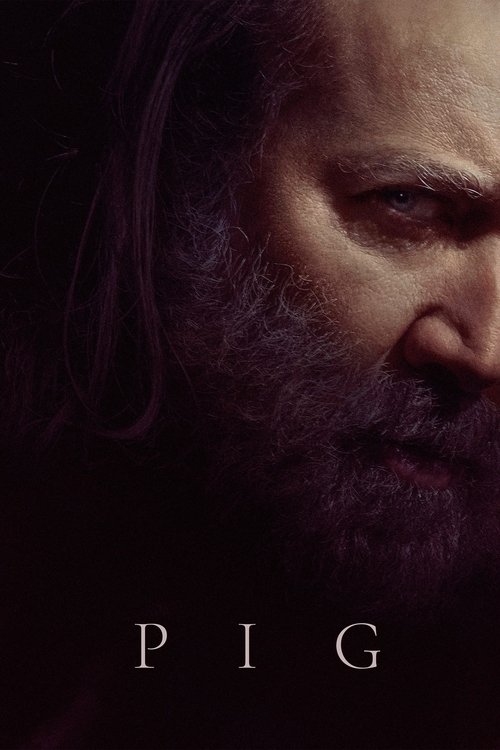
Pig (2021)
Directed by Michael Sarnoski
No — Pig is not woke, scoring 13 out of 100 on our wokeness meter.
Michael Sarnoski's Pig arrives dressed as a revenge thriller and promptly refuses to be one.
Consciousness Markers
The haute-cuisine world is portrayed as soulless, and Rob rebukes a former protege for chasing status over a modest dream pub; this is a melancholy critique of ambition rather than a sustained eat-the-rich polemic.
The film is a quiet meditation that shows rather than tells; the Eurydice scene carries a soft thematic point about dreams versus compromise but stops well short of preaching.
The cast is overwhelmingly white; no deliberate representation casting choices drive the film, and characters' ethnicities are not a narrative element.
No LGBTQ+ characters, relationships, or themes appear anywhere in the film.
A male-driven grief narrative centered on Rob's loss; the deceased wife and comatose mother are mere plot catalysts with no feminist framing.
The film engages no racial themes or commentary; Portland's culinary underworld is presented without racial consciousness.
The Oregon wilderness is a setting, not a cause; no environmental or climate message is present.
No body-positivity themes or body-image commentary appear in the film.
Rob's reclusiveness and misanthropy are presented as grief-driven, not as neurodivergence; no diagnosis or neurodivergent framing is present.
The film makes no historical claims and revises no prior record; it is a wholly fictional contemporary story.
Why it received this score
Michael Sarnoski's Pig arrives dressed as a revenge thriller and promptly refuses to be one. Nicolas Cage plays Rob, a former Portland chef who has retreated to a cabin in the Oregon woods to forage truffles with a pig he loves. When the pig is taken, he returns to the city, and the film becomes a slow, sullen tour of a restaurant culture that has misplaced its soul. The haute-cuisine world is drawn as hollow: a trendy dining room where the food is beautiful and the people are dead behind the eyes. Rob's quiet rebuke of a former protege who abandoned a modest dream pub for status is the closest the film comes to a thesis, and it lands as melancholy, not manifesto. Ambition is the villain here, not capital as such.
The picture is almost aggressively uninterested in the categories we might reach for. The cast is white, the grief is male, the wilderness is scenery. Nobody delivers a speech about the environment, or about identity, or about the body. Rob's misanthropy reads as bereavement, not diagnosis. The film simply declines to make arguments. Its one soft sermon arrives in a scene at a restaurant called Eurydice, where the Orpheus myth is invoked to suggest that some people look back at their dreams and find only compromise. It is a nudge, not a lecture, and the film moves on.
What we are left with is a study of a man who wants his pig back. Cage, restrained and enormous at once, plays it without begging for sympathy. The film is quiet, unfashionable, and genuinely moving, which is its own kind of achievement in a season of noise. There is almost nothing here to classify, and that is the point. Recommended, with a shrug that contains real affection.
Analysis generated by our Consciousness Algorithm


Synopsis
A truffle hunter who lives alone in the Oregon wilderness must visit Portland to find the mysterious person who stole his beloved foraging pig.
Questions about Pig
Is Pig woke?
No — Pig is not woke, scoring 13 out of 100 on our wokeness meter. That earns it a verdict of Ultra Based.
Does Pig have any woke elements?
Very few. None of the 10 markers reaches 30, the level where a marker counts as present; the highest is Eat the Rich at 22.
How does Pig compare to other 2021 movies?
It ranks #144 of the 242 films from 2021 we've scored; their average is 23. The wokest is The Forever Purge (83).
How is the Woke Score calculated?
An AI-assisted process researches the film and its reception, scores it 0–100 on ten markers, then combines those into one 0–100 Woke Score. It measures a specific set of 2020s cultural themes, not film quality.