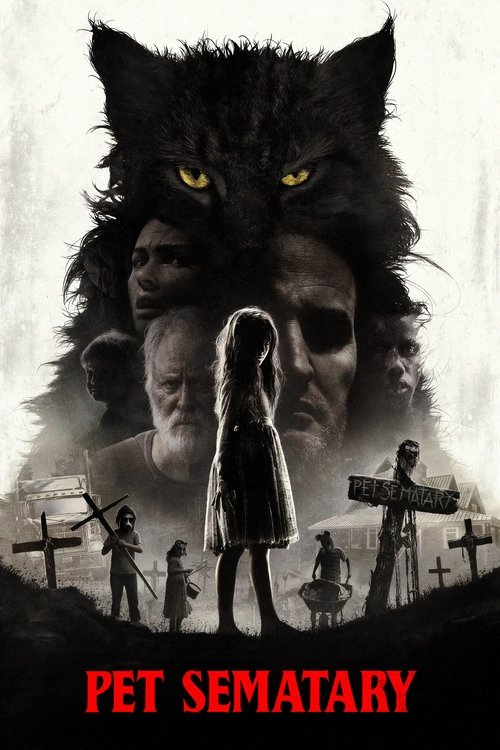
Pet Sematary (2019)
Directed by Dennis Widmyer
No — Pet Sematary is not woke, scoring 4 out of 100 on our wokeness meter.
Pet Sematary arrives in 2019 as the second pass at Stephen King's novel, a remake that conducts itself like a well-maintained sedan.
Consciousness Markers
The film casts a Black actor (Obssa Ahmed) as Victor Pascow, a role played by a white actor in the 1989 adaptation, but the film makes no thematic point of this diversity.
There are no LGBTQ+ characters, relationships, or themes.
The film is a supernatural horror with no feminist agenda; female characters are largely victims or monstrous.
The film uses Native American burial ground mythology as a horror trope without exploring racial consciousness or Indigenous perspectives.
No climate or environmental themes are present.
No anti-capitalist or eat-the-rich themes are present.
No body positivity themes; disability is used for horror effect (Zelda).
No neurodivergence themes are present.
The film is a fictional horror remake and does not revise historical events.
The film does not lecture the audience on social or political issues.
Why it received this score
Pet Sematary arrives in 2019 as the second pass at Stephen King's novel, a remake that conducts itself like a well-maintained sedan. It has a cat, a truck, a rural Maine road, and a father who cannot leave grief alone. The film moves through its obligations with professional courtesy: jump scares at regular intervals, John Lithgow doing sturdy work as the neighbor who should have kept his mouth shut, and a child actor asked to be unsettling on command. Nothing in the runtime stops to instruct us on how to live.
A single gesture deserves a note. The role of Victor Pascow, played by a white actor three decades ago, goes here to Obssa Ahmed. The change is made quietly, without a speech attached, and the film never asks us to notice. That is either confidence or indifference, and the distinction matters little on screen. Elsewhere the ledger stays clean. The Mi'kmaq burial ground functions as a spooky shelf for the plot to reach toward, with no interest in the people who might have a claim on it. Rachel's sister Zelda, ravaged by spinal meningitis, is staged for maximum dread, which is the opposite of a body-positive statement.
By the standards of the current decade, this is a restrained vintage. The film wants to frighten us and then send us home, and it does both with a shrug. There is no sermon in its pocket, no lesson about consumption or carbon, no revisionist account of anything. We are left with a competently made chiller that respects the audience's desire to be startled and then left alone. A modest, unpretentious pour. Note the faint trace of casting initiative on the finish, and nothing else.
Analysis generated by our Consciousness Algorithm
Part of


Synopsis
Dr. Louis Creed and his wife, Rachel, move from Boston to Ludlow, in rural Maine, with their two young children. Hidden in the woods near the new family home, Ellie, their eldest daughter, discovers a mysterious cemetery where the pets of community members are buried.
Questions about Pet Sematary
Is Pet Sematary woke?
No — Pet Sematary is not woke, scoring 4 out of 100 on our wokeness meter. That earns it a verdict of Ultra Based.
Does Pet Sematary have any woke elements?
Very few. None of the 10 markers reaches 30, the level where a marker counts as present; the highest is Representation Casting at 10.
How does Pet Sematary compare to other 2019 movies?
It ranks #244 of the 284 films from 2019 we've scored; their average is 22. The wokest is Black Christmas (79).
How is the Woke Score calculated?
An AI-assisted process researches the film and its reception, scores it 0–100 on ten markers, then combines those into one 0–100 Woke Score. It measures a specific set of 2020s cultural themes, not film quality.